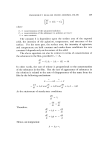
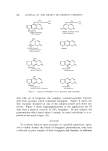
]. Soc. Cosmet. Chem., 21,683-693 (Sept. 17, 1970) Determination of Hexachlorophene by Gas-Liquid Chromatography of Its Trimethylsilyl Derivative B. L. KABACOFF, B.S., G. MOHR, and C. M. FAIRCHILD, B.S. * Presented December 2, 1969, New York City Synopsis--HEXACHI,OROPHENE i5 silylated by reacting it with N,O-bis(trimethylsilyl)- acetamidc. The resulting trimethylsilylhexachlorophenc in GAS-LIQUID CHROMATOG- RAPHY has the same retention time on an SE-30 column as the parent compound, the Kovats retention index being 2804. SILYLATION eliminates the extensive tailing obtained with the parent compound. Quantitation may be obtained by comparing the peak height with that of an internal standard, dicyclohexylphthalate. Methods of isolation from possible interfering substances are presented. DICHLOROPHENE may be silylated and chromatographed in the same way. INTRODUCTION In 1968, the Methods of Analysis Subcommittee of the Society of Cosmetic Chemists of Great Britain reviewed the existing analytical methods for hexachlorophene (1) and concluded that the colorimetric and titrimetric methods were not sufficiently specific. As a result of their collaborative study, they concluded that the method of Elvidge and Peutrell (2) is sufficiently accurate and specific for some toilet preparations such as soaps, talcs, and alcoholic solutions. In this method the difference between the ultraviolet absorption at 312 nm of solutions of hexachlorophene at pH 1.2 and 8.0 is measured. Substances not * Revlon Rescatch Center, 945 Zerega Avenue, Bronx, N.Y. 10473. 683

684 .JOURNAL OF THE SOCIETY OF COSMETIC CHEMISTS ('hanging in ultraviolet absorption between these pH's do not interfere providing their absorption is not so great that measurements cannot be readily made. This was the problem faced by the present authors in analyses of hexachlorophene. In the same year, Porcaro and Shubiak published a GLC method for this substance (3). They used a very short column (to minimize re- tention) heavily loaded with UC W 98 silicone. An electron capture detector was used because of the extreme sensitivity it afforded. In an earlier paper, Porcaro reported that with a flame ionization detector, a detection limit of about 5 t•g was obtained (4). Because of the complex mixtures under investigation in the present study, it was found advisable to use much longer columns to obtain good separation. Because of the very high concentration of hydroxyl coin- pounds relative to that of hexachlorophene in cosmetic formulations, a flame ionization detector was preferred. Oxygenated compounds are readily detected by electron capture, and their presence seriously re- duces detector sensitivity. Further, electron capture detectors are readily contaminated, requiring the use of prolonged treatment to eliminate the contamination (3). Wisniewski (5) reported a GLC method in which hexachlorophene is first extracted from soap by acetone. This method of isolating the com- pound is impractical in most other cosmetic preparations because of the presence of large amounts of interfering substances. EXPERIMENTAL Reagents and Equipment Specific reagents used were hexachlorophene,* dicyclohexylphthalate (DCHP),* and, as silylating agent, Tri-Sil BSA©* (Cat. No. 490107). All other chemicals were of analytical reagent grade. Equipment included silylation vials,* Cat. No. 13028-A, or similar containers, and septumsll (Cat. No. F-138, 0.5 in. in diameter). These septurns are used to cap the sily]ation vials with the Teflon©• coating * Sinda• ' C, orp., 321 42 St., New York, N.Y. 10017. ? K and K l,aboratories, 121 Exprcss St., Plainview, N.Y. 11803. $ Pierce Chem. Co., P.O. Box 117, Rockford, Ill. 61105. I I Canton Bio-Mcdical Proflucts, P.O. Box 154, Swarthmore, Pa. 19081. ô E. I. du Pont de Nemours, Wilmington, Del.
Purchased for the exclusive use of nofirst nolast (unknown)
From: SCC Media Library & Resource Center (library.scconline.org)