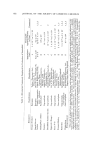
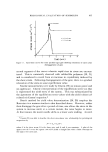
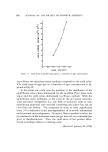
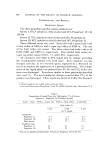
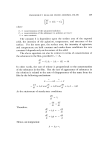
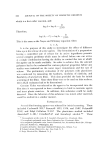
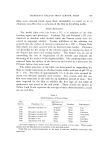
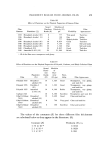
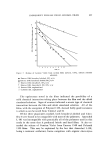
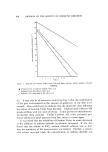
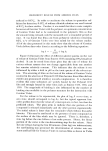
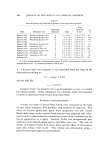
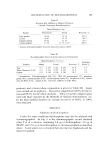
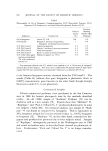
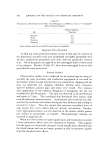
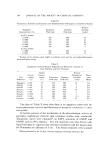
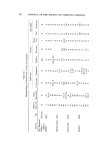
700 JOURNAL OF THE SOCIETY OF COSMETIC CHEMISTS Table I Phototoxicity of Oil of Bcrgamot, Coumarin-psoralcn (C-P) Nonvolatile Fraction, TLC- Separated C-P Components, and Ethyl Ether-Precipitated Portion of C-P • Substance Components Fraction Concen- Showing tration Positive Skin (%) Response Oil of bergamot C-P fraction C-P, TLC band 1 C-P, TLC band 2 C-P, TLC band 3 C-P, TLC band 4 C-P (ethyl ether-pptd. portion recrystallized 3X with methanol), fraction 3A About 2% C-P Bergapten, limettin, bergamottin, bergaptol, methoxygeranoxycoumarin Mainly bergamottin Mainly 7-methoxy-5-geranoxycoumarin Limettin-bergapten Band 3 to origin (includes bergaptol) Mainly bergapten (ca. 90 %) 100 9/9 1 9/9 0.5 1/9 O. 5 3,/9 0.5 9/9 0.5 2/9 0.5 9/9 • Test materials (diluted with 95% alcohol) were applied to a 5 X 12-cm area of "stripped" forearm skin of nine subjects. The areas were irradiated for 40 minutes with UV light (prin- cipally 360-370 nm) emitted from an Inspectolite (Hanovia) at a distance of 8-10 cm. to the limettin-bergapten mixture obtained from the TLC band g. The results (Table II) indicate that pure bergapten is phototoxic down to 0.002% concentration pure limettin on the other hand, though strongly fluorescent under UV, is not phototoxic. Commercial Samples Fifteen commercial perfumes were purchased in the San Francisco area in 1968 for human photopatch tests by the methods described earlier. An old (1964) sample of "Shalimar" Perfume (el) was in- cluded as well as a new sample (½t2). Results show that "Shalimar" "Replique," and "Park 8c Tilford No. 3" produced phototoxicity in some test subjects (Table III). On chemical analysis, our sample of "Shall- mar" el was found to contain 0.1% bergapten. This is equivalent to 30% bergamot, using Cieri's recent analytical data, i.e., 0.33,% bergapten in bergamot (12). "Shalimar" •t2, on the other hand, contained no ber- gapten and produced no phototoxicity in four subjects tested. Samples o15 "Replique," subsequently procured in the Washington area in 1969 and tested on hairless mice, as described later, showed no phototoxic ef- fects. Furthermore, "Park and Tilford No. 3" is no longer manufac- tured.

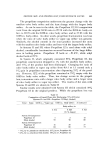
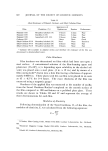
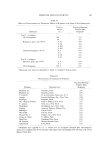
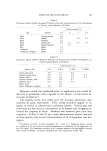
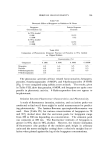
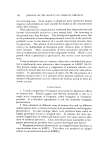
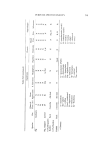
PERFUME PHOTOTOXICITY 701 Table II Effects of Concentration on Phototoxic Effects of Bergamot and Some of Its Components • Concen- Fraction Showing tration Positive Skin Substance (•) Response Test 1 6 subjects Oil of bergamot Bergapten, pure, mp 187øC Limettin-bergapten (96: 4) Test 2 6 subjects Limettin, pure, mp 147øC Oil of bergamot 100 5/6 20 3/5 o. 05 4/4 o. 02 4/4 o. 002 1/2 o.ool 0/2 0.5 4/4 0.2 1/4 O. 02 1/2 O. O1 0/2 1.0 0/6 0.1 0/6 100.0 6,/6 Materials were tested as described in Table I ("stripped" human skin). Table III Phototoxicity of Commercial Perfumes • Perfume Manufac turcr Fraction Showing Positive Skin Response Shalimar #1 Guerlain, Paris 3/9 Shalimar/•2 Guerlain, Paris 0,/4 L' interdit H. de Givenchy, Montvale, N.J. 0/6 Arpege Lanvin Perfumes, Inc., New York 0/13 Replique Raphael, Paris 1/13 No. 3 Park & Tilford Park & Tilford, New York 1/6 L' aimant Coty, Inc., New York 0/5 Houbigant Houbigant, Inc., New York 0/5 Ondine Suzanne Thierry, Miami, Fla. 0/4 Bellodgia Caron, Paris 0/2 Ma Griffe Carven, Paris 0/2 Chanel No. 5 Chanel, Inc., New York 0/6 Crepe de Chine F. Millot, Paris 0/2 Miss Dior Christian Dior, Paris 0/2 M. Rochas Marcel Rochas, Paris 0/2 Cabochard Gres, Paris 0/2 a Perfumes were applied to a 5 X 12-cm area of "stripped" forearm skin (20 subjects). Areas were irradiated for 40-60 minutes with Inspectolite (principally 360-370 nm) at 8-10 cm distance from skin.
Purchased for the exclusive use of nofirst nolast (unknown)
From: SCC Media Library & Resource Center (library.scconline.org)