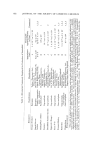
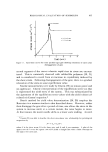
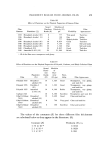
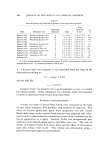
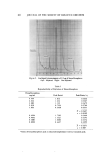
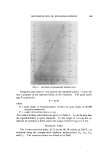
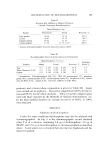
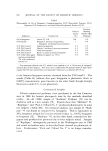
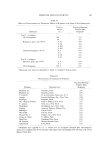
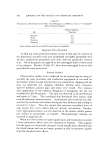
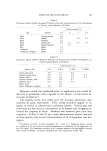
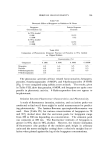
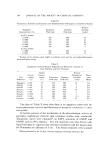
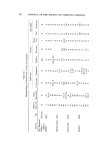
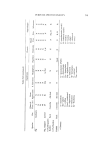
706 JOURNAL OF THE SOCIETY OF COSMETIC CHEMISTS Table IX Fluorescence Intensity and Excitation and Emission Peaks of Bergapten in Alcoholic Solutions Relative Bergapten Excitation Emission Intensity Concentration (%) Peak (nm) Peak (nm) (units) • In 95%alcohol 0.0100 360 480 50 0.0080 360 480 41 0.0010 330 480 26 0.0008 330 480 25 0.0001 320 480 6 In 70%alcohol 0.0080 360 480 26 0.0007 332 484 16 • Product of the emission peak height in arbitrary unim and the spectrophotofluorometer meter multiplier setting. Table X Comparison of Photochemical Properties and Phototoxic Capacity of Four Psoralens and One Coumarin Alcohol Relative Concen- Concen- Fluorescence Photo- Test tration tration Excitation Emission Intensity toxic Substance (%) (%) Peak (nm) Peak (nm) (units) Effects Bergapten 0. 001 95 330 480 26 Yes 8-MOP 0. 001 95 320 480 I Yes 8-MOP 0. 001 70 320 480 2 Yes Psoralen 0. 010 95 395 460 65 Yes Psoralen 0. 001 95 389 460 5 Yes Psoralen 0. 0001 95 389 460 1 Yes 8-HOP 0.100 95 385 480 0.1 No Limettin 0. 00001 95 335 420 55 No The data of Table X show that there is no apparent connection be- tween phototoxic activity and fluorescence intensity, excitation or emis- sion peaks. In further pursuit of the mechanism of the photobiologic activity of psoralens, exploratory electron spin resonance studies were conducted. Absorption curves were obtained* on 0.02% solutions of 8-MOP and 8-HOP, each in 95% ethanol. The test materials were first frozen with liquid nitrogen in a quartz tube and then irradiated with the Inspectolite for $0 minutes at a distance of 5 cm. The frozen solutions were scanned * Work performed by Dr. H. Kon, National Institutes of Health, Bethesda, Md.

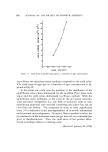
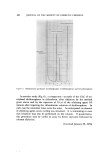
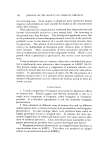
PERFUME PHOTOTOXICITY 707 and the resulting curves showed one principal and three secondary peaks. In both cases, the peak heights and locations were very similar so that this analysis failed to provide a clue to the difference in phototoxic activity of these two compounds. DISCUSSION A satisfactory resolution of this as well as most other biologic prob- lems is dependent upon the availability of appropriate tools. When working with a mixture, bergamot included, it is essential to know the composition with some degree of precision. Thus, the first barrier to overcome in the resolution of bergamot phototoxicity was the lack of simple techniques for chemical analysis and preparation of components. Another more serious problem was the lack of readily available radiation sources whose quantitative output was known. When all the data on man and animals are considered, it is apparent that bergapten is the only significant phototoxic component of bergamot. Since this is the case, the photobiologic effects of bergamot would more appropriately be termed bergapten phototoxicity rather than the more flamboyant but less descriptive "berloque dermatitis." The fact that the more permeable skins of animals, such as rabbit and mouse, the stripped skin of humans, and the more permeable scrotal and neck skins are among the most susceptible to bergapten phototoxicity in- dicates that individuals who develop the syndrome have a poorly de- veloped skin barrier. This has been suggested by others (10, 14). Since the production of phototoxic effects is dependent upon the amount of active ingredient reaching target tissue, these data permit one to establish a safe human concentration of bergapten and bergamot oil on skin. A human safety factor is provided by utilizing results obtained on stripped skin. Thus, since bergamot contains 0.33% bergapten and the ap- parent "no-effect" level on stripped skin for bergapten lies between 0.002 and 0.001%, the safe concentration of bergamot oil on man is pro- jected to be between 0.3 and 0.6%. This is comparable to, although somewhat lower than, the 2% concentration given in regulations issued under the Hazardous Substances Act (15). It is apparent from this that unless bergamot is chemically treated to remove bergapten, it is likely to be phototoxic in some individuals if used in practical amounts in per- fumes. The results obtained on animals show that the rabbit and hairless mouse are more sensitive to bergapten than man and are therefore useful
Purchased for the exclusive use of nofirst nolast (unknown)
From: SCC Media Library & Resource Center (library.scconline.org)