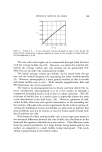
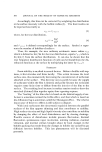
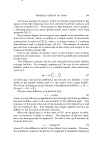
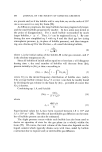
310 JOURNAL OF THE SOCIETY OF COSMETIC CHEMISTS where F is the volumetric flow rate of feed liquid, and CF is the solute concentration in the feed. With nonuniform bubble sizes, r in eqs 12 and 13 is replaced with ra.2. Careful feeding into the foam at some level above the pool, so that the feed drains down countercurrently through the ascending foam, pro- duces a stripping action which further lowers Cw. Collapsing the over- flowing foam mechanically, and returning all or part of it as reflux to the upper region of the ascending foam, produces an enriching action which further concentrates the overflow that is, it elevates Ca (25). Surface loss within the rising foam, which can result from bubble wall rupture or interbubble gas diffusion, furnishes internal reflux. Strip- ping and enriching can also be carried out simultaneously. These higher modes of operation can be analyzed by means of transfer units and limiting equations (26). For further information regarding foam fractionation, including list- ings of many substances which have been separated and discussions of some of the chemistry involved, the reader is referred to several reviews on the subject (27-31). Foam fractionation is one of the adsorptive bubble separation pro- cesses (32, 33) [abbreviated as adsubble processes (32)]. For a thorough discussion of this entire class of processes, the reader is referred to a recent comprehensive book (34). (Received November 2, 1971) REFERENCES (1) Bikerman, J. J., Foams and emulsions, Ind. Eng. Chem., 57 (1), 56-62 (1965). (2) Hoffer, M. S., and Rubin, E., Flow regimes of stable foams, Ind. Eng. Chem., Fundam., 8, 483-90 (1969). (3) Shih, F. S., and Lemlich, R., Continuous foam drainage and overflow, Ibid., 10, 254-9 (1971). (4) deVries, A. J., Foam Stability, Rubber-Stichting, Delft, 1957. (5) Mysels, K. J., Shinoda, K., and Frankel, S., Soap Films, Pergamon, New York, 1959. (6) Leonard, R. A., and Lemlich, R., A study of interstitial liquid flow in foam. Part II. Experimental verification and observations, AIChE J., 11, 25-9 (1965). (7) Miles, E. D., Shedlovsky, L., and Ross, J., Foam drainage, J. Phys. Chem., 49, 95-107 (1945). (8) Clark, N. O., The electrical conductivity of foam, Trans. Faraday Soc., 44, 13-5 (1948). (9) Fanlo, S., and Lemlich, R., Predicting the performance of foam fractionation columns, AIChE--Inst. Chem. Eng. (London) Syrup. Ser. 9, 75-8, 85-6 (1965). (10) Jashnani, I. L., Coalescence and HTU in Foam Fractionation Columns, Ph.D. disserta- tion under R. Lemlich, Univ. Cincinnati, 1971. (11) Leonard, R. A., and Lemlich, R., A study of interstitial liquid flow in foam. Part I. Theoretical model and application to foam fractionation, AIChE J., 11, 18-25 (1965).

PHYSICAL ASPECTS OF FOAM 311 (12) (13) (14) (15) 06) (17) (18) (19) (20) (21) (22) (23) (24) (25) (26) (27) (28) (29) (30) (31) (32) (33) (34) Clark, N. O., and Blackman, M., The transmission of light through foam, Trans. Faraday Soc., 44, 7-13 (1948). Bikeman, J. J., Foams: Theory and Industrial Applications, Reinhold, New York, 1953, p. 144. Chang, R. C., Schoen, H. M., and Grove, C. S., Jr., Bubble size and bubble size deter- mination, Ind. Eng. Chem., 48 (11), 2035-9 (1956). Kitchener, J. A., Foams and Free Liquid Films, in Danielli, J. F., Pankhurst, K. G. A., and Riddiford, A. C., Recent Progress in SurJace Science, Vol. 1, Academic Press, New York, 1964, pp. 68-71. Vrij, A., Possible mechanism for the spontaneous rupture of thin free liquid films, Discuss. Faraday Soc., 42, 23-33 (1966). Vrij, A., and Overbeek, J. Th. G., J. Amer. Chem. Soc., 90, 3074-8 (1968). Culick, F. E. C., Comments on a ruptured soap film, J. Appl. Phys., 31, 1128-9 (1960). Frankel, S., and Mysels, K. J., The bursting of soap films. II. Theoretical considera- ti,ons, J. Phys. Chem., 73, 3028-38 (1969). deVries, A. J., Morphology, Coalescence, and Size Distribution o[ Foam Bubbles, in Lemlich, R., Adsorptiv½ Bubble Separation Techniques, Academic Press, New York, 1972, pp. 7-31. Princen, H. M., Overbeek, J. Th. G., and Mason, S. G., The permeability of soap films to gases. II. A simple mechanism of monolayer permeability, J. Colloid InterJace Sci., 24, 125-30 (1967). Ross, S., Bubbles and foam, Ind. Eng. Chem., 61 (10), 48-57 (1969). Lemlich, R., Principles o[ Foam Fractionation and Drainage, in Lemlich, R., Adsorp- tive Bubble Separation Techniques, Academic Press, New York, 1972, pp. 33-51. Shih, F. S., and Lemlich, R., A study of interstitial liquid flow in foam. Part III. Test of theory, AIChE J., 13, 75l-4 (1967). Lavi, E., and Lemlich, R., Foam fractionation with reflux, Science, 134, 191 (1961). Lemlich, R., Principles o[ Foam Fractionation, in Perry, E. S., Progress in Separation and Purification, Vol. 1, Interscience (Wiley), New York, 1968, pp. 1-56. Rubin, E., and Gaden, E. L., Jr., Foam Separation, in Schoen, H. M., New ChemiCal Engineering Separation Techniques, Interscience (Wiley), New York, pp. 319-85. Lemlich, R., Adsorptive bubble separation methods, Ind. Eng. Chem., 60 (10), 16-29 (1968).* Lemlich, R., Separations Based on Bubble Adsorption, in Perry, R. H., and Chilton, C. H., Chemical Engineerrs Handbook, 5th ed., McGraw-Hill, New York, in press. Lemlich, R., Foam fractionation, Chem. Eng., 75 (27), 95-102 (1968)*. Errata in 76 (6), 5 (1969). Lemlich, R., Adsubble Methods, in Li, N. N., Recent Developments in Separation Sci- ence, Chemical Rubber, Cleveland, Ohio, in press. Lemlich, R., Adsubble methods, Chem. Eng., 73 (21), 7 (1966). Karger, B. L., Grieves, R. B., Lemlich, R., Rubin, A. J., and Sebba, F., Nomenclature recommendations for adsorptive bubble separation methods, Separ. Sci., 2, 401-4 (1967). Lemlich, R., ed., Adsorptive Bubble Separation Techniques, Academic Press, New York, 1972. * The interested reader is referred to p. 36 of ref. 23 for clarification of an ambiguity in refs. 28 and 30 regarding the quantitative effect of collector micelies.
Purchased for the exclusive use of nofirst nolast (unknown)
From: SCC Media Library & Resource Center (library.scconline.org)