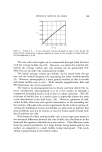
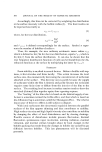
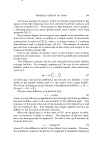
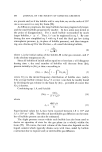
1. So•. Cosmet. Chern., 23• 333-345 (May 23, 1972) Analytical Procedures and Evaluation of Sunscreens BORIS M. CUMPELIK, B.S.* Presented October 11, 1971, Joint Symposium of the Association o[ cial Analytical Chemists-Society o[ Cosmetic Chemists, Washington, D.C. Synopsis--The purpose of this paper is to present a simple, step-by-step ANALYTICAL METHOD for SUNSCREEN EVALUATION. Although there have been many publications dealing with the theory and mechanics of ULTRAVIOLET absorbers, there was a definite need for a practical easy-to-follow yet reliable method for the analytical chemist. INTRODUCTION Modern sunscreens are "transparent" preparations aimed at pro- tection of the human skin against the potentially harmful segment of the ultraviolet solar radiation. The ultraviolet (uv) region is roughly divided into three parts: far uv (short wave), middle uv, and near uv (or long wave). Short wave is lethal, and fortunately for us that part of radiation is absorbed by the earth's upper atmospheric strata. The concern therefore is with the middle and the near sections of uv radiation. In loose terms, the middle range uv causes reddening of hu- man skin, while the longer ultraviolet waves cause the often desirable tanning of the skin. However, it should be remembered that some erythema (reddening) is essential to trigger the production of melanin, with subsequent tanning. A potentially dangerous aspect of exposure to excessive ultraviolet irradiation is the time lag between actual exposure and the moment the effects of that exposure are first felt. * Van Dyk & Co., Inc., Main and William Sts., Belleville, N.J. 07109. 333

334 JOURNAL OF THE SOCIETY OF COSMETIC CHEMISTS
Purchased for the exclusive use of nofirst nolast (unknown)
From: SCC Media Library & Resource Center (library.scconline.org)