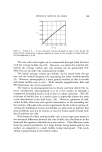
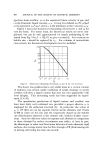
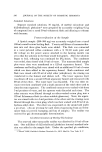
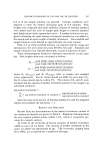
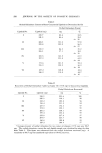
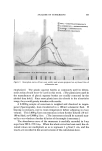
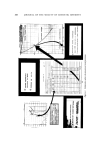
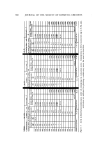
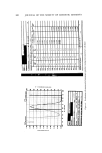
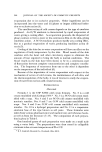
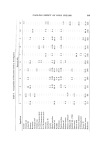
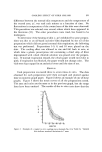
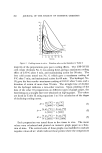
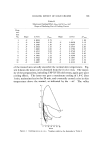
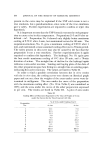
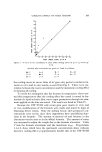
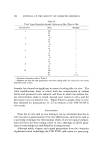
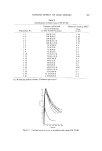
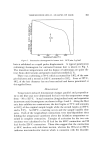
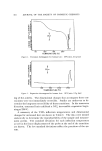
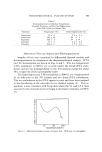
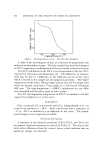
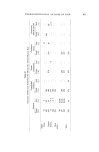
366 JOURNAL OF THE SOCIETY OF COSMETIC CHEMISTS EO.6 •0.2 I I I I00 :500 500 TEMPERATURE (øC) Figure 7. Thermogravimetry of hair: 20øC/min, He atmosphere A study of the birefringence of hair as a function of temperature also indicates an orientation change. The hair samples lost their birefringence at 239øC suggesting a randomization of the previously oriented a-keratin. The 80øC endotherm in the DTA is not in agreement with the 116øC reported by Schwenker and Dusenbury (6). The difference in tempera- tures may be due to a difference in the diffusion process of the water which is related to the sample size and apparatus geometry. The higher temperature result used a 150-rag sample packed into a DTA sample tube while the present study had a 7-rag sample in a well-vented aluminum DSC pan. The high-temperature (•200øC) endotherms are not diffu- sion-controlled and therefore agree in both studies. The TG decomposition temperature of 25•øC is consistent with that reported by Crighton et al. (7) for wool. Subambient Hair contracted 3% transversely and 0.2% longitudinally as it was cooled from ambient to --50øC. Both contractions had a transition at --17 to --20øC as indicated by an inflection in the curve. The dimen- sional changes were completely reversible. Chemical A Iterations A summary of the thermal transitions (TMA, DTA, and TGA) for the general chemical treatments are shown in Table II. The data in the table reflect differences from the control, hence a dash indicates that no significant change was observed.

THERMOMECHANICAL ANALYSIS OF HAIR 367
Purchased for the exclusive use of nofirst nolast (unknown)
From: SCC Media Library & Resource Center (library.scconline.org)