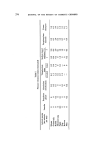
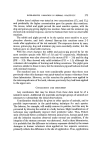
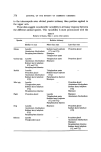
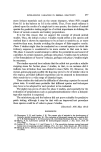
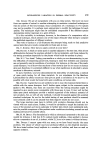
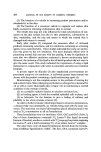
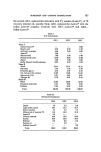
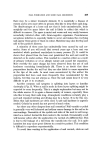
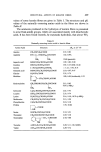
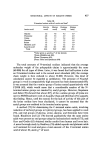
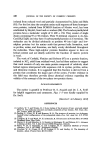
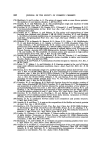
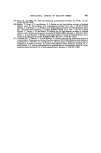
STRUCTURAL ASPECTS OF KERATIN FIBRES 437 Table Ill. N-terminal amino acids of wools and hair* Amino acid Lincoln Merino Romney Human wool'• wools woolõ hairõ Glycine Threonine Valine Alanine Serine Glutamic acid Aspartic acid Total 5.2 7.8 4.5 3.9 4.8 5.6 4.9 4.0 2.4 1.7 2.4 4.0 1.2 1.5 1.2 1.0 1.2 1.7 1.2 1.0 1.2 1.1 1.2 1.0 0.6 0.5 0'6 0.5 16.6 19.9 16.0 15'4 *Value given as/2mole g-X of dry keratin. •'From Middlebrook (62). :•From Thompson (63). õFrom Tibbs and Speakman (64). The total amounts of N-terminal residues indicated that the average molecular weight of the polypeptide chains is approximately the same (60 000) for all types of fibres. Later, it was found that half-cystine is also an N-terminal residue and is the second most abundant (68) the average chain weight is then reduced to about 36 000. However, this kind of calculation cannot be regarded as satisfactory. The presence of N-acetyl groups in wool in comparatively high amounts has been demonstrated (69). It was assumed that the e-amino group of lysine reacted quantitatively with FDNB (62), which would mean that a considerable number of the N- terminal amino groups are masked by acetyl groups. However, Siepmann and Zahn (70) showed that about 20• of the e-amino groups of lysine are inert to FDNB and later work of Asquith, Chan and Otterburn (71) supports this finding. Hence, until the reasons for the lack of activity of this part of the lysine residue have been elucidated, it cannot be assumed that the acetyl groups are confined to the terminal amino group. A method (72) for determining the C-terminal amino acids, involving reduction of carboxyl groups to hydroxyl groups, has been applied to wool (73), and end groups of glycine, serine, alaninc, and threonine have been found. Blackburn and Lee (74) showed qualitatively that the same amino acids were present as end groups using the hydrazinolysis method (75), and Kerr and Godin (65) obtained similar results from human and horse hair. A more thorough study by Bradbury (76) added aspartic and glutamic acids as C-terminal for wool and gave a total amount of the C-terminal amino acid of about 10 vmole g4 of wool.

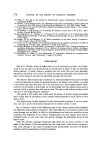
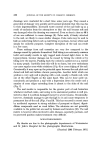
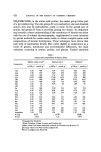
438 JOURNAL OF THE SOCIETY OF COSMETIC CHEMISTS ISOLATION AND CHARACTERIZATION OF PROTEIN FRACTIONS FROM KERATIN FIBRES In the last 15 years, numerous attempts have been made to fractionate wool keratin into homogeneous protein fractions without main chain hydrolysis. In general, two main kinds of protein fractions could be obtained, i.e. the so-called low-sulphur and high-sulphur protein fractions. Oxidation of the disulphide bonds of keratins with peracetic acid (77) or performic acid (78) and extraction with ammonia solution leaves an insoluble residue termed [•-keratose. The low-sulphur fraction, a-keratose, is precipitated by acidification of the filtered extract and the high-sulphur fraction, T-keratose, remains in solution. By keratose estimations on wool, human hair, and some isolated cell components, Asquith and Parkinson (79) have provided chemical confirmation that a-, [•-, and T-keratoses are to be identified respectively with fibrillar, cell membrane, and matrix components of the fibre. Similarly, reduced and subsequently carboxy- methylated wool gives the S-carboxymethylkerateines (SCMK), which can be fractionated to give SCMKA low-sulphur fraction and SCMKB high- sulphur fraction (80). a-Keratose and SCMKA are heterogeneous low- sulphur protein fractions of almost identical amino acid composition (81), while T-keratose and SCMKB are extremely heterogeneous high-sulphur protein fractions with similar but not identical am/no acid composition (82). The low-sulphur fractions are relatively rich in aspartic and glutamic acids, lysine, tyrosine, leucine, and alanine, while the high-sulphur fractions are poor in these amino acids but contain relatively large amounts of cysteic acid or S-carboxymethylcysteine, proline, serine, and threonine. Studies on these protein fractions are yielding useful information about the molecular structure on keratin fibres. In [•-keratose, a substantial amount of the lysyl amino group has been found to exist naturally as Nø-T-glutamyllysine cross-link (83) and in T-keratose, 83•o of the glutamic or aspartic acids are present as their amides (84). Seasonal factors have a marked influence on the proportion of keratoses in wool keratin during maintenance of sheep on pasture, the percentage of T-keratose increases while in the wool grown during the winter stall-maintenance, a-keratose increases (85). In the SCMKA fraction the carboxyl groups are present mainly as glutamic acid rather than aspartic acid residues, whereas in the SCMKB fraction there is a relatively high content of glutamine (11). It has been shown that low-sulphur SCMKA kerateines contain about
Purchased for the exclusive use of nofirst nolast (unknown)
From: SCC Media Library & Resource Center (library.scconline.org)