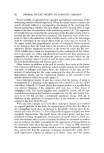
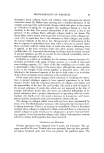
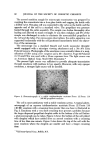
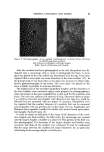
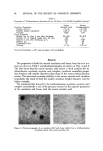
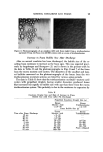
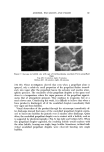
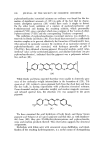
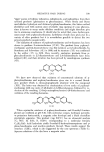
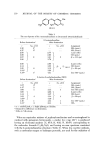
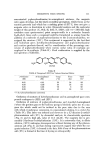
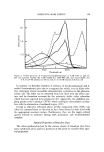
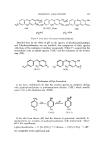
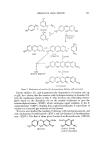
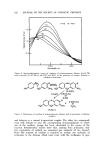
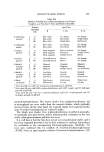
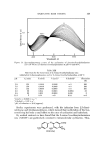
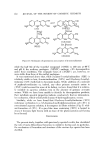
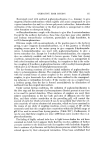
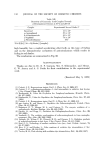
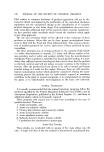
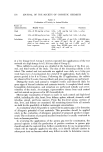
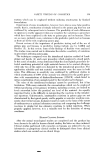
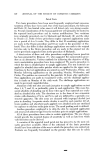
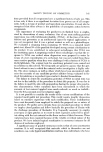
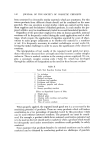
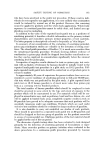
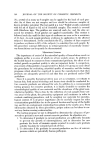
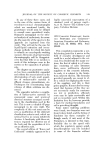
AEROSOL EMULSIONS AND FOAMS 97 Figure 7. Increase in bubble size with age of triethanolamine myristate/Freon propellant foam Top left. 2 minutes right, 5 minutes Bottom left. 10 minutes right, 30 minutes (19, 20). These investigators showed that even when a propellant alone is sprayed, only a relatively small proportion of the propellant flashes immedi- ately into vapor after the propellant leaves the actuator and reaches atmo- spheric pressure. The remainder of the propellant droplets in the spray cool down to a temperature where the vapor pressure of the propellant approxi- mates that of atmospheric pressure. They continue to evaporate, but at a much slower rate. Considering this work, it is difficult to believe that when a foam product is discharged, all of the emulsified droplets immediately flash into vapor and form bubbles. Visual observation of the product through the microscope immediately af- ter discharge showed that many of the emulsified propellant droplets contin- ued to burst into bubbles for periods over 2 minutes after discharge. Quite often, the emulsified propellant droplet was in contact with a bubble, such as is suggested by photomicrographs (Fig. 6, top right and bottom left). When this propellant droplet vaporized, the resulting bubble would coalesce with the other bubble, forming one single, large bubble. Sometimes, isolated indi- vidual emulsified propellant droplets were observed bursting into single bubbles.

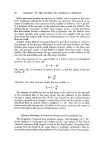
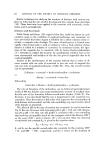
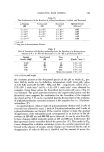
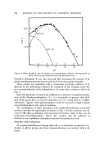
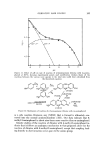
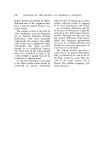
98 JOURNAL OF THE SOCIETY OF COSMETIC CHEMISTS Other processes causing an increase in bubble size occurred at the same time. Continual coalescence of the bubbles was observed. This caused an in- crease in bubble size, but a decrease in the number of bubbles. This is partial- ly a function of the strength of the interfacial film around the bubbles. The triethanolamine myristate-myristic acid complex forms a strong interfacial film that retards bubble coalescence. This is probably why the bubbles from the excess myristic acid system increase in size less rapidly with age than those from the system with excess triethanolmnine, in which the interfacial films are weak. Another reason that has been postulated for growth of bubbles in a foam is that because of the pressure differential in small and large bubbles, the large bubbles grow larger and the small bubbles become smaller as the foam ages (21). The pressure inside a small bubble is higher than that inside a larger bubble. This difference causes the gas molecules in the smaller bubbles to dif- fuse into the liquid films and enter the larger bubbles. The total pressure, P•, in a gas bubble in a foam is equal to atmospheric pressure, P•, plus a factor, Ap. P• = P• + AP The factor, AP, is a function of surface tension T, and the radius of the gas bubble, R. AP- 2y R Therefore, the total pressure inside the gas bubble is: 2y P• = P• + • The change in bubble size due to this factor is also affected by the strength of the interfacial film. It has been shown that the diffusion of gas bubbles through a strong interfacial film of the type formed by the triethanolamine myristate-myristic acid complex is much slower than that through the weaker interfacial films of systems without complexes (1, 21). This may be an addi- tional reason why the growth of bubbles in the excess myristic acid system is slower than that in the excess triethanolamine system. Effect of Discharge on Emulsion Droplet and Foam Bubble Size The properties of aerosol foam products change with discharge (2, 7, 15). As the product is discharged, the volume of the vapor phase in the aerosol container increases with respect to that of the liquid phase. Propellant then migrates from the liquid to the vapor phase to maintain equilibrium. This de- creases the concentration of propellant in the liquid phase. Since foam proper-
Purchased for the exclusive use of nofirst nolast (unknown)
From: SCC Media Library & Resource Center (library.scconline.org)