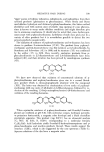
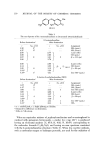
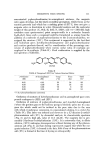
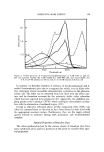
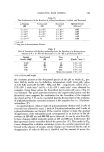
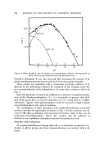
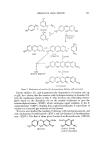
AEROSOL EMULSIONS AND FOAMS 89 emulsions were selected for the study. One had an excess of myristic acid and had been shown by Sanders (8) to produce aerosol cmulsions and foams with high stability because of the presence of the triethanolamine myristatc-my- ristic acid surfactant complex (also referred to as acid soaps). The other had an excess of triethanolamine and, therefore, contained a minimum of the com- plex. This aerosol system had been shown to produce emulsions and foams with low emulsion and foam stability. The existence of complexes formed between the salts of fatty acids and free fatty acids was reported by McBain and Field as carly as 1933 (9). Subse- quently, Arkins (10) determined that the pearlincss in sodium or potassium stearate creams formulated with an excess of stearic acid was related to the acid-soap complex of free stcaric acid and sodium stearate. Kohlhass showed that complexes between sodium palmirate and palmitic acid existed in stoi- chiometric ratio of 1:1 and had a crystal pattern (11). In aqueous systems, these complexes were usually considered to be liquid-crystalline in nature (12). Kung and Goddard, who have done a considerable amount of work on these complexes, have reported fatty acid-potassium salt complexes with a tool ratio of 1:1 (13). EXPERIMENTAL Concentration ol ½ the Sur[actants The stoichiometric concentration of triethano]amine myristate in the aque- ous phase (distilled water) was 0.20M. One emulsion contained a 50% molar excess of myristic acid* and the other a 50% excess of triethanolamine.? The tota] wt % concentration of the surfactant portion, considering the excess of myristic acid or triethanolamine, was about 10%. Preparation o• the Aqueous Phase The myristic acid was heated alone to 54.4øC. The aqueous phase contain- ing the triethanolamine was heated separately to 54.4øC. The aqueous phase was then added slowly to the melted myristic acid xvith stirring. After addi- tion was complete, the aqueous phase xvas allowed to cool to room tempera- ture with stirring. Composition o• the Aerosol Emulsions The aerosols had a composition of 90 wt % aqueous tricthanolamine myris- rate and 10 wt % Freon 12/Freon 114 (40/60) propellant. The concentrates were purged with propellant before the containers were capped and the pro- pellant was pressure loaded. *"Wecoline" 1495, E. F. Drew Chemical Corp., Boonton, N.J. lFischer Scientific Co., Pittsburgh, Pa.

90 JOURNAL OF THE SOCIETY OF COSMETIC CHEMISTS Evaluation o[ the Aerosol Emulsions and Foams Emulsion Stability Emulsion stability was iudged visually with glass bottle samples by measur- ing the time interval between agitation of the samples and the first indication of phase separation. Before the determination, the samples were shaken 20 times by hand, allowed to stand overnight, and reshaken 20 times immediate- ly before the stability measurement. Phase separation, or creaming, as a method for judging emulsion stability, is commonly used. It is dependent upon such factors as droplet size, agglom- eration, viscosity, etc., but does not necessarily indicate a change in droplet size as a result of coalecsence. However, Schulman and Cockbain considered phase separation to be sufilciently valid for stability comparison purposes if all the samples were prepared in the same way (14). Phase separation was noticeable either by the appearance of propellant droplets that settled to the bottom of the glass bottles or by the separation of the emulsion into two lay- ers as a result of the initial settling of larger droplets. Foam Sti]Jness Foam stiffness was determined using a Curd Tension Meter* (15). Foam stiffness values are reported in grams and indicate the relative resistance of the foam to deformation by the downward penetration of a curd knife. Foam stiffness is considered to be related to foam viscosity. Foam Drainage Foam drainage rates were obtained by discharging a known quantity of foam into a glass funnel positioned over a graduate and determining the amount of liquid that drained from the foam into the graduate at various time intervals (16). The per cent drainage of the foam at given time intervals could then be calculated. Foam Stability Foam stability is another term that has various interpretations depending upon the particular investigator. True foam stability is a function of a number of factors, such as drainage, change in bubble size, bubble coalescence and foam collapse, etc. In this paper, it is defined as persistence of foam structure. The foam was discharged in front of a backboard with lines drawn horizon- tally at ¾4 in. intervals. The rate of collapse of the foam with time could then be determined. OThe Curd Tension Meter is no longer available from the Cherry-Burrell Corp., Des Moines, Iowa, but can be obtained from Marine Colloids and is now designated as the Marine Colloids Gel Tester.
Purchased for the exclusive use of nofirst nolast (unknown)
From: SCC Media Library & Resource Center (library.scconline.org)