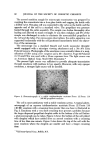
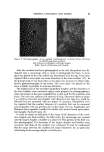
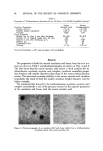
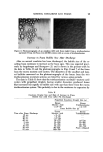
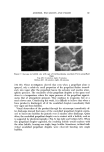
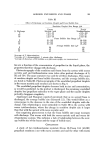
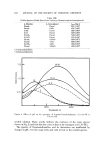
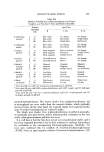
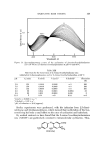
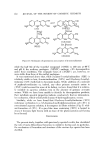
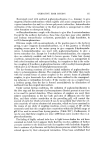
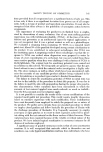
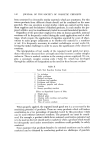
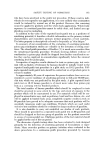
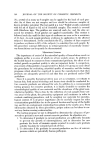
AEROSOL EMULSIONS AND FOAMS 99 Table III Effect of Discharge on Emulsion Droplet and Foam Bubble Size Emulsion Droplet Size Range (t•) a Excess Excess % Discharge Myristic Acid Triethanolamine 5 2.0--30 0.5--100 50 2.0--10 0.5--70 75 2.0--10 0.5--40 Foam Bubble Size Range 5 10-105 10--180 50 10--105 10-180 75 10-160 15-250 Average Bubble Size (t•) 5 52 •63 50 41 61 75 41 55 aAverage of 5 determinations. øAverage of 3 determinations, 1 minute after discharge. CAverage of diameters of 50 bubbles on a photomicrograph, one measurement. ties are a function of the concentration of propellant in the liquid phase, the properties therefore change with discharge. Photomicrographs of the emulsions m•d foams from the system with excess myristic acid and triethanolamine were taken after product discharges of 5, 50, and 75%. The same container was used for all three discharges. The ranges of emulsion droplet and foam bubble diameters, and the average bubble size, are listed in Table III. Photomicrographs of the emulsified propellant droplets in the excess myristic acid emulsion are shown in Fig. 8. The emulsified propellant droplets decrease both in size and concentration, as would be predicted. As the product is discharged, the remaining emulsified droplets lose propellant molecules to the vapor phase and the smaller droplets probably disappear completely. Augsburger and Shangraw reported previously that as an aerosol foam is discharged, the average bubble size decreased (2). This would follow as a consequence in the decrease in the size of the emulsified droplets with dis- charge. This relationship is more noticeable in Table III in the system with excess triethm•olamine, where the change in emulsion droplet size is larger than that with the aerosol with excess myristic acid. One surprising phenomenon is that the foam bubble size range increases with discharge. This occurs with both the excess myristic acid and excess tri- ethanolamine systems. This indicates a lack of relationship between the aver- age bubble size of the foams and the range of bubble sizes. CONCLUSIONS A study of two triethanolamine myristate/Freon 12/Freon 114 (40/60) propellant emulsions (one with excess myristic acid and the other with excess

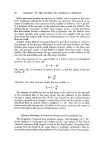
100 JOURNAL OF THE SOCIETY OF COSMETIC CHEMISTS Figure 8. Triethanolamine myristate/Freon propellant emulsion after discharge Top left. 5% discharge right, 25% discharge Bottom left. 50% discharge right, 75% discharge triethanolamine) showed that a definite relationship exists bet•veen the prop- erties of aerosol emulsions and those of the foams h'om the emulsions. Aerosol emulsions with the smaller dispersed propellant droplets had better emulsion stability and, upon discharge, produced foams with smaller bubble size, su- perior stability, higher stiffness, and decreased rate of drainage and wetting. The primary factor in obtaining aerosol emulsions with a small droplet size is the surfactant system. The system with an excess of myristic acid forms a triethanolamine myristate-myristic acid complex. This complex produces the smaller emulsified propellant droplets and the foams with superior properties. The bubbles in the foams froin both types of emulsions continue to increase in size with time after discharge. Initially, this increase is considered to result mainly h'om continued vaporization of residual liquefied propellant in the dis- charged product. The foam with an excess of myristic acid increases in bubble size at a slower rate than that h'om the system with excess triethanolamine. This decreased rate of bubble growth from the excess myristic acid system is postulated to be due to the stronger interfacial film sun'ounding the emulsi- fied droplets and bubbles. The stronger interfacial film is formed by the tri- ethanolamine myristate-myristic acid complex. The stronger interfacial film also results in a slower growth of the large bubbles in the foam at the expense of the smaller bubbles and decreases the possibility of bubble coalescence.
Purchased for the exclusive use of nofirst nolast (unknown)
From: SCC Media Library & Resource Center (library.scconline.org)