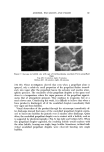
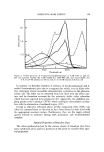
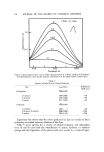
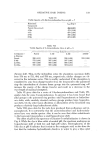
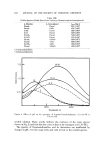
J. Soc. Cosmet. Chem., 24, 87-101 (February 2, 1973) The Relationship between Emulsions and Foams. Aerosol I. Triethanolamine Myristate/Freon Propellant Systems PAUL A. SANDERS, Ph.D.* Presented May 25, 1972, Serai•ar, Los Angeles, Calif. Synopsis-Two aqueous triethanolamine myristate/Freon propellant emulsions with differ- ent degrees of stability were studied in conjunction with their corresponding foams to de- termine ff any relationship existed between the PROPERTIES of the EMULSIONS and those of the FOAMS. A glass pressure cell was developed for microscopic observations of the emulsions. MICROSCOPIC and VISUAL OBSERVATIONS of the two systems showed that the surfactant system producing emulsified propellant droplets with the smaller diameters also produced foams with an initially smaller bubble size and a slower increase in bubble size after discharge. The systems with the smaller emulsified droplets were the most stable and produced the most stable foams. The average diameter of the emulsified propellant droplets and their corresponding foam bubbles decreased with product discharge. However, the range of the diameters of the foam bubbles increased near the end of the discharge. INTRODUCTION Most aerosol cosmetic foam products are formulated as aqueous oil-in-water emulsions in which the propellant droplets, liquefied under pressure, are dis- persed throughout the aqueous phase. When the emulsion is discharged, the dispersed liquefied propellant droplets vaporize when they reach atmospheric *"Freon" Products Laboratory, E. I. du Pont de Nemours & Co., Inc., Wfiraington, Del. 19898. 87

88 JOURNAL OF THE SOCIETY OF COSMETIC CHEMISTS pressure, producing a foam consisting of propellant gas bubbles dispersed in an aqueous surfactant phase. A considerable number of papers have been published on the properties of aerosol foams (1-8), but relatively little information has been available about the emulsions from which the foams were obtained. One reason is that, up to the present, no satisfactory microscopic equipment was available for observ- ing the aerosol emulsions under pressure. Another is that since the foam was the consumer product, it was only natural that more attention should have been focused upon the properties of the foam instead of those of the emulsion. As a result, little is known about possible relationships between the properties of aerosol emulsions and their foams. The pressure of the liquefied propellants limits the commercial methods for preparing aerosol emulsions compared to those available for nonaerosol emul- sions. In aerosol products, where the concentrate itself is an emulsion, the properties of the emulsion can be modified by varying the method of prepara- tion of the emulsion concentrate. Since the concentrate is not under pressure, a variety of procedures can be used to prepare the concentrate. The proce- dure producing the best emulsion can be determined by conventional meth- ods. When the propellant is the only organic phase in an aerosol emulsion, the method for preparing the emulsion is essentially restricted to adding the propellant last to the aqueous phase at room temperature by pressure loading. The agitation necessary to achieve emulsification of the propellant is obtained by the turbulence created by the pressure filling process, by hand or machine shaking during production, during transportation, or when the consumer shakes the product immediately before use. In view of the limited methods for achieving emulsification of the propel- lant, it is essential to select a surfactant system that promotes emulsification of the propellant with the minimum amount of agitation. The surfactant should also produce dispersed droplets of the smallest possible size to reduce creaming and with strong interfacial films to minimize coalescence and in- crease stability. The major objective in the present work was to determine what relation- ships existed between aerosol emulsions and their foams with the hope that an understanding of this relationship would ultimately lead to better and more aerosol cosmetic foam products. In order to study the emulsions, it was neces- sary to develop a glass pressure cell for microscopic observations of the aero- sol emulsions. The development of the pressure cell is an important contribu- tion of this paper. The triethanolamine salts of the fatty acids are commonly used as surfac- rants for aerosol foams. In the present investigation, two diffcrcnt aqueous triethanolamine myristate/Freon© 12/Freon©* 114 (40/60) propellant *Registered trademark of E. I. du Pont de Nemours & Co., Inc., Wilmington, Del. •9898.
Purchased for the exclusive use of nofirst nolast (unknown)
From: SCC Media Library & Resource Center (library.scconline.org)