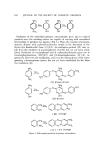
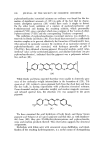
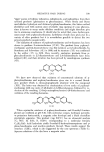
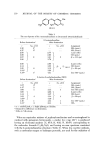
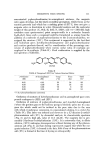
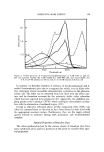
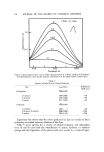
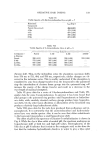
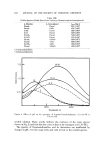
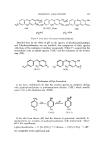
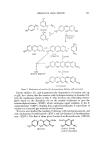
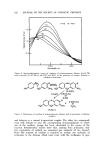
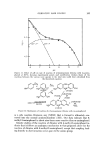
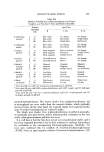
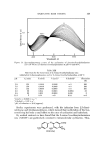
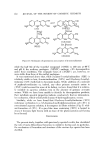
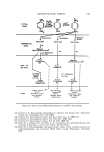
OXIDATIVE HAIR DYEINC 105 The products shown in Fig. 1 are the principal products of the oxidative coupling reactions. It is known, however, that other colored species are formed from the peroxide oxidation of p-phenylenediamine (10). In modern oxidative dyeing practice, hydrogen peroxide is the normal oxi- dant, although persalts of various acids or solid organic hydrogen peroxide adducts are employed when product presentation requires the use of a solid oxidant. Nevertheless, it should be noted that the persalts and adducts usually generate hydrogen peroxide on dissolution in water. A particular advantage of hydrogen peroxide is that it is a relatively unreactive oxidant and results in only slow oxidation of the primary intermediates in the dye bath. In fact, we have found that color development is more rapid when dilute solutions of pre- cursors are oxidized with air than when the frequently used 3% hydrogen peroxide is employed. It may well be that peroxide undergoes catalytic de- composition to yield molecular oxygen within the hair fiber, thus resultin• in the desirable situation of a more rapid color development with:n the fiber than pertains in the dyebath. The third component type consists of the couplers, which are important in producing the color nuances necessary to the simulation of natural hair colors. The couplers do not undergo facile oxidation but, by virtue of their bearing strong electron donating groups, produce dyes by reaction with the electro- philie quinone-imines. In practice, any aromatic compound having an amino or hydroxy group and an unblocked para position can react with a quinone- imine to produce an indo dye. However, it has been found that anilines and most monohydric phenols are generally insufficiently reactive to compete with the self-coupling reactions of the primary intermediates, under hair dyeing conditions. For this reason, the most important couplers are phenols or ani- lines bearing a second strong electron donor in the meta position. Thus, al- though the choice has been made pragmatically, we find that the most impor- tant couplers in current practice are resorcinols, rn-phenylenediamines, and rn-aminophenols (11-13). The present paper describes a study of the mechanism of the reactions of the reactive aliimines with the meta difunctional couplers, and of the nature of the major colored species formed in these reactions. It should be noted that chromatographic examination of oxidized reaction mixtures shows the pres- ence of a number of minor species in addition to one or, sometimes, two major products. EXPERIMENTAL The spectrophotometric and kinetic techniques employed in this work have been described previously (1,14). As has been pointed out earlier, the oxidation of p-phenylenediamine to p- benzoquinone diimine by hydrogen peroxide or molecular oxygen is slow rela- tive to the rate of reaction of the diimine with couplers. For this reason, the

106 JOURNAL OF THE SOCIETY OF COSMETIC CHEMISTS use of these oxidants is unsuited to studies of the kinetics of the coupling re- actions. However, we have found that, above pH 8, the reaction p-diamine + 2 ferricyanide •--- diimine + 2 ferrocyanide is quantitative and virtually instantaneous. Therefore, this system was used, as far as possible, for the generation of the diimine. In kinetic experiments employing 4-equivalent couplers, stoichiometric reaction mixtures can be pre- pared using the p-diamine :ferricyanide: coupler molar ratios of 1:4:1 or 2:4:1. In the first case, the leuco dye is oxidized by ferricyanide while in the second case it is oxidized by a mole of diimine with the consequent formation of a mole of p-phenylenediamine. Below pH 8, the above equilibrium lies partly to the left-hand side and it is therefore necessary to use freshly prepared aqueous solutions of the diimine (15) for kinetic work at pH 8. With 4-equivalent couplers, the required ali- imine:coupler ratio is 2:1. In experiments with 2-equivalent couplers, the req- uisite p-diamine: ferricyanide: coupler ratio is 1: 2:1 and diimine: coupler ratio is 1:1. All the above systems lead to second-order kinetic forms. With less reactive couplers, an excess of coupler must be used and first-order kinetic forms re- sult. Relevant kinetic equations have been given elsewhere (16) as has a consideration of the reaction conditions required to avoid interference of side reactions such as hydrolysis of the diimine and self-coupling with p-diamine (17). t•ESULTS AND DISCUSSION Colors Produced on Hair Resorcinol is the most widely used of all the oxidation dye couplers, being incorporated into most shades as a "drabber," and to achieve a better color balance on hair of differing prior chemical history. Its use as a "drabber" arises from the fact that, in the presence of oxidizing p-phenylenediamine (i.e., p-benzoquinone diimine and p-phenylenediamine), it produces greenish (18,19) and golden brownish (13) shades, depending on the conditions of dyeing. We have confirmed these dyeing results and found that similar color effects are produced using mixtures of p-phenylenediamine or 2,5-diaminotoluene with resorcinol, or the 2-methyl, 5-methyl, or 4-chloro derivatives of resorci- nol. On the other hand, 4-alkyl resorcinols produce pinkish brown shades with either of the above p-diamines. Among the m-phenylenediamines which have been employed in oxidative dyeing, 2,4-diaminoanisole is undoubtedly the most important. Additionally, references to the use of m-phenylenediamine, its 4-chloro and 4-methyl deriv- atives, and 2,4-diamino-5-methylanisole and 2,4-diamino-l,5-dimethoxyben- zene are to be found in the literature (13,20). All these m-diamines react with
Purchased for the exclusive use of nofirst nolast (unknown)
From: SCC Media Library & Resource Center (library.scconline.org)