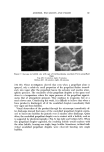
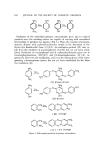
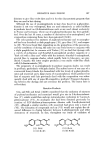
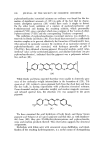
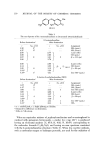
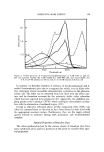
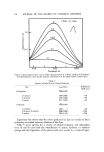
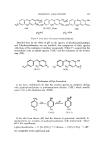
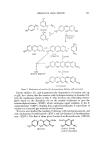
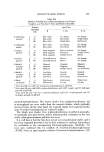
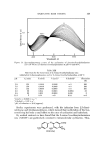
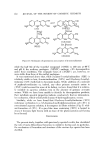
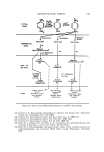
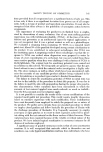
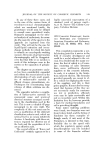
OXIDATIVE HAIR DYEING 117 H•I • H •N •'•--.,,/•IH• H•N •"k'• H•N •"t"'•.,/"•H• H• •N'"t'"• H •N•NH red (XVIII) blue red pK•.4.o pKa* 10'4 Figure 5. Ionic forms of 2-amino-5-mefi•ylindamine Detailed data on the effect of pH on the spectra of 2-hydroxyindoanilines and 2-hydroxyindamines are not available but comparison of their spectra with those of the analogous 2-methoxy compounds (Table V) suggest that the indoanilines exist as anionic species (XIX) and the indamines as the Zwitter ions (XX). Mechanism o[ Dye Formation It has been established (2) that the reactive species in oxidalive dyeing with p-phenylenediamine is p-benzoquinone diimine (XXI) which usually reacts ( 14 ) as the diiminium ion (XXII). NH• NH z NH NH (XX1) (XX11) It has also been shown (46) that the diimine is generated, essentially in- stantaneously, by reaction of p-phenylenediamine with ferricyanide. Above pH 8, this equilibrium p-phenylenediamine + 2 [Fe (CN)o] -a • diimine + 2 [Fe (CN)o] -4 + 2H + lies completely to the right hand side.

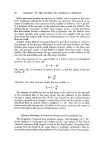
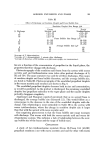
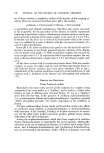
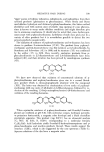
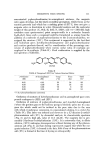
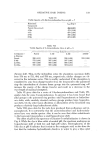
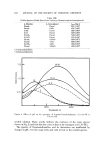
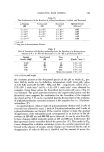
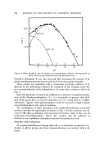
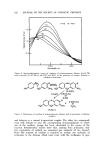
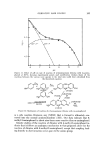
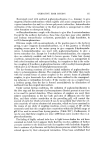
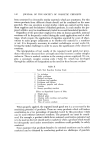
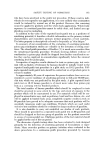
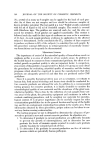
118 JOURNAL OF THE SOCIETY OF COSMETIC CHEMISTS Kinetic techniques for studying the reactions of diimines with various cou- plers by following the rate of color development have already been described (14). These have now been applied to the reactions with resorcinols, m-dia- mines, and m-aminophenols. Diimines with Resorcinols While Brody and Burns (39) reported that they could not detect an early oxidation stage in the oxidation of p-phenylenediamine and resorcinol, we have now found that when oxygen is bubbled into a dilute solution of the re- actants, a magenta color develops. The same colored species is formed more rapidly when ferricyanide is used as oxidant or when a fresh solution of pure diimine is added to a solution of resorcinol. As mentioned earlier, the spec- trum of the magenta dye is consistent with its being 2-hydroxyindoaniline (V). Attempts to confirm the structure by unambiguous synthesis have so far been unsuccessful and isolation of the dye has proved impossible due to its marked instability. Studies of the stoichiometry of the reaction indicate that 2 moles of di- i•nine reacted with one mole of resorcinol to give one mole of magenta dye and one mole of p-phenylenediamine (Table IX). Thus, the overall reaction can be represented: or 2 diimine + resorcinol • hydroxyindoaniline + p-diamine dii•nine + resorcinol • lcuco dye followed by leuco dye + diinfine • hydroxyindoaniline + p-diamine The rate of formation of the indoaniline can be followed spectrophotomet- rically at 484 nm. Kinetic runs using stoichiometric amounts of reactants show that the rate of dye formation follows second-order kinetics (Table X). Fur- thermore, it was also found that the rate is proportional to the resorcinol con- centration. Thus, the reaction is first order with respect to the concentration of both diimine and resorcinol, and the rate-controlling step must involve attack of the diimine on resorcinol. The effect of pH on the rate of reaction was examined. As can be seen from Fig. 6, the rate decreases with increasing pH at pH 10.5 and with decreas- ing pH at pH 10. This rate/pH profile is consistent with a rate-controlling step involving electrophilic attack by the coniugate acid of the diimine (DH +) on the mono-(RH-) and/or dianion (R =) of rcsorcinol. Thus, the observed second-order rate constant kobs is given by the equation where kob s = k a OIDii+ OtR= -I- kl• OtDII OtRII- and kb are the specific second-order rate constants for the reactions DH + R = and DH + + RH-, respectively, and the rr values are the fractions of
Purchased for the exclusive use of nofirst nolast (unknown)
From: SCC Media Library & Resource Center (library.scconline.org)