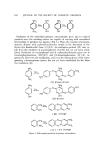
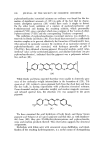
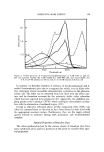
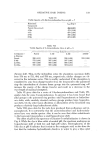
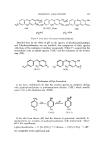
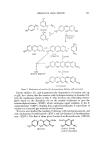
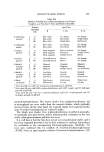
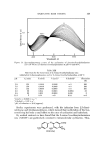
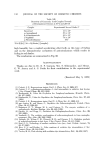
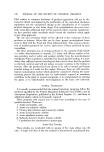
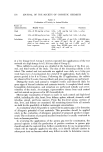
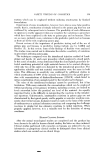
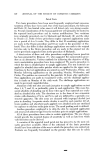
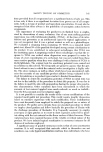
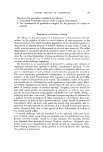
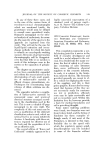
OXIDATIVE HAIR DYEING 107 diimines to give blue-violet dyes and it is for this characteristic property that they are used in hair dyeing. Although the use of m-aminophenols in hair dyes based on p-phenylene- diamine is not very widespread, they are used extensively as color builders in products based on 2,5-diaminotoluene such as are used ahnost exclusively in France and Germany, where use of p-phenylenediamine has been prohib- ited. Over the last 10 years, a number of derivatives of m-aminophenol, and compositions containing them, have been patented (21-30). The color produced by mixtures of p-phenylenediamine and m-aminophe- nol has been described as dark purple-grey (13), grey-blue (31), and magen- ta (32). We have found that, depending on the proportions of the precursors, and the conditions of dyeing, the color can vary from brown to magenta with a slight purplish tint. In common with Tucker (13) we find that dyeings with a variety of p-diamines and 6-methyl-3-aminophenol produce magenta or a "dark red with a blue east" while with the isomeric 4-methyl-3-aminophenol, greyish blue to magenta shades, which rapidly fade to blue-grey, are pro- duced. Uniquely, this latter coupler produces a very stable violet-blue shade with 2,5-diaminoanisole (33). The propensity of m-aminophenols to produce magenta shades can result in problems, particularly with pale shades. The author knows of one case of a commercial honey-blonde dye formulated with low levels of p-pheny!enedia- mine and resorcinol and a large excess of m-aminophenol, which produced no hint of magenta until hair previously dyed with the composition was subse- quently dyed with any of some 20 competitive products! Frequent shampoo- ing between the dyeings did not overcome the problem. The lesson here is self-evident. Reaction Products Cox, and Sidi and Zviak (34-36) considered that the oxidation of mixtures of p-phenylenediamine and resorcinol would give rise to 2-hydroxyindoani- line (V), which would then undergo intramolecular cyclization to 7-amino-3- phenoxazinone (VI). An analogous dye had been obtained previously by reaction of N,N'-dichloro-p-benzoquinone diimine with 5-methylresorcinol (37), although a similar reaction with resorcinol had given only a trace of (VI). The formation of compounds such as (VI) would not explain the ob- served difference in dyeing behavior between 4-alkylresorcinols and other derivatives of resorcinol. In fact, throughout our study of oxidation of (v) R=H (VII) R=Et (VI) R= H (VIII) R=Et

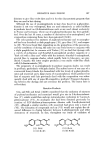
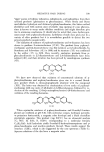
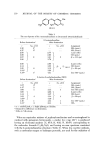
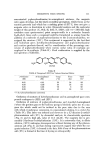
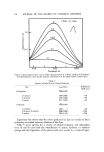
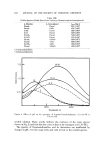
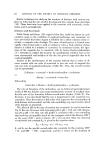
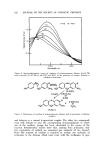
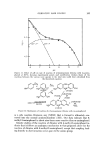
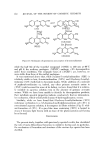
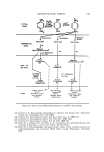
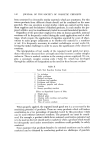
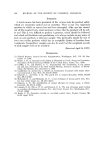
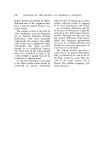
108 JOURNAL OF THE SOCIETY OF COSMETIC CHEMISTS p-phenylenediamine/resorcinol mixtures no evidence was found for the for- mation of significant amounts of (VI) in spite of the fact that its charac- teristic absorption spectrum (38) would have made it simple to detect. On the other hand, oxidation of a mixture of p,-phenylenediamine and 4-ethylresorcinol and heating the resulting solution, which presumably contained (VII), gave a product which was a mixture of the 7-amino-2-ethyl- 3-phenoxazinone (VIII) and the corresponding 7-hydroxy compound. The oxidation of p-phenylenediamine/resorcinol mixtures was studied ex- tensively by Brody and Burns (39). They found that resorcinol is a sufficiently reactive coupler as to prevent effectively the formation of Bandrowski's base, when present in equimolar amount. By oxidation of an equimolar mixture of p-phenylenediamine and resorcinol, with hydrogen peroxide at pH 9 (Na2COa), they obtained a brown pigment. Elemental analysis, acetyl value, methoxyl value (of the methylated pigment), and alkaline hydrolysis (to give p-phenylenediamine), indicated that the pigment was a polymeric indoani- line, such as (IX). While Brody and Burns reported that they were unable to detect the pres- ence of low molecular weight intermediates in the formation of (IX), Tol- gyesi et al. (18) isolated a green pigment both from the dyed hair and from the dye bath, in dyeing experiments with p-diamine/resorcinol mixtures. From elemental analysis, molecular weight, and nuclear magnetic resonance and infrared spectral data, the structure (X) was assigned to the green pigment. H2N' • H O- •"•,'"'•O •"N (X) We have examined the acid hydrolysis of both Brody and Burns' brown pigment and Tolgyesi et al.'s green pigment and find that, as with Bandrow- ski's base (40), they give 2,5-dihydroxybenzoquinone and p-phenylenedia- mine and reaction products thereof. This observation supports the structural assignments. Hydrolysis with dilute acid, with concurrent steam distillation, and identi- fication of the resulting hydroxyquinones, is a useful means of distinguishing
Purchased for the exclusive use of nofirst nolast (unknown)
From: SCC Media Library & Resource Center (library.scconline.org)