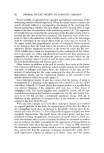
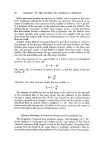
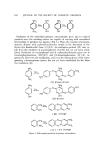
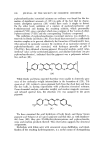
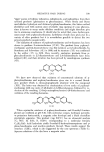
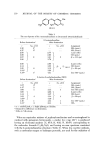
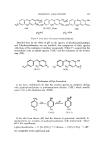
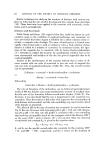
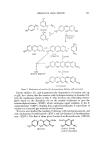
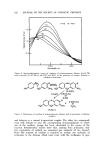
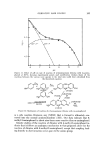
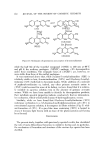
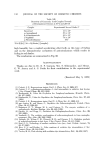
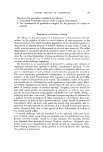
OXIDATIVE HAIR DYEING 109 "open" amino or hydroxy indamines, indophenols, and indoanilines from their cyclized products (phenazines or phenoxazines ). \'Vhile Brody and Burns used alkaline hydrolysis and obtained p-phenylenediamine, this latter method should be used with caution since reversible ring opening of some phenoxa- zincs is known to occur under alkaline conditions and might therefore give rise to erroneous conclusions. It should also be noted that, since hydroxyqui- nones react with p-phenylenediamine, hydrolysis of indo dyes gives rise to a variety of other products but it is nevertheless possible to detect the two primary products unequivocally. The oxidation of mixtures of p-phenylenediamine and m-diamines has been shown to produce g-aminoindamines (17,41). The product from p-phenyl- enediamine and g,4-diaminotoluene was first isolated, as its hydrochloride, by Bernthsen and Sehweitzer (41) in 1886, and its structure (XI) was confirmed by the author (17) in 1939. More recently, analogous products from p- phenylenediamine or g,5-diaminotoluene and g,4-diaminoanisole have been isolated (49.), and their structure has been proved by unambiguous synthesis (43). R2N H2NNH (Xl) We have now observed that oxidation of concentrated solutions of p- phenylenediamine and m-phenylenediamine gives rise to a second bluish- grey product which is chromatographically identical with the compound (XII). The latter was obtained by condensation of two moles of p-phenyl- enediamine with one mole of 4,6-dinitro-l,3-difluorobenzene, followed by re- duction of the resulting 1,3-bis(p-aminophenylamino)-4,6-dinitrobenzene and oxidation of the resulting hexamine. H2N• H•N•NH '•NH• (XII) When equimolar mixtures of p-phenylenedianfine and 6-methyl-3-amino- phenol are oxidized, at pH 8-10, with molecular oxygen, hydrogen peroxide, or potassium ferricyanide, a magenta color develops and a black crystalline precipitate separates. This product (mp g10øC) has an elemental analysis (C, 68.7 H, 5.91 N, 18.5%) corresponding to a molecular formula C•aH•aNaO. Acid hydrolysis yields 5-methyl-g-hydroxybenzoquinone and p- phenylenediamine and reaction products thereof. These results suggest the structure (XIII), which is also supported by the nmr spectrum (Table I). Aqueous solutions of the dye have a magenta color.

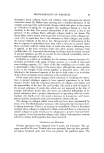
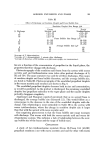
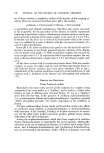
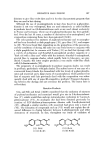
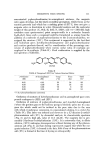
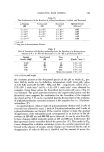
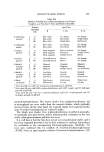
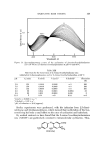
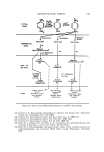
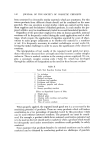
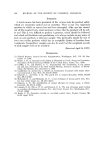
110 JOUBNAL OF THE SOCIETY OF COSMETIC CHEMISTS .•N••Me H2N' •'"•.• HzN•O (XIII) Table I The nmr Spectra of the Aminoindoanilines in Deuterated Dimethylsulfoxide Before deuteration a g-Aminoindoaniline After deuteration r No. of H r No. of H Assignment 3.32 2 b ...... NH.o (quin.) 4.37 2 b ...... NH. (benz.) 2.88 • 2.77 • lpairortho 3.06 2.96 CH (quin.) 3.67 j•' 2 3.61 • 2 (J: 111 cps) 3.86 3.79 3.00 '• 2.88'[ 2 pairs ortho 3.14 3.02 • CH (benz.) 3.20 • 4 3.12 • 4 (J:S4cps) 3.34 TM 3.26 4.37 TM 1 b 4.31 lone CH a (quin.) Before deuteration • 2-Amino-5-methylindoaniline (XIII) After deuteration r No. of H r No. of H Assignment 3.37 2 • ...... NH2 (quin.) 4.47 2 ...... NH2 (benz.) 3.00 1 3.13 1 lone CH (quin.) 3.00'[ 2.92 • 2 pairs ortho 3.14 3.07 CH (benz.) 3.gl • 4 3.14 • 4 (J-90cps) 3.35 TM 3.29 4.40 i 4.31 1 ]one CH c (quin.) 8.13 s 3 8.11 3 CHo m -- masked peak, s = slight splitting to doublet. Obtained by difference on deuteration. Ortho to NH• group. When an equimolar mixture of p-phenylenediamine and m-aminophenol is oxidized with potassium ferricyanide, a similar dye (mp 131 ø ) is produced having an elemental analysis (C, 67.9 H, 4.92 N, 19.4%) corresponding to the molecular formula C•2H•NaO, and having an nmr spectrum consistent with the 2-aminoindoaniline structure (Table I). When less reactive oxidants, such as molecular oxygen or hydrogen peroxide, are used for the oxidation of
Purchased for the exclusive use of nofirst nolast (unknown)
From: SCC Media Library & Resource Center (library.scconline.org)