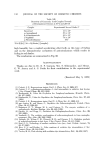
SAFETY TESTING OF COSMETICS 141 done provided that all components have a significant history of safe use. This is true only if there is no significant deviation frmn proven use of all compo- nents, both as to type of product and ingredient concentration. It must also be recognized that there always is the possibility of synergistic action between components. The importance of evaluating the product in its finished form is e•npha- sized by observations of many evaluators. One of our •nost striking personal experiences was with triehlorosalieylanilide (TCSA). At the ti•ne of its intro- duction and prmnotion as an antibacterial agent for topical applications, it was not recognized that it was a potent contact as well as a photoallergen. We evaluated a cleansing lotion containing 1% TCSA in a repeated insult patch test. About 5% of the panelists developed strong contact sensitization to the .product. It was established, in subsequent reehallenges, that TCSA was the sensitizing agent. A surprising result of these reehallenges was that the re- sponse to TCSA was evoked when dispersions were prepared in water by means of a low concentration of a surfaetant, but was not evoked frmn these same reactive panelists when they were challenged with solutions of TCSA in diethylphthalate. The original tests for sensitizing potential were carried out on solutions in this solvent. We frequently are prone to assrune that the pre- ferred solvent is one in which the •naterial under investigation is highly solu- ble. The above instance, as well as others which have been encountered, indi- cates the necessity of any candidate product additive being evaluated in fin- ished formulations or in product types si•nilar to finished formulations. The failure to detect the sensitization potential of TCSA in initial tests was not due to the inability of the procedure to detect this property. It was due to the failure to insult the skin with preparations having the proper skin penetra- tion characteristics. Other variations have been encountered in which the mnounts of test •naterial applied were much reduced-as much as tenfold- frown the 0.5-g amounts most investigators apply. It is not possible to consider the •nerits of the various modifications of the repeated insult patch test procedure. This would require lengthy discussions based on extensive experience with each modification. These •nodifieations have most frequently been e•nployed to satisfy the proposed use or nature of the product. We prefer not to deviate from our standard procedure in which we employ closed patches and follow basically the procedure of Draize with the challenge procedure of Shelanski. It is frequently necessary to employ se•ni-open or open patches or to resort to short exposures achieved by panel- ists sitting with the test material on the flexor surface of their forearms. These variations have been required because of the volatile or irritant nature of the product. We have induced typical sensitization in numerous instances by all degrees of occlusion employed. A significant cause of possible erroneous results is that of eross-sensitization reactions. It is •vell recognized that materials which in themselves are not sensitizers can evoke typical sensitization reactions from individuals who have

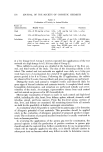
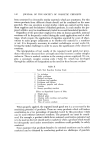
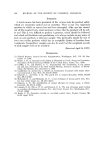
142 JOURNAL OF THE SOCIETY OF COSMETIC CHEMISTS been sensitized by chemically similar materials which are sensitizers. For this reason products from different clients should not be combined on the same panelists. The one exception is joint studies which are carried out for ingre- dient suppliers and formulators of finished products. In such studies the pro- posed additive may be si•nultaneously tested in several formulated products. Regardless of the procedure employed in tests on human panelists, minimal reactions will be frequently evoked during the serial applications and at chal- lenge, which require the application of expertise acquired by years of obser- vations to make proper judgments as to whether the material is a sensitizer or not. It is frequently necessary to conduct rechallenges several weeks fol- lowing the initial challenge in order to assess the significance of the observed reactions. The interpretation of test results of the repeated insult patch test proce- dures will not be discussed here at length since this becomes a rather complex endeavor. There is marked variation in the scoring systems employed. We em- ploy a seemingly complex scoring scale (Table II) which has developed through the addition of designations as the need for them became evident. Table II Patch Test Reaction Scoring Scale 0 No irritation 1 Slight erythema 2 Marked erythema 3 Erythema and papules E Erythema and edema 4 Erythema, papules and edema 5 Vesicles 6 Strong spreading reaction Effect on Superficial Layers of Skin A Slight glaze B Marked glaze C Glazing with cracking and peeling F Moist fissures G Film of serous exudate When properly applied, the repeated insult patch test is a severe test for the sensitizing potential of products. There are many products which will induce sensitization in a low percentage of panelists tested by this procedure which can be used without untoward reactions. The proposed use must be consid- ered. For example, a product which shows minimal sensitization potential and is to be used on the feet should not be marketed, while a product which would be infrequently used under nonocclusive conditions could probably be safely marketed. Some assurance that products found to be minimal sensitizers can be safely marketed can be obtained by conducting product-use challenges of panelists
Purchased for the exclusive use of nofirst nolast (unknown)
From: SCC Media Library & Resource Center (library.scconline.org)