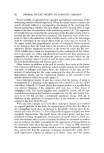
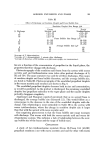
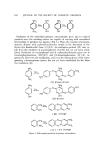
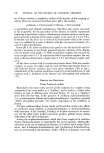
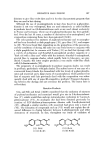
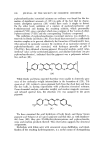
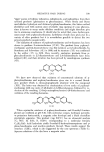
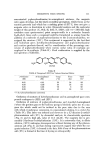
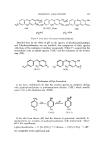
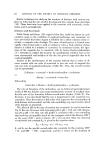
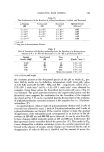
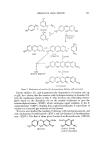
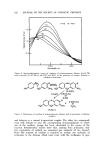
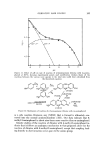
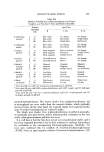
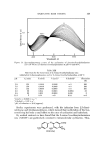
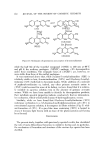
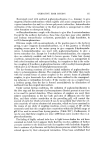
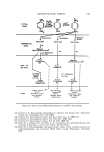
OXIDATIVE HAIR DYEING 131 Resorcinols react with oxidized p-phenylenediamine (i.e., diimine) to give magenta 2-hydroxyindoanilines which rapidly add amino compounds to give a green trinuclear dye and/or a brown polymeric indoaniline. Intramolecular cyclization of the intermediate or the final products is unimportant in either color formation or subsequent fading. m-Phenylenediamines couple with diimines to give blue 2-aminoindamines. Except for the methoxy derivatives, these blue dyes have poor color stability and undergo intramolecular cyclization, particularly at high humidities, to red 2,8-diaminophenazines. Diimines couple with m-aminophenols, at the position para to the hydroxy group, to give magenta 2-aminoindoanilines, or, if this position is blocked, coupling occurs para to the amino group to give magenta 2-hydroxyinda- mines. 2-Aminoindoaniline can react with p-phenylenediamine to give a brown trinuclear dye. Except for 5-methyl-2-aminoindoaniline, the magenta dyes are relatively unstable and fade to brown species. Under hair dyeing conditions, intramolecular cyclization of the magenta dyes is unimportant in both color f'ormation and subsequent fading. An exception to this is the oxida- five coupling of 2-methoxy-p-phenylenediamine with 4-methyl-3-aminophenol which gives a 3,7-diamino-2-methylphenoxazinium salt. The dye-forming reactions all involve initial oxidation of p-phenylenedia- mine to p-benzoquinone diimine. The conjugate acid of the latter then reacts with the neutral forms of amine couplers or the anionic forms of phenolic couplers, to give leuco-indo dyes which are then oxidized to the correspond- ing indamine or indoaniline derivative. If the reactive site on a coupler bears a methoxy group, then the dye is formed nonoxidatively by elimination of methanol from the coupled intermediate. Under normal dyeing conditions, the oxidation of p-phenylenediamine is the slow step and the amount of p-benzoquinone diimine present at any time is too small to permit detection. When mixtures of couplers are used, their relative concentrations in the dye bath and rates of diffusion into the hair fiber, and their relative reactivities at the prevailing pH, will control the amount of each dye which is formed. It can be no accident that while the rel- ative reactivity of various electron-rich aromatics, which we have examined in the course of our study of coupling reactions, covers a range of 107, all the commonly used hair dye couplers have reactivities within the 20-fold range at pH 9.5 as used in normal hair dyeing practice (Table XIV). Furthermore, it can be seen that these couplers are some 1,000 times more reactive than is p- phenylenedialnine. The fading of highly colored indo dyes to light brown shades has not been cxamined in detail, but it appears likely that this involves addition of further aromatic moieties to the dinuclear indo dye together with hydrolyric degrada- tion to mixtures of p-diamines and hydroxybenzoquinones which form further colored species by their subsequent interaction. It has been established that

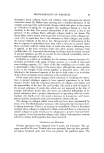
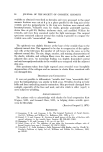
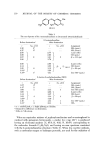
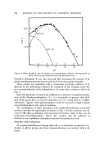
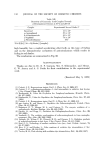
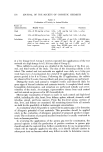
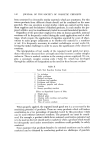
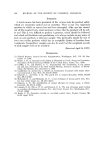
JOURNAL OF THE SOCIETY OF COSMETIC CHEMISTS Table XIV Reactivity of Commonly Used Couplers Towards p-Benzoquinone Diimine at 3OøC and pH 9.5 Coupler Experimental Second Order k • Resorcinol 1.5 X 10⁵ m-Aminophenol 5.5 X 10⁴ 2,d-Diaminoanisole 6.0 X 10⁴ 1-Naphthol 7.4 X 10⁵ p-Phenylenediamine 34.7 •For d [ dye] /dr ---- k [diimine] [coupler]. high humidity has a marked accelerating effect both on this type of fading and on the intramolecular cyclization of aminoindamines which results in fading to red shades. The conclusions are summarized in Fig. 16. ACKNOWLEDCMENT Thanks are due to Dr. E. P. Camson, Mrs. S. Schumacker, and Messrs. G. W. Arecry and A. G. Fooks for their contributions to the experimental work. (Received May 5, 1972) i•EFERENCES (1) Cotbert, J. F., Benzoquinone imines, Part I, J. Chem. Soc., B, 1969, 207. (2) Corbett, J. F., p-Benzoquinonediimine-A vital intermediate in oxidative hair dyeing, J. $oc. Cosmet. Chem., 20, 253 (1969). (3) Bandrowski, E., Ueber die Oxydation des Paraphenylenediamins, Monatsh. Chem., 10, 127 (1889). (4) Bandrowski, E., Ueber die Oxydation des Paraphenylenediamins, Chem. Bet., 27, 480 (1894). (5) Corbett, J. F., Benzoquinone imine, Part IV, I. Chem. Soc., B., 1969, 818. (6) yon Auwers, K., and Dienes, G., Oxydation des Orthoaminophenols, Fortsch. Chem. Phys., 18, 41 (1924-26). (7) Nagasawa, H. T., Morgan, M. A., and Gutman, N., The enzymic oxidation of o- aminophenols, Biochim. Biophgs. Acta, 28, 665 (1958). (8) Fischer, O., and Hepp, E., Oxidation des Orthophenylenediamins, Chem. Ber., 22, 355 (1889). (9) Yembrick, C., The oxidative condensation of ortho-aminophenols to form aminophe- noxazones, Diss. Abstr., 22, 3862 (1962). (10) Dolinsky, M., Wilson, C. H., Wisneski, H. H., and Demers, F. X., Oxidation products of p-phenylenediamine in hair dyes, J. Soc. Cosmet. Chem., 19, 411 (1968). (11) Kass, G. S., Technology of modern oxidation hair dyes, Amer. Perirum. Aromat., 71, 25, 47 (1956). (12) Kass, G. S., and Hoehm, L., Color reactions of oxidative dye intermediates, J. Soc. Cosmet. Chem., 12, 146 (1961). (13) Tucker, H. H., Hair coloring with oxidation dye intermediates, Ibid., 18, 609 (1967).
Purchased for the exclusive use of nofirst nolast (unknown)
From: SCC Media Library & Resource Center (library.scconline.org)