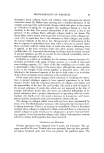
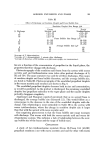
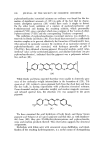
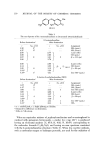
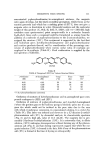
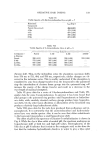
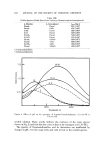
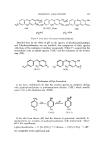
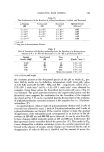
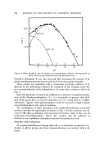
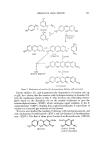
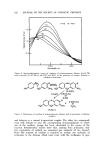
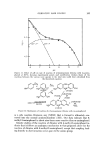
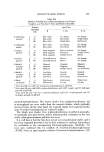
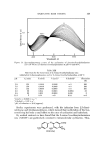
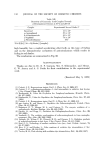
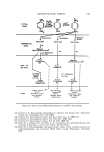
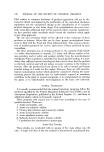
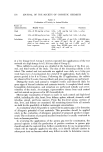
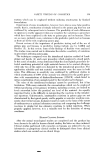
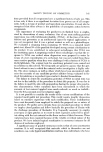
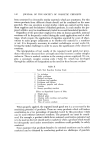
OXIDATIVE HAIR DYEING 119 Table IX The Stoichiometry of the Reaction of p-Phenylenediamine, Oxidant, and Resorcinol p-Diamine Ferricyanide Resorcinol Optical Density (M) (M) (M) (484 nm.) • 2 X 10 -4 4 X 10 -4 1 X 10 -4 0.97 1 X 10 -4 4 X 10 -4 1 X 10 -4 0.95 I X 10 -• 4 X 10 -• 2 X 10 -4 0.97 1 X 10 -4 4 X 10 -• 1 X 10 -4 0.49 2 X 10 -4• 0 1 X 10 -4 0.96 1-cm cell. Using pure p-benzoquinone diimine. Table X Rate of Formation of 2-Hydroxyindoaniline from the Reaction of p-Benzoquinone Diimine (1.0 X 10-•M)with Resorcinol (5 X 10-•M) at pH 9.94 and 30øC Optical Dye Formed Time k Density (480)' (%) (see) (1 mole -• min-•) 0.435 25 1.1 1.82 X 10 • 0.87 150 3.15 1.71 X 10 • 1.30 75 10.5 1.71 X 10 * 1.52 87.5 22.2 1.87 X 10 • Mean rate constant 1.78 X 10 • For a 4.0-cm path length. the reactants present as the designated species at the pH to which ko,,• per- tains. Both ka and k• are, by definition, independent of pH. Using pKa values of 5.75, 9.20, and 11.27 for DH+, RH2 and 'RH-, respectively, values of k, = 5.75 x 10 'ø i mole-•min -• and k• = 1.21 x 10 s i mole4min -• were obtained by computer. Using these values, the theoretical log k versus pH curve (Fig. 6) was obtained. The good agreement between the experimental points and the theoretical curve supports the mechanism for the formation of the magenta dye shown in Fig. 7. It can be concluded that the first product of the oxidation of p-phenylenediamine resorcinol mixtures is the magenta dye, i.e., 2-hydroxy- indoaniline (V). As reported above, when 2 moles of p-benzoquinone diimine and i mole of resorcinol are allowed to react, i mole of 2-hydroxyindoaniline and I mole of p-phenylenediamine are formed. If the reaction mixture is kept, the gradual disappearance of the indoaniline peak, accompanied by an increase in the ab- sorbance at 325-425 nm and 600-700 nm is observed. As can be seen from Fig. 8, these changes exhibit isosbestic points at 428 and 600 nm furthermore, the final spectrum closely resembles that of the green dye (X). The results in Fig. 8 were obtained for a solution containing oxygen. In a similar experiment per- formed in the absence of oxygen, similar changes are observed but the rate of disappearance of color at 484 nm is doubled and the amount of green dye

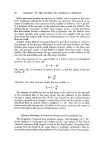
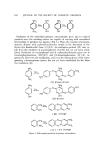
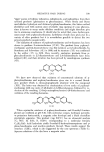
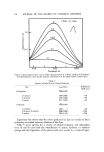
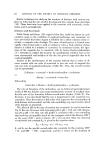
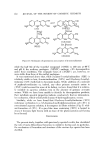
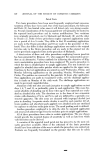
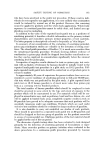
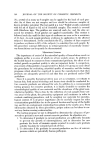
19.0 JOURNAL OF THE SOCIETY OF COSMETIC CHEMISTS 5.0 4.0 \ \o 9 10 11 12 13 pH Figure 6. Effect of pH on rate of reaction of p-benzoquinone diimine with resorcinol, at 30 ø C, showing experimental points and theoretical curve formed is decreased. It was also observed that increasing the amount of p- phenylenediamine present increases the rate of reaction proportionately. These results are consistent with a mechanism involving addition of p- diamine to the indoaniline followed by oxidation of the resulting leuco dye by a second molecule of the indoaniline or by some other oxidant as shown in Fig. 7. Since the green dye is formed by addition of a molecule of p-phenylenedia- mine to the 2-hydroxyindoaniline (V), it is reasonable to propose that addi- tion of the green dye, or its leuco derivative, to (V) would lead to a higher "polymeric" species. Such polymerization would be favored by high reactant concentrations and a slow rate of oxidation. The mechanism of color formation from p-phenylenediamine/resorcinol mixtures can thus be represented as shown in Fig. 7. Similar reactions are ob- served with other p-diamines and resorcinol derivatives. Only in the case of p-diamine/4-alkylindoanilines, where the reactive site for addition is blocked, is any significant aminophenoxazinone formation observed. Diimines with m-Diamines All m-phenylenediamines having either the 4- or 6-position occupied by hy- drogen or alkoxy groups give blue 2-aminoindamincs on reaction with a di- irainc.
Purchased for the exclusive use of nofirst nolast (unknown)
From: SCC Media Library & Resource Center (library.scconline.org)