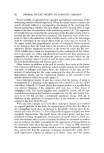
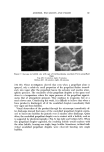
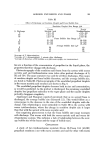
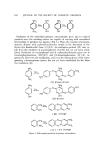
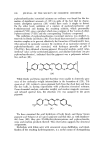
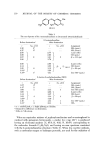
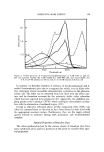
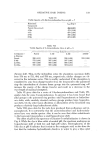
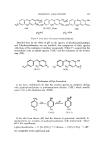
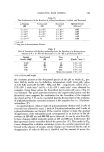
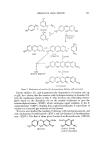
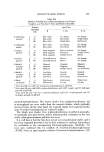
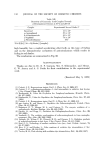
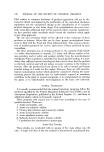
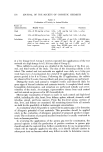
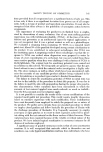
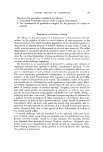
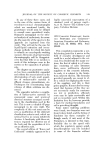
OXIDATIVE HAIR DYEING 123 + I•e MeO H N •,...• H•.N •"'•..,/" N Hz H•N NH z (xxviii) eOH ,,• N %..•• R H•N• H•N %"%./•NH R-- MeO or Me Figure 10. Mechanism of reaction of p-benzoqninone diilnine with 2-equivalent m-diamine couplers a ]euco dye, the conversion of the latter to the indamine dye must oc- cur with the elimination of methanol. Thus, the mechanism can be rep- resented as shown in Fig. 10, involving attack by the diiminium ion on the methoxy]ated carbon atom to give (XXVIII) followed by elimination of methanol. The kinetics of the reaction of these 2-equivalent couplers confirm this mechanism and are more complex than those for the 4-equivalent in- diamine couplers. Thus, we have found that at high pit ( 10.5) the coupling step is rate controlling, i.e., when stoichiometric amounts of reactant are used the rate of dye formation follows a second-order rate law. At low p It(8.5), color development follows a first-order rate law, being independent of initial reactant concentrations, i.e., the elimination of methanol is rate controlling. Obviously, the higher the reactant concentrations the higher will be the upper pit limit to which the first-order rate law will pertain. Table XI gives data for the relative rates of coupling of various diimines with various m-diamines. (It should be noted that the relative rates of cou- pling are independent of pit over the pit range 7-13, but that the absolute Table XI Relative Rates of Coupling of p-Benzoquinone Diimine and m-Phenylenediamines at pit 9.5 and 30øC p-Diamine Parent 2-Me 2,5-Me,, 2,6-Me,o Parent Parent 1.00 0.28 0.22 0.19 4-MeO 21.6 m-Diamine 4-Me 3.03 1.05 1.19 0.56 4,6-(MeO)2 •760 2-Me 5.33 1.11 0.76 0.83 4-MeO 21.5 6.8 1.8 2.1 4-Me-6-MeO ,-•30

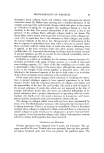
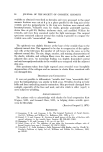
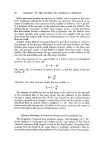
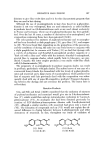
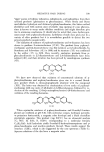
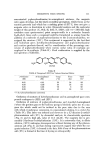
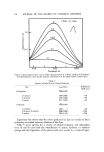
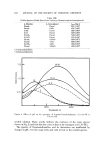
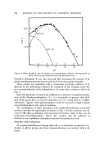
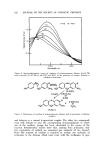
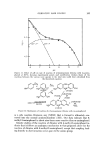
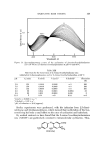
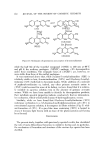
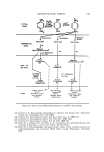
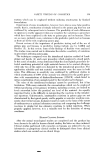
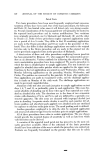
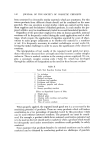
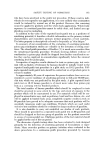
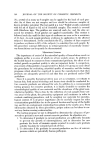
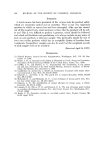
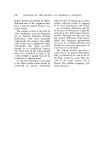
124 JOURNAL OF THE SOCIETY OF COSMETIC CHEMISTS rates decrease tenfold for each unit increase of pH). It can be seen that C- methylation of the m-diamine increases the reactivity by a factor of 3.8 +- 0.8 while C-methylation of the diimine decreases the rate of reaction by a similar factor. Of all the m-diamines examined, the anisole derivatives are, by far, the most reactive and can therefore be expected to be the most efllcicnt for form- ing blue aminoindamine dyes in any given oxidation dye mixture. Diimines and m-Aminophenols The formation of the 2-aminoindoaniline in aqueous buf[er solutions can be followed spectrophotometrically. For kinetic studies stoichiometric reactant concentrations were used, according to the equation p-diamine + m-aminophenol + 4 ferricyanide -• aminoindoaniline + 4 ferrocyanide The rate of dye formation follows a second-order rate law and studies using nonstoichiometric conditions indicated that the reaction is first order with re- spect to both diimine and m-aminophenol concentration. The effect of pH on the rate of reaction (Fig. 11) is typical of that for the reaction of a diimine with a monohydric phenol (47). Thus, the observed rate constant is given by the equation where ka and kb are the specific second-order rate constants for the reaction of the conjugate acid of the diimine (DH +) with the phenolate ion (P-) and the neutral phenol (PH), respectively, and the a-values are the fractions of the reactants existing as the designated species at the pH to which kob• per- tains. Figure 11 compares the experimental values of kob• with the theoretical curve generated from the above equation using values of ka = 1.04 x 10" 1 mole-•min -• and kb = 1.63 x 10⁶ 1 mole-•min -• and pK• values of 5.75 and 9.90 for diimine and m-aminophenol, respectively. These results support the reaction mechanism shown in Fig. 12. This involves an initial rate-controlling electrophilic attack of the conjugate acid of the diimine on the phenolate ion and/or the neutral phenol (depending upon the pH) to give the leuco-ami- noindoaniline (XXIX) which is then rapidly oxidized to the dye (XXX). Similar results were obtained for the reaction of diimine with 6-methyl-3- aminophenol although the detailed kinetics are more complex due to the ap- parent reversible formation of what is probably a pseudoquinoneanil (XXXI), H,•N H NH (XXXl)
Purchased for the exclusive use of nofirst nolast (unknown)
From: SCC Media Library & Resource Center (library.scconline.org)