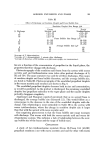
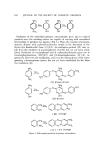
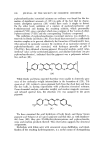
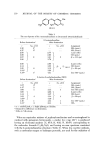
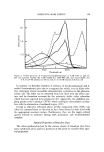
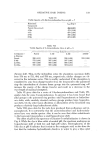
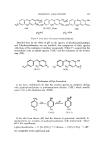
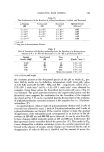
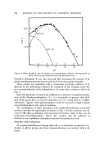
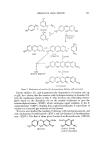
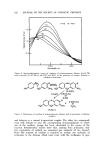
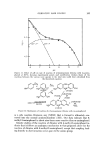
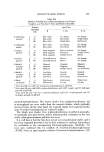
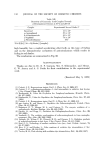
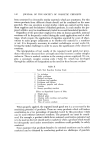
OXIDATIVE HAIR DYEING 115 Table VI Visible Spectra of 2-Hydroxyindoaniline Dyes at pH • 7 Resorcinol Xmax (log e) Component Parent (Resorcinol) 484 (3.93) 4-Me 478 (3.84) 4-Et 476 (3.86) 2-Me 490 (3.92) 5-Me 474 (3.85) Table VII Visible Spectra of 2-Aminoindamine Dyes at pH •, 8 r X .... (Log e) m-Diamine:-- Parent 4-Me 2-Me p-Diamine Parent 552 (4.13) 549 (4.09) 552 (4.09) 2-Me 572 (4.06) 567 (4.06) 567 (4.09) 2,5-Me• 600 (4.00) 585 (4.00) 584 (4.04) 2,6-Me• 580 (4.02) 565 (4.02) 573 (4.11) 4-MeO 511 (3.96) .o o ß . . .o. chromic shift. Thus, in the indoaniline series the absorption maximum shifts from 554 nm to 511, 484, and 538 nm, respectively similar changes are ob- served in the indamine series. This is readily understood if the absorption is considered to arise from charge transfer from the benzenoid to the quinonoid ring-the introduction of electron donor groups into the quinonoid ring xvill increase the energy of the charge transfer and result in a decrease in the wavelength of maximal absorption. Table VI gives data for a series of 2-hydroxyindoanilines and Table VII, similar data for some 2-aminoindamines. In general, it has been found that alkyl groups in the quinonoid ring produce small hypsochromic or bathochro- mic shifts, while similarly situated methoxy groups produce large hypsochro- mic shifts. On the other hand, alkylation or alkoxylation of the benzenoid ring produces relatively large bathochromic shifts. Table VIII gives data for the indo dyes produced from p-diamines and m- aminophenols. It is noteworthy that the aminoindoanilines and hydroxyinda- mines have very similar spectra. Also, it can be seen that chloro substituents in the benzenoid ring produce a small hypsochromic shift. The effect of pH on the spectrum of 2-amino-5-methylindamine is shown in Fig. 4. While the dye is blue-violet at neutral pH, the spectrum undergoes an hypsochromic shift at both low and high pH values. Electrophoresis of the blue dye at pH 8 indicates that it exists as the conjugate acid, as also does the fact that the indaminc hydrochloride dissolves in water to givq a blue-violet

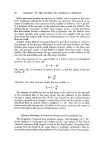
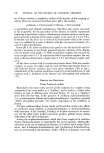
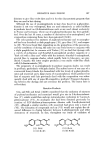
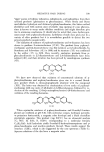
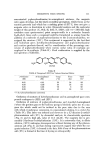
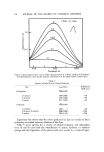
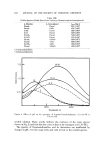
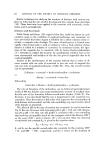
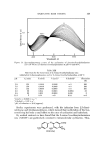
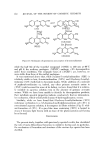
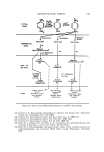
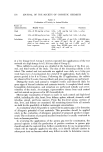
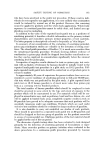
116 JOURNAL OF THE SOCIETY OF COSMETIC CHEMISTS Table VIII Visible Spectra of Indo Dyes From Various p-Diamines and m-Aminophenols p-Diamine 3-Aminophenol Xm.. (log e) Parent Parent 511 (3.98)" Parent 6-Me 492 (3.96)" 2-Me Parent 520 (3.90)" 2-CI Parent 500 (3.86)" 2,5-Cla Parent 500 (3.86) a 2,6-Cla Parent 485 (3.68)" Parent 6-MeO 489 (3.97)" Parent 4-Me 504 (3.99) * 2,6-C1, 4-Me 493 (3.64) • Parent 4-MeO 492 (4.00) * "2-Aminoindoanilines. * 2-Hydroxyindamines. 1.5 [-- 8-9 0.,5 500 600 Wove[engfh, nm Figure 4. Effect of pH on the spectrum of 2-amino-5-methylindamine (1.0x 10-•M in 1.0-cm cell) neutral solution. These results indicate the existence of the ionic species shown in Fig. 5, and that the dye exists in hair as its conjugate acid (XVIII). The spectra of 2-aminoindoaniline and its derivatives are m•affected by changes in pH, over the range 4-14, and exist in hair as the neutral species.
Purchased for the exclusive use of nofirst nolast (unknown)
From: SCC Media Library & Resource Center (library.scconline.org)