J. Soc. Cosmet. Chem. 25 159-181 (1974)¸ 1974 Society of Cosmetic Chemists ofGreatBritain Decision analysis and its to subjective testing relevance A. H. CHRISTER* Presented at the 2nd Joint Perfumery Symposium organized by the British Society of Perfumers and the Society of Cosmetic Chemists of Great Britain at Eastbourne on 7-9th May 1973 Synopsis--This paper introduces some of the basic concepts of DECISION ANALYSIS and discusses how decision analysis might be applied to a variety of decision situations to be found within the COSMETIC and PERFUMERY INDUSTRY. In particular, the decision situation in which only subjective information is available is discussed. INTRODUCTION The purpose of this paper is to introduce the fundamental ideas of decision analysis and to discuss in particular how it might be employed to assist in making subjectively based decisions within the perfumery and cosmetic industry. Here we are not so much concerned with the mechanism of subjective testing, Pridmore (1), as with the way in which the results of any such subjective measure might be incorporated into a decision pro- cedure. General business use of decision analysis is very much in its infancy, but growing. Perhaps the main gain to be obtained by the use of such analysis is that it enables decisions to be made in a logical manner, consistent with available information and the designated objective of the decision-maker. In this sense its use can be said to enhance management's ability to make *Department of Operational Research, University of Strathclyde, Glasgow. 159

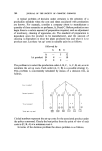
160 JOURNAL OF THE SOCIETY OF COSMETIC CHEMISTS good choices in situation of risk and uncertainty. Of course, many decisions can be and are made without any fuss because the best solution is obvious. When this is not the case, however, decision analysis can provide a frame- work within which the pertinent decision may be discussed in a logical and objective fashion. The decision procedure We define here some of the terms and concepts of decision analysis. In essence, the decision process can be represented as follows' Possible Problem situation actions DECISION Outcome Here the decision-maker views the alternatives available and selects that one which leads to the most desirable outcome. For a decision to be taken, it is clear that: (a) there must be at least two or more alternative courses of action possible (b) the process of decision will select from these alternatives only one course of action which will actually be carried out and (c) the selection process is made so as to accomplish some designated purpose. Alternatives, or strategies Alternatives or strategies comprise all the factors which are within the decision-maker's control. Such factors could be the following. How much/many to make. What type of advertising media to use. What size and shape of container to market a product in. A stock control policy. The size and location of a new factory or extension. We denote the ith strategy by X i.
Purchased for the exclusive use of nofirst nolast (unknown)
From: SCC Media Library & Resource Center (library.scconline.org)