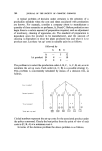
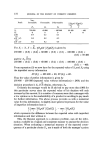
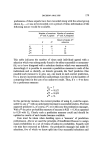
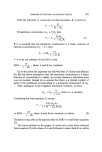
DECISION ANALYSIS ] 61 Environments The assemblage of all factors outwith the control of the decision-maker constitute the environment. States of nature and environments are inter- changeable terms. Possible environmental factors are: weather conditions a price index availability of raw material availability of labour cost of raw material competitors' marketing strategy demand for a product A particular choice of strategy could influence an environmental factor but not determine it, e.g. advertising policy and demand for a product. Unless otherwise stated, it is here assumed the environment is under no intelligent control. Should such a control exist the situation is likely one of gaming. We denote the jth state or environment by Z•. Result/Outcome The result is the outcome R that will be observed when a given strategy X i and specific environment Zj appear together, and is denoted by Clearly R•j is some function of both X• and Zj, so we may write Rv = f(X,, Z•). If in any situation this function were known, for example R u = aX• + bZ'j, the result of each strategy environment interaction could be calculated. Such a result might be written as follows: Results Environments Zx Z• Z8 Z• X• R• R•2 Rx8 R• Strategies X• R• R• R•8 R• Possible sources of difficulty This simple notation conceals a number of problems. For example, it may not be possible to identify and define all environments pertinent to a specific decision. The environments considered in any decision situation will be those the decision-maker thinks most likely to occur or influence the problem. Obviously the sheer size of certain problems will cause some environments and strategies to be disregarded. It is interesting to observe

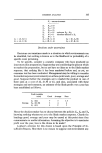
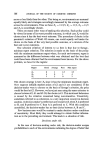
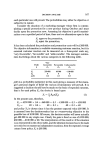
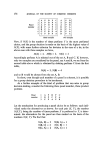
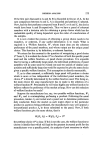
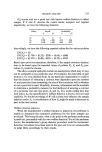
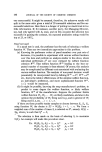
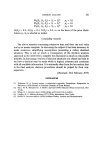
162 JOURNAL OF THE SOCIETY OF COSMETIC CHEMISTS that this possible restriction exists whether or not decision-analysis is used, and represents an initial and subjective identification of a 'sub-decision' on the part of the decision-maker. Starr (2) refers to the resulting problem as decision-making under ambiguity. A second difficulty can arise when evaluating the results Rij. This matrix can sometimes be compiled by direct observation, but more likely costly experimentation or an operational research type study is required. White (3) defines the process of evaluating R o given environment Zi and strategy X i as the object study. Having determined Ro, there is still the problem of deciding an order of preference between results. Any specific result R e could be viewed in a multitude of ways. Consider, for example, the decision concerned with the selection of a marketing policy for a product. The results of various policies could be measured by r• -- value of sales in the first 6 months, rs -- value of sales in the first 2 years, ra = total net profit gained over first year, r• -- expenditure on advertising over first 6 months. Clearly there are numerous other measures one might be concerned with here such as possible counter measures by competitors, etc. If the result R is restricted to the above four measures, we see it has the form of a four-dimen- sional vector R(rx, r2, rs, r•) with different strategies and environments giving rise to different values of rx. Suppose the two possible strategies Xx, X2 (under a specific environment) give rise to X 1 -- R(5 000, 23 000, 2 000, 1 400) X• -• R(8 000, 19 000, 1 900, 1 850) which result is preferred ? Before this question is answered it is necessary for the decision-maker to have a clear idea as to his objectives in making the decision. Perhaps the objective is to maximize profits. If so, over what period of time? Should a period of time be specified: presumably the decision- maker would wish to select that policy which maximizes his profits over this period, subject to his company being in a viable trading position for the subsequent period of time. The true objective is seldom simple in reality and will likely be reviewed within a dynamic context. There are some techniques available to assist with this preference selection procedure. Suppose in the above marketing problem the decision-
Purchased for the exclusive use of nofirst nolast (unknown)
From: SCC Media Library & Resource Center (library.scconline.org)