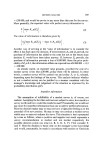
DECISION ANALYSIS 1(53 maker decided that the order of paramount importance and concern was rs, r4, r•. and r•, and a fractional increase in rs was preferable to any increase in r4, r•. and rx: that a fractional increase in r• was preferable to any extent of increase in r2 and rx: and that an increase in r•. was superior to any increase in rx. Then the order rs, r•, r2 and r• is a lexicographic ordering (3) of the out- come parameters for the decision-maker. His choice of R would be that with the best value of rs. Should two or more policies have the same best value of rs, the choice is made between them on the basis of the next most important variable r•, and so on. Alternatively, it might be possible to determine a value function V, whose argument is an outcome R s, with the property V(Rs) V(R,) if and only if R s is preferred to R, (3). Clearly the decision function is itself dependent upon the decision-maker. The existence of such a decision function reduces the selection procedure to a mathematical problem, namely find R* where V(R)* = max V(Rt). Yet another approach to the problem exists using utility theory (4). Here each outcome is given a single numerical value (utility) which reflects its desirability as measured by the decision maker. The most desirable out- come is that with the greatest utility. The final difficulty we shall mention here is that due to the uncertainty introduced through the unknown environment Z. According to the type of uncertainty, decision problems are divided into those of certainty, uncer- tainty and risk. In what follows, we will assume the result R can always be determined, and furthermore, that it is a scalar quantity such as cash or time. This being so, most of the difficulties mentioned in this section will not apply. Decisions under certainty In this case an outcome R is known for certain once the alternatives are specified. Any uncontrolled events are assumed known or irrelevant to the decision. Here either the environment is unique or the decision is indepen- dent of the environment. Thus the result R is a function of X only, i.e. R = R(X,).

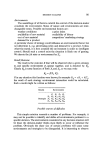
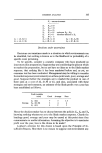
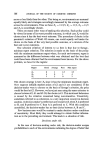
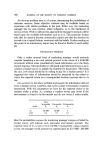
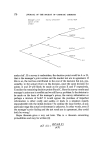
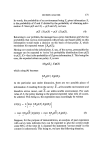
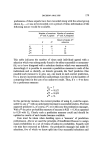
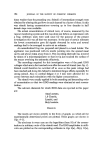
164 JOURNAL OF THE SOCIETY OF COSMETIC CHEMISTS A typical problem of decision under certainty is the selection of a production schedule when the cost and times associated with production are known. For example, consider a company about to manufacture a quantity of three cosmetics or perfumes, A, B and C. Before production can begin there is a certain amount of preparation required, such as adjustment of machinery, cleaning of apparatus, etc. The standard of preparation is dependent upon the product to be manufactured, and the amount of cleaning is dependent on what the plant produced last and what it is to produce next. Let these 'set up' costs in suitable units be as follows. followed by A B C A -- 5 12 1st product B 4 -- 10 C 8 2 The problem is to select the production order A, B, C, A, C, B, etc, so as to minimize the set up costs. Each order (A, C, B) is a possible strategy X•. This problem is conveniently tabulated by means of a decision tree, as follows. First product Second product Third product Totol set-up c, ost A C Circled numbers represent the set-up costs for the associated product under the policy concerned. Clearly the best policy from the point of view of such costs is (C, B, A) at a minimum cost 6. In terms of the decision problem the above problem is as follows.
Purchased for the exclusive use of nofirst nolast (unknown)
From: SCC Media Library & Resource Center (library.scconline.org)