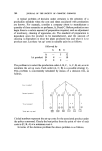
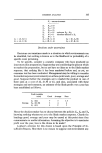
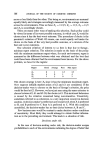
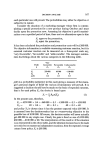
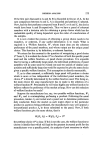
DECISION ANALYSIS 175 If the first pair discussed is A and B, B is discarded in fayour of A. In the next comparison between A and C, A is discarded and perfume C selected. Now, had the first perfumes compared been B and C or A and C, the choice would have been A and B respectively. Thus we have a panel of coherent members with a decision rule for obtaining a group choice which has the undesirable quality of being dependent upon the order of consideration of the samples. It is now evident the process of obtaining a group choice needs to be transitive, or coherent, if any useful information is to result. What is required is a 'Welfare function, W', whose input data are the coherent preferences of the panel members, and whose output are the unique panel choice. This function is, by definition, a coherent function. We return for the moment to the question of recognizing a good choice S* from S t. It is evident the choice S* is a function of both the specific panel used and the welfare function--or panel choice procedure. It is arguable that by having a sufficiently large panel, the individual preferences of panel members will in some sense be evened out and two panels of similar com- position and sufficiently large size would be expected to give the same choice given a specific welfare function. This assumption is directly measurable. If, as is often assumed, a sufficiently large panel will produce a choice which is more or less independent of the individual panel members, the choice S* is directly determined by the welfare function used. This being so, the main choice the soap manufacturer has to make is the selection of a welfare function W. Presumably he will value highly any welfare function he believes reflects the preference of the market at large. How can this selection of welfare function be made? Suppose the manufacturer has, say, two possible welfare functions, Wx and W•, and is contemplating perfuming a product. Following the usual procedure, tenders S i are invited and a panel test to determine preferences duly conducted. Since the market as such might object to the particular product in question being perfumed, the manufacturer may well append a non-perfumed product S o to those submitted to the panel. Now, if both welfare functions give the same choice, that is So) = So) = s* the perfume choice S* is clear. If this is not the case, the welfare function to choose is ideally that which will lead to the greatest increased profit for the manufacturer over a specific period. An analysis of past occasions in which

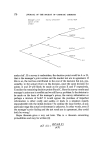
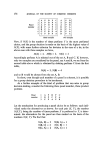
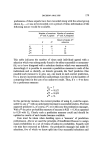
176 JOURNAL OF THE SOCIETY OF COSMETIC CHEMISTS Wx and W2 have been used could resolve this issue on the basis of expected increase in profit due to the selection procedures Wx and W2 respectively. The perfumer's tendering decision Consider now the situation of the perfumer when selecting a particular perfume to tender for a specific contract. In the normal course of events, the perfumer might create three or four possible candidates in response to the perfume specification and then choose one as a tender. How can this choice be made? There are two classes of problem here. (a) The perfumer knows the customer's (soap manufacturer) welfare function W. (b) The perfumer is ignorant of the customer's welfare function. Welfare function known Here the perfumer has the opportunity of performing a panel test himself and use the known welfare function to identify which, of his set of perfumes, would be the most desirable according to the customer, and so increase his chance of gaining the contract. How much is this increased chance worth to the perfumer? Suppose over the past 50 tenders submitted for similar types of contract, the following information is available. Number of tenders Number of contracts awarded X•--no panel test used 25 8 X•--panel test used 25 12 On the basis of this information, the probability of a successful tender given no panel test is used in its selection is p(sIXO = 8/25, = 0.32 and that when a panel test is used is P(S I X•) -- 12/25 = 0.48. This is a quantified expression of experience to date. Consider a new contract worth oe4 000 say, in which the development costs are oe300, and should the subsequent tender be accepted, expected production cost of oe1 000 would be incurred. If a panel test costs oe250, should it be used? The following actions are open, (X0 do not tender, (X•) tonder, but do not use a panel test,
Purchased for the exclusive use of nofirst nolast (unknown)
From: SCC Media Library & Resource Center (library.scconline.org)