186 JOURNAL OF THE SOCIETY OF COSMETIC CHEMISTS extraneous odours and, when required, carries the odour stimulus to the sensory area. This stream flows at 50 ml min -• and emerges from a jet 1 mm inside diameter in laminar flow. (Mean linear velocity--100 cm s -• approx.) The six odorant streams are switched into the carrier stream as close to the point of discharge as possible so that downstream there is minimum dead space and wall surface to delay delivery. The volume of the dead space is in fact about 0.15 ml so that with a flow rate of 50 ml min -• there would be a delay of 0.18 s before a stimulus reached 63•o (-- 1 - l/e) of its full strength. This would represent the worst possible case, i.e. instantaneous forward mixing in the nozzle causing 'rounding' of the stimulus profile. (If there were no forward mixing in the nozzle, the stimulus would still take 0.18 s to reach the orifice but would arrive there at full strength.) The odorant streams (up to six in number) are generated by passing clean dry air over pools of liquid odorants held in U tubes. These U tubes have a straight central portion so that the air stream passes over about 8 cm a liquid surface without bubbling through it. This prevents formation of spray which might be carried forward and upset the concentration. The air flow through each tube can be regulated from about 1 ml min -• to 5 ml min -• by controlling the pressure to a sintered stainless steel flow restrictor before the U tube--or up to 10 ml rain -• by changing the flow restrictor. At these small flow rates the vapour leaving the U tube is practically in equilibrium with the liquid odorant. If necessary the U tubes can be im- mersed in a water bath to keep their temperature constant at or below room temperature. The odorants used are chemicals whose purity has been checked by glc analysis of head-space samples. They are used either neat or diluted with water or paraffin oil. (The paraffin oil used is first deodorized by treatment with activated silica.) This dilution is the means most used to provide widely different rates of delivery of odorant. The rates can also be regulated by adjusting the air flow rates or by cooling the U tubes in order to lower the vapour pressures. The odorants are conveyed to the applicator (where they are switched into the main carrier stream) by means of PTFE tubing of inside diameter 0.4 mm. This tubing is conveniently flexible and is easily and cheaply replaceable. It does absorb some of the odorant but, some minutes after starting the flow, it reaches a steady state which is not disturbed by the switching operation since the flow is not thereby interrupted. It is an important feature of the design of the system that this should be so. All

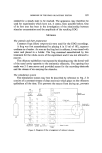
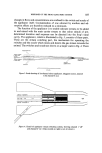
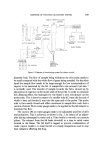
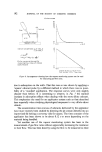
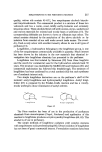
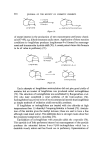
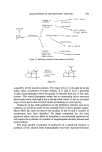
RESPONSE OF THE FROG OLFACTORY SYSTEM 187 changes in flows and concentrations are confined to the switch and nozzle of the applicator itself'. Contamination of' one odorant by another and ad- sorption effects are therefore reduced to a minimum. The function of' the applicator is to enable odorant streams to be added to and mixed with the main carrier stream so that odour stimuli of' pre- &term[ned duration and sequence can be directed into the f'rog's nasal cavity. The applicator, which is illustrated in Fig. 3, consists of three parts. These are the stream switching part, the mechanism for operating the switches and the nozzle which mixes and directs the gas stream towards the animal. The switches and nozzle are shown on a larger scale in Fig. 4. There Compressed Odour stream I •% (I,Sml/min) •_ •_• Carrier • • (100 •/min) .... • (I.Sml/m[n) • Suction • •'- Carrier (50mt/m[n) • channel 4 Suct (lO0 ml/min) ! I IO cm Figure 3. Scale drawing of six-channel odour applicator. (Saggital section, channel 1 off, channel 4 on.) Odour streaml Carrier --• ---* --• Odour stream Figure 4. Detail of applicator stream switching system, showing channel 1 'off' and channel 4 'on'. (Glass nozzle on right is not all shown.)
Purchased for the exclusive use of nofirst nolast (unknown)
From: SCC Media Library & Resource Center (library.scconline.org)