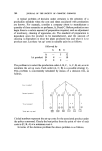
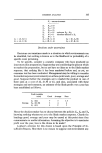
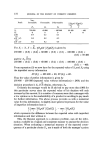
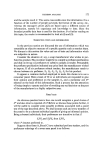
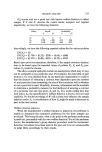
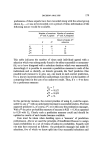
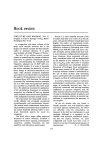
DECISION ANALYSIS 167 each particular one will prevail. The probabilities may either be objective or subjective in nature. Consider the situation of a marketing manager whose firm is contem- plating a special promotion for a new product during October and must decide upon the promotion now. Assuming his objective is profit maximi- zation over a specified period of time, there are two alternatives open to him X• approve the promotion, X: reject the promotion. It has been calculated the production and promotion costs will be oe100 000. No objective information is available concerning customer reaction, but it is assumed customer reaction can be measured on a three-point scale say, 'very favourable', 'favourable' and 'unfavourable'. The manager summa- rizes his feelings about the various categories in the following table. Very Profit favourable Favourable Unfavourable oe Zx Z• Za X•. 250 000 60 000 -- 100 000 X,, 0 0 0 p(Z) 0.4 0.3 0.3 p(Z) is a probability (subjective in this case) giving a measure of the mana- ger's personal degree of belief the various environments will prevail. It is suggested a decision should here be made on the basis of expected outcome, that is for each policy Xi, the choice is based upon x, In the present case, therefore, Xx ~ oe250 000 x 0.4 + oe60 000 x 0.3 - oe100 000 x 0.3 = oe88 000 X•~ oe0 x 0.4+ oe0 x 0.3 + oe0 x 0.3 =oe0 and policy Xx is chosen since it has the greatest expected value oe88 000. It is assumed here the decision-maker has no overpowering objection to the possible loss of oe100 000. Of course, the decision-maker will never actually get oe88 000 in any single case. Clearly his gain is fixed as one of oe250 000, oe60 000, moe100 000 or oe0. The interpretation of this result is: if the situation is as represented in the above table, and the identical decision has to be made not once but on numerous independent occasions, then the expected average return from policy Xx is oe88 000.

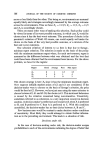
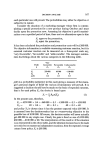
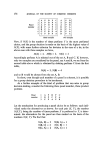
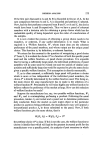
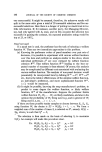
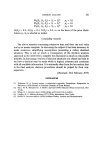
168 JOURNAL OF THE SOCIETY OF COSMETIC CHEMISTS An obvious problem here is, of course, determining the probabilities of customer reaction. Some objective evidence may be available based on experience with similar problems in the past. Either way, the marketing manager has his own opinion, albeit subjective, as to the likelihood of various events. With or without this approach the manager's decision will be based upon the available information such as it is. This particular format asks that his opinion become numerically explicit and that the decision be arrived at in a logical fashion, consistent with his beliefs. Further reading on this point of an introductory nature may be found in Raiffa (5) and Lindley (4). INFORMATION PROBLEM Only a rather unusual kind of marketing manager would seriously consider launching a new and untried product to the extent of a oe100 000 investment without some quantitatively based information as to the likely market response. Most probably he will spend some time and money so as to conduct a market survey to sample the response for his product. This being the case, how much should he be willing to pay for a market survey? It is suggested the value of information should be measured by the extent to which the expected return on a consequential decision increases due to its use. Let us return to the above problem and assume the information derived from a market survey is perfect, that is the correct environment would be determined. With this assumption we have for the expected return to be realized under a policy Xs--conduct a market survey and invest if the environment is found to be favourable and do not invest if unfavourable. Very favourable Favourable Unfavourable Profit Z• Z2 Za Xa 250 000 60 000 0 p(Z) 0.4 0.3 0.3 Here the probabilities express the marketing manager's degrees of belief the market survey will indicate each particular environment prevails. The expected value of ffa is seen to be oe118 000. Consequently, using a market survey, the manager would increase his expected gain by oe118 000--oe88 000
Purchased for the exclusive use of nofirst nolast (unknown)
From: SCC Media Library & Resource Center (library.scconline.org)