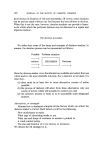
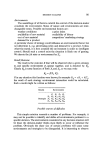
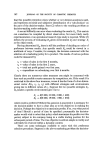
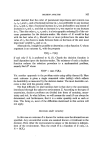
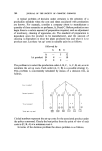
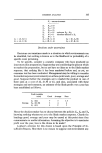
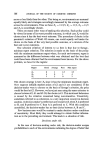
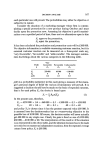
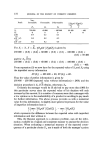
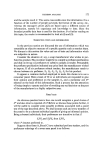
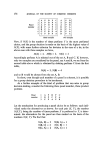
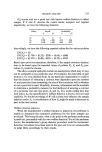
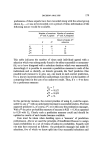
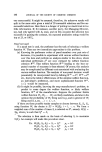
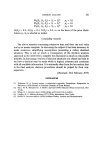
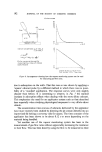
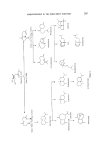
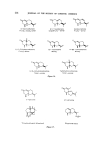
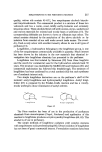
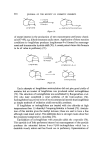
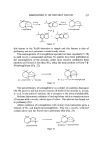
DECISION ANALYSIS 181 w,(&, &., &) = & = &* w,(&, &., &) = & = &* wo(&, &., &) = & = so* P4 = 0.1 P5 = 0.1 P6 = 0.1 = jV[D2) = 6,-, = v.o, •,t•,aJ ,.. th• basis of the prior distri- bution p, Sa is selected as tender. Concluding remarks The above remarks concerning subjective tests and their use and value are by no means complete. In discussing the subject it has been necessary to make numerous simplifying assumptions presenting a rather idealized situation. This is not so much a consequence of the decision analysis approach as the need here to simplify the discussion as much as reasonably possible. In discussing a variety of decision situations our object has been to see how a decision may be made which is logical, coherent and consistent with all available information. It is eminently clear from the last section that in the final analysis, decision procedures should be judged by their con- sequences. (Received: 23rd February 1973) (l) Pridmore, W. A. Sensory testing--a statistician's approach, Proceedings--Symposium on Perfumery (1970) (Society of Cosmetic Chemists of Great Britain). (2) Starr, M. K. Management: A Modern Approach (1971) (Harcourt Brace Jovanovich, New York). (3) White, D. J. Decision theory (1969) (Allen and Unwin Ltd, London). (4) Lindley, D. V. Making decisions (1971) (Wiley Interscience, New York). (5) Raiffa, H. Decision analysis (1970) (Addison-Wesley, London and Massachusetts).

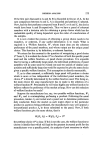
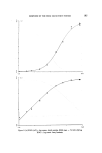
J. Soc. Cosmet. Chem. 25 183-202 (1974) ¸ 1974 Society of Cosmetic Chemists of Great Britain Response of the frog olfactory system to controlled odour stimuli T. MICHAEL POYNDER* Presented at the 2nd Joint Perfumery Symposium organized by the British Society of PerJkmers and the Society of Cosmetic Chemists of Great Britain at Eastbourne on 7-9th May 1973 Synopsis--The electrical events which occur in the nose of a frog when it is stimulated with ODORANTS have been studied. For this study new techniques were developed for applying STIMULI of known composition and controlled concentration in a reproducible manner. The concentration and timing of the stimuli in the nose cavity has been monitored by means of a new device consisting of a sampling probe connected to a FLAME IONIZATION DETECTOR. The ranges of concentration used have been wider than those reported previously and the form of the relationship between concentration and response size is now seen more dearly. It is that to be expected for a Langrnuir type ADSORPTION of odorant molecules on the RE- CEPTOR surface. INTRODUCTION This investigation concerns the slow changes of electric potential which take place at the surface of an animal's olfactory mucosa when it is stimulated by an odorant. These changes can be observed only in the region of the olfactory receptor cells and can be presumed to result from processes essential to olfactory perception. Their study should therefore help towards an understanding of the receptor mechanism. In practice the changes in electric potential are recorded using a pair of electrodes, one of small tip diameter placed on the surface of the olfactory *Bush Boake Allen Ltd, London El5 and the Department of Physiology, University College London, London WC1E 6BT. 183
Purchased for the exclusive use of nofirst nolast (unknown)
From: SCC Media Library & Resource Center (library.scconline.org)