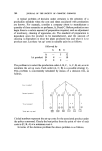
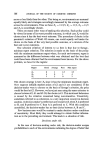
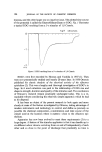
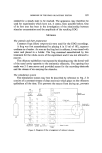
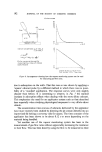
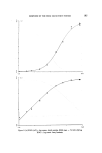
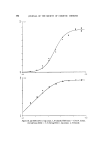
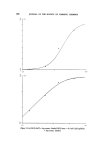
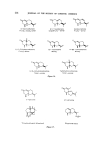
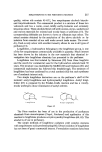
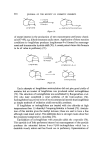
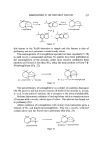
200 JOURNAL OF THE SOCIETY OF COSMETIC CHEMISTS 12(a} and 13(a)and the logarithms (base 10} of the EOG's are in Figs 9(b}, 10(b), il(b) 12(b) and 13(b). Thus for each experiment there is a pair of graphs. representing the same data in two different ways: (a) log stimulus v. response, and (b) log stimulus v. log response. The curves drawn on the graphs represent a postulated mathematical relationship between stimulus and response analogous to 'the Langmuir adsorption isotherm (5). (See Discussion.) This postulated relationship contains only two arbitrary constants which define (a) the EOG for infinite stimulus concentration, and (b) the. stimulus concentration required for half'this' (hypothetical) maximum EOG. These constants have been chosen in the case of each experiment to make the curve fit the experimental points as closely as possible. The values of the maximum EOG's are shown in the legends under 'each figure. DISCUSSION In order to discuss the significance of the foregoing results it will be helpful to have a picture in one's mind of the events as far as they are known which give rise t,o an EOG. The origin of the potential is the electrical polarization which exists between the inside and outside of cells forming the olfactory epithelial layer. This layer is formed by a mosaic of mainly two kinds of columnar cells. One kind is the receptor cells and the other the supporting cells. Odorant molecules in the mucus overlying these cells spread by diffusion and interact with receptor sites which form some part of a'cell membrane. This interaction results in an increase of membrane permeability to certain ions. An ionic current then,flows Which depolarizes the receptor cell. (It is .this ,depolarization of the receptor cell which causes it to generate action potentials.) 'The ionic current' ,flOWS .in a circuit through receptor cell, supporting cell and' overlying mucU. s..Each of these components of the circuit contributes some resistance so that there is a potential difference between the surface of the mucus and the.bas,e of the receptor cells. The EOG is the summed effect of the 5 000 or so receptor cells which lie within range of the electrode tip. The magnitude of the EOG can therefore be considered in terms of the local circuits at cellular level. Suppose that the EMF of the circuit is E, that the active membrane has a variable resistance, R m, depending on presence of odorant and that the other resistances of mucus and tissue total Rt which is constant.

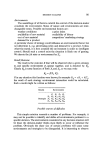
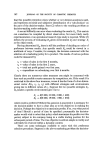
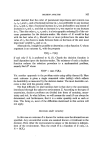
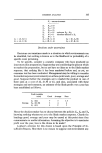
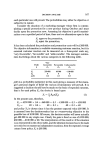
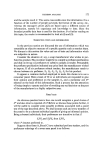
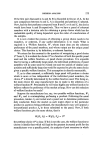
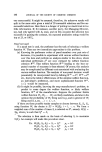
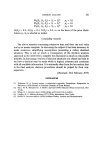
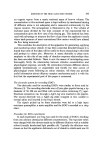
RESPONSE OF THE FROG OLFACTORY SYSTEM 201 Then the potential, Vt, across the constant resistance, Rt, is given by R t R t + R m If membrane conductance, Gm, is 1/R m then V t = E. Rt'Gm 1 + G m R t (1) If it is assumed that the membrane conductance is a linear function of odorant concentration, G m = k.c, then kc Vt = E'Rt' 1 + kc R t V is to be our estimate of the EOG so that EOG -• _,•c 1 + Bc ' where A and B are constants. Up to this point the argument has followed that of Tucke? and Shibuya (6). But the above assumption that the membrane conductance is a linear function of concentration is clearly not correct because a saturation must soon be reached. Instead let us assume that there is a limited number of gates in the membrane corresponding to a maximum conductance of G•. Then, analogous to the Langrnuir adsorption isotherm, we have kc 1 +kc where k is a constant. Combining this with equation (1) we get E. Rt.G•.k.c 1 + (k + Gu. Rt.k).c _,'•c so EOG - where A and B are constants as before. (2) 1 +Bc Therefore it may after all be expected that the EOG's would follow equation (2). The curves plotted on the graphs of results are in fact those obtained from equation (2) with values of A and B chosen to make them fit as well as
Purchased for the exclusive use of nofirst nolast (unknown)
From: SCC Media Library & Resource Center (library.scconline.org)