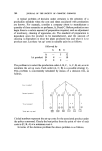
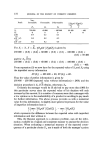
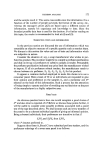
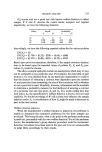
DECISION ANALYSIS 177 (Xa) tender and use a panel test with known welfare function to select sample. If S and S • denotes the events tender accepted and rejected respectively, we have the following situation: Policy Payoff Probability S S x S 0 0 0 1 700 -- 300 0.32 0.68 350 -- 550 0.48 0.52 Accordingly, we have the following expected values for the various policies EV(X•) = oe0 EV(X2) = oe2 700 x (0.32)- oe300 x (0.68) = oe660 EV(Xa) = oe2 350 x (0.48)-oe550 x (0.52) = oe842 Based upon previous experience, therefore, if the sample selection decision were to be based upon the expected values of policies X•, X2 and -Ya, pro- cedure Xa would be chosen. The above example embodies numerous assumptions which may or may not be acceptable in any particular case. For instance, the data table of past tenders is in a very idealized form. In any particular organization it could be that the chances of obtaining a contract were dependent upon the number of, and particular firms competing, the size of the contract as well as whether or not a panel test is used. Hopefully, however, information will be available to determine a probability measure for the likelihood of securing a contract of a particular size and type given ,Y• and Xa. It is worth noting here that with policy X•, the manufacturer's welfare function is known, but not used explicitly. No doubt knowledge of W will in some way influence the sample selection under X2. A consideration of how Xa might be made is discussed in part in the next section. Welfare function unknown When the manufacturer's welfare function is unknown, the perfumer is unable to determine the customer's preference for the three samples say produced. This being the case, what is the point in the perfumer performing a panel test, presumably with his own welfare function ? For all the perfumer knows, the manufacturer's group decision procedure could be incoherent! Selection procedures have been used in the past and it is not unreasonable to judge them accordingly by their results.

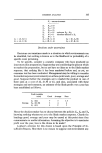
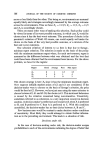
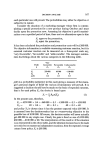
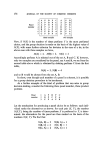
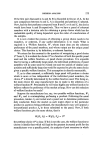
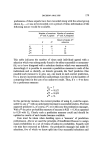
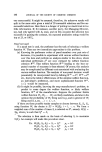
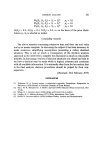
178 JOURNAL OF THE SOCIETY OF COSMETIC CHEMISTS Past selection decision could be analysed according to contract value, expected profit, number and type of competing companies, whether or not a panel test was used, etc., and the recommended selection procedure based upon this analysis. Suppose, for the sake of simplicity, it appears reasonable to assume the likelihood of winning a contract is independent of the number of firms competing, and also the value of the contract. (If these assumptions are not valid, the same subsequent analysis may be performed but considera- tion restricted to, and based upon data from contracts within a value range, say oe8 000-oe10 000, and with a specific number of competing firms.) We have, therefore, information such as Number of contracts where the number of successful and unsuccessful tenders selected on the basis of a panel test (Xs) and a specific welfare function W are ns and ms etc. Based upon this information, the probabilities of successful tenders using and not using a panel test are respectively P(s Ixs)- ns p(slx)- ns . ns + go ns + ms On the basis of these probabilities the same cost analysis as before may be performed. Non-panel decision Under policy Xs, the selection of the tender sample is made within the company without recourse to a panel test. Presumably the decision or selection criterion is some function of the considered opinion of perhaps a (•) the chief perfumer a © the marketing manager and a © the produc- tion manager. Each of these individuals has his own opinion as to the most likely candidate to submit as a tender and this opinion is based on his or her own subjective understanding and knowledge of perhaps current trends and fashions in perfumery, or even upon some subconscious consideration. If the individual
Purchased for the exclusive use of nofirst nolast (unknown)
From: SCC Media Library & Resource Center (library.scconline.org)