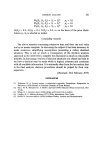
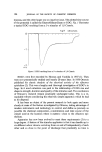
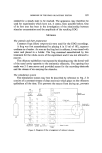
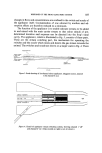
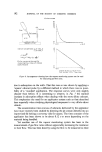
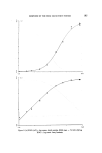
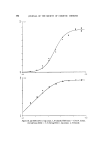
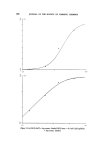
202 JOURNAL OF THE SOCIETY OF COSMETIC CHEMISTS possible the experimental points. The curves fit well especially having regard to the wide range of concentrations used and there is no evidence to suggest that the relationship is other than that deduced. Earlier researchers (2, 7 and 8) have worked with smaller concentration ranges. When their results were plotted on log-log axes, the points fell approximately on straight lines implying a power function relationship. The lines for different substances had different gradients and it was thought that the gradients (exponents) were characteristic of the substance. The results of the present study have also been plotted on log-log axes and it can be seen that for low concentrations the relationship is indeed practically linear. However, in no case is there suggestion that the gradient is other than 1 for low concentrations. Another feature of the results is that there is no evidence for a threshold concentration below which there is no EOG response. In conclusion it may be noted that the sense of smell now seems to fall into line with other senses in following a stimulus-response relationship which is sigmoidal in form when plotted on semi-log paper. ACKNOWLEDGMENTS I would like to thank my employers, Bush Boake Allen Ltd, for allowing me to pursue this research and for grants for equipment. I also thank the Medical Research Council for grants for equipment and colleagues at University College London for help and encouragement--especially Hugh Bostock. (1) Hosoya, Y. and Yashida, H. Ueber die bioelektrische Erscheinungen an der Riechschleim haut. Jap. J. Med. Set. 3 Biophys. 8 22 (1937). (2) Ottoson, D. Analysis of the electrical activity of the olfactory epithelium. Acta Physiol. Scand. 35 suppl. 122 1 (1956). (3) Bostock, H. and Poynder, T. M. Apparatus for delivering and monitoring a sequence of odour stimuli. o r. Physiol. 224 14P (1972). (4) British Patent Appln. 10851/72. (5) Langmuir, i. Adsorption of gases on plane surfaces of glass, mica and platinum. J. Amer. Chem. $oc. 40 1361 (1918). (6) Tucker, D. and Shibuya, T. A physiologic and pharmacologic study of olfactory receptors. $yrnl•. Qualitat. Biol. 30 207 (1965). (7) Drake, B., Johansson, B., Sydow, E. yon and Dqbving, K. B. Quantitative psychological and electrophysiological data on some odorous compounds. Scand. J, Psychol. 10 89 (1969). (8) Ottoson, D. The electro-olfactogram. Handbook of Sensory Physiology Vol. IV/I95 (1972) (Springer-Verlag, Berlin).

J. Soc. Cosmet. Chem. 25 203-231 (1974)¸ 1974 Society of Cosmetic Chemists of Great Britain Sesquiterpenes industry in the perfumery H. R. ANSARI and A. J. CURTIS* Presented at the 2nd Joint Perfumery Symposium organized by the British Society of Perfumers and the Society of Cosmetic Chemists of Great Britain at Eastbourne on 7-9th May 1973 Synopsis--The developments in SESQUITERPENOID CHEMISTRY are reviewed with especial reference to their application in PERFUMERY. Sesquiterpenes are the group of terpenoids which are formed by the combination of three isoprene units and are found widely distributed in many essential oils in the high boiling fraction. These represent a collection of highly complex and diverse structural systems. Although certain ses- quiterpene-based essential oils, such as oil of sandalwood and vetiver, have been used in perfumery since antiquity, the detailed study of sesquiterpene chemistry commenced only about 20 years ago. This progress has been possible mainly due to modern methods of isolation, structural determi- nation and synthesis. It is generally believed that the future of our industry lies in simulating as many essential oils as possible and hence lessen its dependence on the natural oils. In this respect the detailed and more comprehensive analysis of essential oils is revealing that many commercially important oils contain a number of sesquiterpenes which are important to the overall odour of such oils. Consequently, in many cases the scope of commercially producing synthetic oils will depend on the availability of *Buah Boake Allen Ltd, London El5. 2O3
Purchased for the exclusive use of nofirst nolast (unknown)
From: SCC Media Library & Resource Center (library.scconline.org)