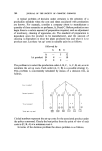
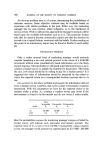
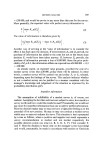
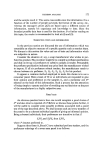
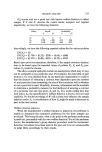
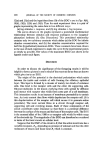
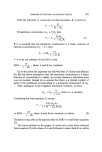
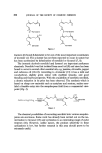
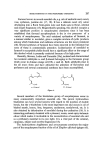
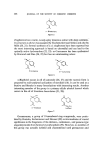
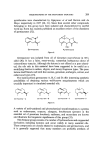
DECISION ANALYSIS 171 In words, the probability of an environment being Z, given information X, is the probability of Z and X divided by the probability of obtaining infor- mation X. Since p(Z and X) -- p(X and Z), we have p(Z IX) p(X) = p(X I Z) p(Z). (4) Returning to our problem, the manager has a prior distribution p(Z) for the probability that various environments will prevail, and based solely on this information would make a decision on the basis of that policy X i which maximizes his expected return Y_,Rop(Zj). J Having now received the information X, say, of the survey, presumably the manager can be expected to 'revise' his probability distribution from p(Z) to p(Z [ X) that is the probability of Z given information X. This being the case, the expected return on policy X• is now which using (4) becomes In the particular case under discussion, there are two possible pieces of (1) information X resulting from the survey: X--a favourable environment and therefore advise invest, and X--an unfavourable environment. For each value of X, the policy leading to the greatest expected value will, of course, be selected. This being so, the expression may accordingly be written EV(Xi) = Zlmax ZR•p(X I Zj)p(Zj)} x• t J (1) (2) -- max Y-,RoP(XI Zj)p(Z j) + max ZRup(xIgj)p(gj). i j i j (5) Suppose, for the purpose of demonstration, an analysis of past experience with survey tests indicates they can be expected to give the correct result some 80•o of the time (it is assumed the statement 'correct result' in this context is understood). This being so, we have the following situation.

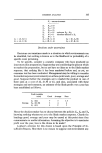
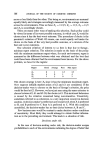
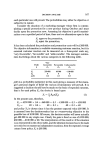
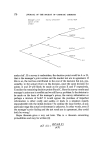
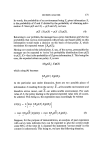
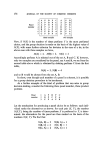
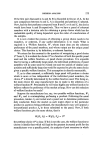
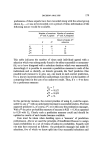
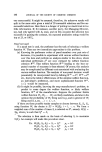
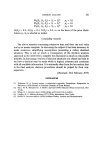
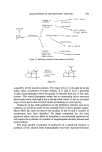
172 JOURNAL OF THE SOCIETY OF COSMETIC CHEMISTS Very Profit favourable ml Favourable Unfavourable Z Rop(X Zj)p(Zj) j (1) (2) Z• Za X X Xx 250 000 60 000 - 100 000 x• o o o p(Z) 0.4 0.3 0.3 (1) pur I z) 0.8 0.8 0.2 (2) p(x I z) 0.2 0.2 0.8 88 400 - 400 0 '0' (1) For X i = X, X = Xx, I Rep(X I Z•)p(Z.•) is given by 250 000 x (0.8) x (0.4) + 60 000 x (0.8) x (0.3) - 100000 x (0.2) x (0.3) = 88 400 (2) and for Xx, X by 250000 x (0.2) x (0.4) + 60 000 x (0.2) x (0.3) - 100 000 x (0.8) x (0.3): - 400. From expression (5) we now have for the expected value of Xx and X2 using the imperfect survey information EV(XO = oe88 400 + oe0, EV(X•) = oe0. Thus the value of perfect information is given by oe88 400 - oe88 000 (expected value without information) = oe400, and the (2) decision procedure is Xx if X obtains, otherways X•.. Evidently the manager would be ill advised to pay more than oe400 for this particular survey since the expected value of his decision will only increase by this amount. It is a matter of common sense that a manager with a low opinion as to the marketability of a product is unwilling to pay much for further information. The above process provides us with a numerical value for this information. A slightly more general expression for the value of imperfect information here is Zoemax ZR, P(XIZ•)p(Zj) } - max ZR•jp(Z•) z•. i j j j which represents the difference between the expected value with imperfect information and that without it. This, the Baysian approach to a decision problem, uses all the infor- mation available in a logical and consistent manner to analyse the decision situation. When evaluating a numerical measure of the expected conse- quences of a particular choice Xi, use is made of both the manager's priors
Purchased for the exclusive use of nofirst nolast (unknown)
From: SCC Media Library & Resource Center (library.scconline.org)