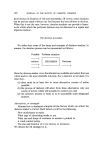
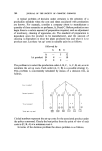
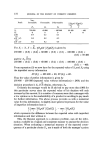
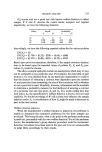
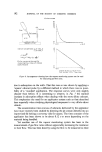
168 JOURNAL OF THE SOCIETY OF COSMETIC CHEMISTS An obvious problem here is, of course, determining the probabilities of customer reaction. Some objective evidence may be available based on experience with similar problems in the past. Either way, the marketing manager has his own opinion, albeit subjective, as to the likelihood of various events. With or without this approach the manager's decision will be based upon the available information such as it is. This particular format asks that his opinion become numerically explicit and that the decision be arrived at in a logical fashion, consistent with his beliefs. Further reading on this point of an introductory nature may be found in Raiffa (5) and Lindley (4). INFORMATION PROBLEM Only a rather unusual kind of marketing manager would seriously consider launching a new and untried product to the extent of a oe100 000 investment without some quantitatively based information as to the likely market response. Most probably he will spend some time and money so as to conduct a market survey to sample the response for his product. This being the case, how much should he be willing to pay for a market survey? It is suggested the value of information should be measured by the extent to which the expected return on a consequential decision increases due to its use. Let us return to the above problem and assume the information derived from a market survey is perfect, that is the correct environment would be determined. With this assumption we have for the expected return to be realized under a policy Xs--conduct a market survey and invest if the environment is found to be favourable and do not invest if unfavourable. Very favourable Favourable Unfavourable Profit Z• Z2 Za Xa 250 000 60 000 0 p(Z) 0.4 0.3 0.3 Here the probabilities express the marketing manager's degrees of belief the market survey will indicate each particular environment prevails. The expected value of ffa is seen to be oe118 000. Consequently, using a market survey, the manager would increase his expected gain by oe118 000--oe88 000

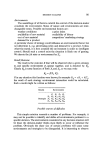
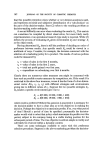
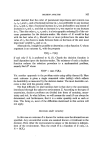
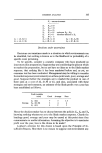
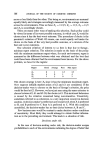
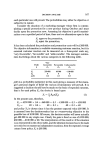
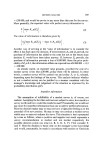
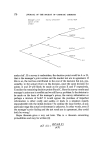
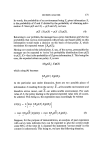
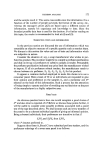
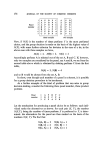
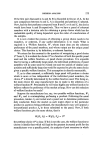
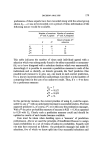
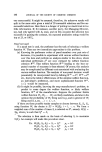
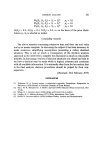
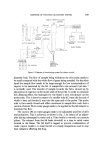
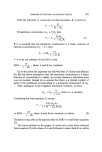
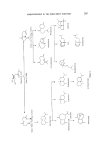
DECISION ANALYSIS 169 = oe30 000, and would be unwise to pay more than this sum for the survey. More generally, the expected value with perfect survey information is •Z {m•.ax R ii P(Zj) } . (2) The value of information is therefore given by ( Z•max Rijp(Z•)} - •ax Z R• p(Zi)} . (3) Another way of arriving at the 'value of information' is to consider the effect it has had upon the decision. If environments Zx and Z• prevail, the purchase of information has added to the costs but not to the return since decision X• would have been taken anyway. If, however Za prevails, the purchase of information prevents a loss of El00 000. Since the prior prob- ability of Za is 0.3, the information offsets an expected loss of E100 000 x 0.3 = •30 000. As already stated, on expected value grounds, provided the cost of a market survey is less than •30 000, policy three will be selected. In other words, a market survey will be carried out and policy X• or X• selected, depending upon the findings of the survey. This analysis indicates whether or not a market s•vey can be justified in a manner consistent with the manager's knowledge and judgement of the situation as expressed by his probability distribution p(Z). Imperfect information The assumption of infallibility of a market survey is, of course, not realistic. Accepting the fact that such tests are subject to error, how much is a survey worth and how would the results be used? Presumably one would not pay more for imperfect information than one would for perfect information. Here the decision-maker may or may not have a high prior feeling as to the potential of his new product. He may or may not conduct a market survey which may or may not endorse his views. This situation is best represented by a tree as follows, where a positive and negative test result represents a survey recommendation to market and not market respectively Six possible decision points can arise (A, B, C, D, E, F). First consider E. and F. Here the decision is based only on the manager's prior knowledge and would, presumably, be made in accordance with section on 'Decisions
Purchased for the exclusive use of nofirst nolast (unknown)
From: SCC Media Library & Resource Center (library.scconline.org)