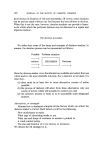
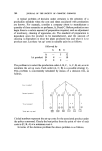
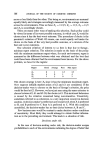
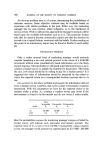
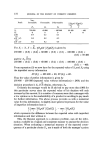
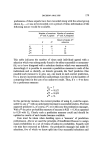
176 JOURNAL OF THE SOCIETY OF COSMETIC CHEMISTS Wx and W2 have been used could resolve this issue on the basis of expected increase in profit due to the selection procedures Wx and W2 respectively. The perfumer's tendering decision Consider now the situation of the perfumer when selecting a particular perfume to tender for a specific contract. In the normal course of events, the perfumer might create three or four possible candidates in response to the perfume specification and then choose one as a tender. How can this choice be made? There are two classes of problem here. (a) The perfumer knows the customer's (soap manufacturer) welfare function W. (b) The perfumer is ignorant of the customer's welfare function. Welfare function known Here the perfumer has the opportunity of performing a panel test himself and use the known welfare function to identify which, of his set of perfumes, would be the most desirable according to the customer, and so increase his chance of gaining the contract. How much is this increased chance worth to the perfumer? Suppose over the past 50 tenders submitted for similar types of contract, the following information is available. Number of tenders Number of contracts awarded X•--no panel test used 25 8 X•--panel test used 25 12 On the basis of this information, the probability of a successful tender given no panel test is used in its selection is p(sIXO = 8/25, = 0.32 and that when a panel test is used is P(S I X•) -- 12/25 = 0.48. This is a quantified expression of experience to date. Consider a new contract worth oe4 000 say, in which the development costs are oe300, and should the subsequent tender be accepted, expected production cost of oe1 000 would be incurred. If a panel test costs oe250, should it be used? The following actions are open, (X0 do not tender, (X•) tonder, but do not use a panel test,

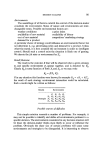
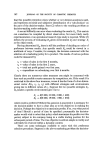
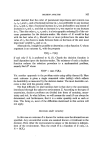
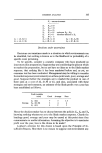
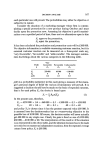
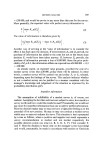
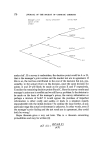
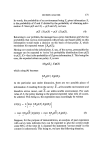
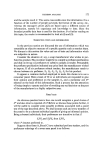
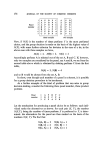
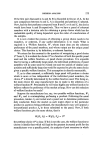
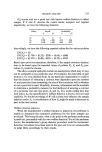
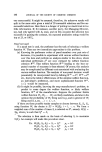
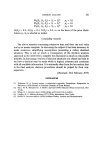
DECISION ANALYSIS 177 (Xa) tender and use a panel test with known welfare function to select sample. If S and S • denotes the events tender accepted and rejected respectively, we have the following situation: Policy Payoff Probability S S x S 0 0 0 1 700 -- 300 0.32 0.68 350 -- 550 0.48 0.52 Accordingly, we have the following expected values for the various policies EV(X•) = oe0 EV(X2) = oe2 700 x (0.32)- oe300 x (0.68) = oe660 EV(Xa) = oe2 350 x (0.48)-oe550 x (0.52) = oe842 Based upon previous experience, therefore, if the sample selection decision were to be based upon the expected values of policies X•, X2 and -Ya, pro- cedure Xa would be chosen. The above example embodies numerous assumptions which may or may not be acceptable in any particular case. For instance, the data table of past tenders is in a very idealized form. In any particular organization it could be that the chances of obtaining a contract were dependent upon the number of, and particular firms competing, the size of the contract as well as whether or not a panel test is used. Hopefully, however, information will be available to determine a probability measure for the likelihood of securing a contract of a particular size and type given ,Y• and Xa. It is worth noting here that with policy X•, the manufacturer's welfare function is known, but not used explicitly. No doubt knowledge of W will in some way influence the sample selection under X2. A consideration of how Xa might be made is discussed in part in the next section. Welfare function unknown When the manufacturer's welfare function is unknown, the perfumer is unable to determine the customer's preference for the three samples say produced. This being the case, what is the point in the perfumer performing a panel test, presumably with his own welfare function ? For all the perfumer knows, the manufacturer's group decision procedure could be incoherent! Selection procedures have been used in the past and it is not unreasonable to judge them accordingly by their results.
Purchased for the exclusive use of nofirst nolast (unknown)
From: SCC Media Library & Resource Center (library.scconline.org)