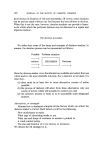
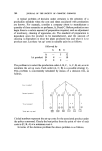
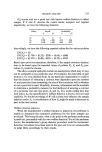
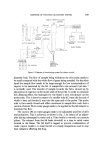
160 JOURNAL OF THE SOCIETY OF COSMETIC CHEMISTS good choices in situation of risk and uncertainty. Of course, many decisions can be and are made without any fuss because the best solution is obvious. When this is not the case, however, decision analysis can provide a frame- work within which the pertinent decision may be discussed in a logical and objective fashion. The decision procedure We define here some of the terms and concepts of decision analysis. In essence, the decision process can be represented as follows' Possible Problem situation actions DECISION Outcome Here the decision-maker views the alternatives available and selects that one which leads to the most desirable outcome. For a decision to be taken, it is clear that: (a) there must be at least two or more alternative courses of action possible (b) the process of decision will select from these alternatives only one course of action which will actually be carried out and (c) the selection process is made so as to accomplish some designated purpose. Alternatives, or strategies Alternatives or strategies comprise all the factors which are within the decision-maker's control. Such factors could be the following. How much/many to make. What type of advertising media to use. What size and shape of container to market a product in. A stock control policy. The size and location of a new factory or extension. We denote the ith strategy by X i.

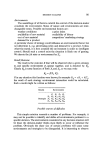
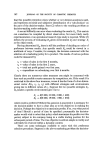
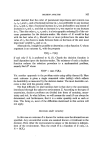
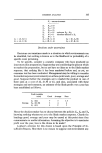
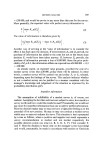
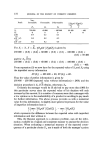
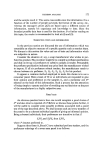
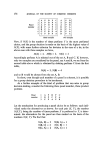
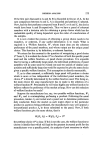
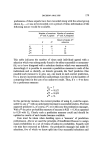
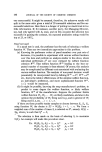
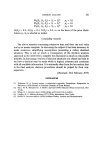
DECISION ANALYSIS ] 61 Environments The assemblage of all factors outwith the control of the decision-maker constitute the environment. States of nature and environments are inter- changeable terms. Possible environmental factors are: weather conditions a price index availability of raw material availability of labour cost of raw material competitors' marketing strategy demand for a product A particular choice of strategy could influence an environmental factor but not determine it, e.g. advertising policy and demand for a product. Unless otherwise stated, it is here assumed the environment is under no intelligent control. Should such a control exist the situation is likely one of gaming. We denote the jth state or environment by Z•. Result/Outcome The result is the outcome R that will be observed when a given strategy X i and specific environment Zj appear together, and is denoted by Clearly R•j is some function of both X• and Zj, so we may write Rv = f(X,, Z•). If in any situation this function were known, for example R u = aX• + bZ'j, the result of each strategy environment interaction could be calculated. Such a result might be written as follows: Results Environments Zx Z• Z8 Z• X• R• R•2 Rx8 R• Strategies X• R• R• R•8 R• Possible sources of difficulty This simple notation conceals a number of problems. For example, it may not be possible to identify and define all environments pertinent to a specific decision. The environments considered in any decision situation will be those the decision-maker thinks most likely to occur or influence the problem. Obviously the sheer size of certain problems will cause some environments and strategies to be disregarded. It is interesting to observe
Purchased for the exclusive use of nofirst nolast (unknown)
From: SCC Media Library & Resource Center (library.scconline.org)