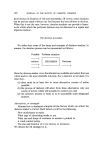
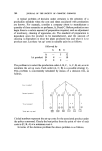
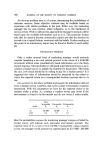
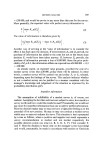
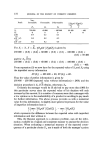
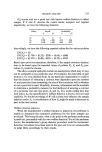
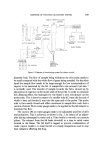
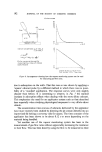
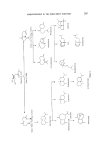
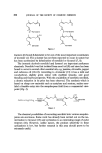
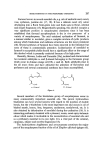
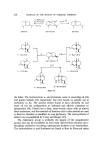
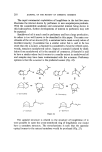
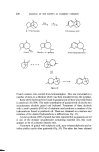
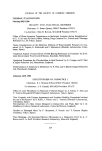
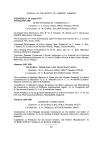
164 JOURNAL OF THE SOCIETY OF COSMETIC CHEMISTS A typical problem of decision under certainty is the selection of a production schedule when the cost and times associated with production are known. For example, consider a company about to manufacture a quantity of three cosmetics or perfumes, A, B and C. Before production can begin there is a certain amount of preparation required, such as adjustment of machinery, cleaning of apparatus, etc. The standard of preparation is dependent upon the product to be manufactured, and the amount of cleaning is dependent on what the plant produced last and what it is to produce next. Let these 'set up' costs in suitable units be as follows. followed by A B C A -- 5 12 1st product B 4 -- 10 C 8 2 The problem is to select the production order A, B, C, A, C, B, etc, so as to minimize the set up costs. Each order (A, C, B) is a possible strategy X•. This problem is conveniently tabulated by means of a decision tree, as follows. First product Second product Third product Totol set-up c, ost A C Circled numbers represent the set-up costs for the associated product under the policy concerned. Clearly the best policy from the point of view of such costs is (C, B, A) at a minimum cost 6. In terms of the decision problem the above problem is as follows.

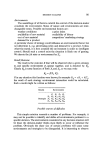
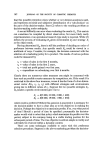
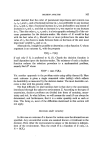
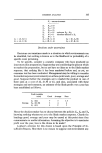
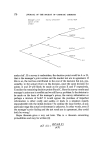
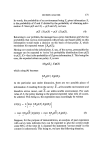
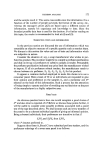
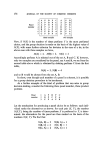
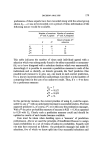
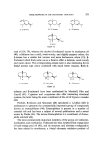
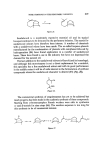
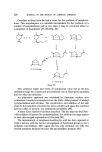
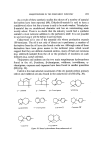
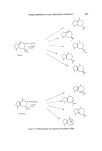
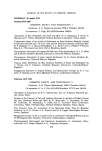
DECISION ANALYSIS 165 Zx - one environment X X: R:• ----- 14 Xa Ra• = 16 Xa R =18 optimum R/j - Xa R: =13 therefore decision is X• Ra•= 6 x, = (A, B, C) X• = (8, A, C) X• = (C, A, B) x2 = (A, C, B) X• = (B, C, A) X• = (C, B, A) Decisions under uncertainty Decisions are sometimes made in a situation in which environments can be identified, but nothing is known as to the likelihood or probability of a specific event pertaining. To be specific, consider a cosmetic company who have produced an innovatory skin preparation. Suppose they are considering the price at which to market the preparation, but as yet have no ideas as to the likely market response, that nothing like it has been marketed before and, as yet, no consumer test has been conducted. Management may be willing to consider themarketresponse (environments) on a three-point scale, poor, average and good. Suppose further the strategies are to market the product in one of three sizes at a cost of oe2, oe1.50 or oe1, and also, associated with these strategies and environments, an estimate of the likely profit over a year has been established as follows. Strategy Profit (suitable units) Good Average Poor x• (oe2) 7 3 X2 (oe1.50) 3 4 4 x• (oeD 4 2 Hence the decision-maker has to choose between the policies Xx, .Y• and X3 knowing nothing whatsoever as to the likely market response. Clearly the headings good, average and poor may be erased at this point since they communicate no usable information. Assuming the objective is to maximize profit over the year, how is the choice to be made? Laplace's criterion for this choice is based upon the Principle of In- sufficient Reason. Here there is no reason to suppose one environment any
Purchased for the exclusive use of nofirst nolast (unknown)
From: SCC Media Library & Resource Center (library.scconline.org)