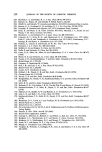
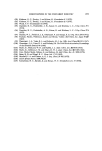
SESQUITERPENES IN THE PERFUMERY INDUSTRY 231 (92) (93) (94) (95) (96) (97) (98) (99) (lOO) (101) (102) (103) (104) (105) (106) (107) Kitshens, G. C., Dersky, J. and Kaiser, K. GivaudanJan 1 3 (1971). Kitshens, G. C., Dersky, J. and Kaiser, K. GivaudanJan 2 9 (1971). Wood, T. F. GivaudanJan I 3 (1970). Daeniker, H. U., Hochstetler, A. R., Kaiser, K. and Kitshens, L. C. J. Org. Chem. 37 1 (1972). Daeniker, H. U., Hochstetler, A. R., Kaiser, K. and Kitshens, L. C. J. Org. Chem. 37 6 (1972). Dauben, W. L., Freidrich, L. E., Oberhansli, P. and Aoyagi, E. I. J. Org. Chem. 37 9 (1972). Tsubaki, Naoko, Nishimura, Kiichi and Hirose, Yeshie. Bull Chem. Sec. Japan 59 407 (1967). Wenninger, J. A., Yates, R. L. and Dolinsky, M. J. Ass. O•c. Anal. Chem. 501313 (1967). Wenninger, J. A., Yates, R. L. and D olinsky, M. The Toilet Goods Association, Proceedings of the Scientific Section 44 (1966). Buchi, G., MacLeod, W. D. and Padilla, J. J. Amer. Chem. $oc. 86 4438 (1964). Buchi, G., Goldman, I. M. and Mayo, D. W. J. Amer. Chem. Sec. 88 3109 (1966). Cren, Marie-Claude, Defaye, G. and Fetizon, M. Bull. Chim. Sec. Ft. 3020 (1970). Bates, R. B. and Slagel, R. C. Chem. Ind. 1715 (1962). Marshall, J. A. and Greene, A. E. J. Org. Chem. 37 982 (1972). South African Patent, 6904,445,07. Kretschmar, H. C., Bameis, Z. and Erman, W. F. Tetrahedron Lett. 37 (1970).

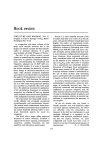
Book review STRUCTURE AND BONDING. Vol. 12. Progress in Theory. Springer Verlag, Berlin- Heidelberg-New York. In comparison with three volumes of the series most recently reviewed this is the largest and almost certainly the least directly useful to practical chemists. It is quite appropriately sub-titled 'Progress in Theory'. The first of six articles reviews revived interest in quantifying the concept of electron interaction in quantum mechanical calcula- tions, notwithstanding the widespread and frequently adequate use of SCF (self con- sistent field) models. In a series of examples the author evaluates the sensitivity of corre- lation energy to structural alternatives, con- siders other physical properties dependent upon electron correlation (EC), and questions the need for all calculations to start with, and be refined from, SCF functions. In his simple (ammonia 'flip' and ethane rotation) examples EC is of little value but equilibrium distance and one-electron properties offer more scope for it. He selectively examines the application of EC perturbation treatments to molecular properties but whether EC has any physical reality depends upon the absolute significance of the independent particle models chosen. The importance and remarkable variety of Cu(I1) chelates has prompted exceptional crystallographic and spectroscopic interest. The second article substantiates some theor- etical models and represents data compiled by the author hopefully allowing others to con- struct theoretical spectra for novel Cu complexes. The third, short, paper offers empirical treatment of cation solvation. Evidence is adduced from donor capacity, polarographic reductions, complex formation, ion pair equilibria and absorption spectroscopy. 233 Fourth is a most readable account of the so-called 'acid salts' of a variety of carboxylic acids, with special reference to hydrogen bond lengths. The author, an experienced crystal- lographer, draws heavily on X-ray and neutron diffraction evidence in discussing salts of the M(HXo•) and MX.HX types and more com- plex examples, giving dimensional data and, in most instances, configurational representa- tions. However, those concerned with par- tially neutralized soaps will be disappointed by the absence of any reference to the acid salts of C•2/C•8 acids. The review is rounded with a generalized and admittedly tentative discussion of hydrogen bond participation, taking some account of IR and NQR spec- troscopic evidence. Interest is maintained by the use of short sections each discussing known carboxylate salts in amiable prose free of jargon and free of mathematical physics. In contrast, the last two papers are abstruse mathematical contributions, using the tech- nique of irreducible tensorial sets. One is exclusively concerned with deriving coupling coefficients in quantum integrals and the other analyses harmonic situations potentially of value in calculating spectra of adducts, and which may generate orbitals of pictorial sig- nificance in understanding the geometry of the complex. Of the six articles only the fourth is directly readable--and, with additions, might well merit separate republication the others are definitely only for consultation on demand. In the first four mathematics is used sparingly although it is necessary to be familiar with quantum mechanical jargon the last two papers, however, are quite indigestible and would have been more at home in a journal of mathematical physics or spectroscopy G.F. PHILLIPS
Purchased for the exclusive use of nofirst nolast (unknown)
From: SCC Media Library & Resource Center (library.scconline.org)