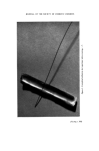
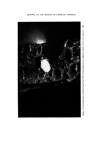
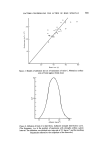
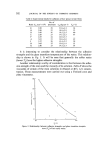
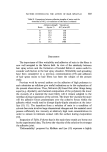
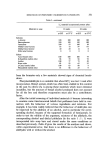
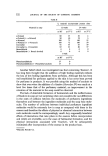
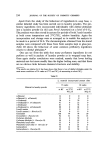
FACTORS CONTROLLING THE ACTION OF HAIR SPRAYS-II 305 CONCLUSIONS The technology of non-woven bonded fabrics and of the production of fabrics with anti-felting properties may be usefully compared to the pro- cesses occurring when hair sprays are applied to hair. Thus, M/Sschler (15) and Tikhomirov (16) have both demonstrated that the production of bonded fabrics involves the formation of resin bridges between fibres and at fibre intersections. The resin bonds in non-woven fabrics can be formed in the same manner as those formed when using a hair spray, i.e. from a solution of the resin, or by alternative techniques such as the use of polymer melts or aqueous dispersions. Various workers have attempted to characterize the types of bonding found in bonded fabrics (17, 18). There appear to be three main types of bond simple, parallel and complex (17). The simple bonds involve only two fibres, approximately at right angles parallel bonds involve two fibres bonded side by side, while complex bonds involve more than two fibres which are sufficiently dose to be included in the same resin bond. Measurements of adhesion of hair spray resins to hair fibres have shown that for several commercially available resins the adhesive strengths are in the range 14-22 kg cm -a. Tikhomirov and Gusev (4) have reported the value 40.1 kg cm -• for the adhesion of epoxy resin to wool fibres. Certain general trends are noticeable from the results. For example, the greatest adhesion is found for resins which give solutions of lower viscosity. This is in agreement with previous observations on the adhesion of high polymers to such substrates as cellulose and it is considered essen- tial that a good adhesive should have a low viscosity in solution in order that the resin remains in intimate contact throughout the dimensional changes accompanying the loss of solvent. Intimate interfacial contact is essential for good adhesion since the adhesive bonds act only over very small distances. Similarly the adhesive strength shows a general increase with the soft- ness or deformability of the resin. Again reference to earlier adhesion studies shows that deformability allows stresses, set up on drying of the adhesive, to be dissipated. If such stresses cannot be dissipated they may cause shattering of the joint when any subsequent stress is applied. Deform- ability is also needed to allow flexing or bending of the joint. This latter condition will promote lasting hold in a hair spray.

306 JOURNAL OF THE SOCIETY OF COSMETIC CHEMISTS ACKNOWLEDGMENT The author wishes to thank Mr P. J. Petter for supplying the viscosity data used in this study. (Received: 20 October 1973) REFERENCES (1) (2) (3) (4) (5) (6) (7) (8) (9) (10) (• 1) 02) (13) (14) 05) (16) (17) (18) 09) Feldtman, H, D. and McPhee, J. R. The spreading and adhesion of polymers on wool. Text. Res. J. 34 634 (1964). Tikhomirov, V. B. The influence of adhesion on the strength of cemented fibrous materials. Dokl. Akad. Nauk. SSSR 167 207 (1966). Hearle, J. W. S. and Newton, A. Non-woven fabric studies. XVt: The behaviour of model systems of bonded fibres. Text. Res. J. 38 488 (1968). Tikhomirov, V. B. and Gusev, V. E. Analysis of the structural and mechanical properties of bonded non-woven fabrics. Tech. Text. Ind. USSR 1 103 (1966). McBain, J. W. and Hopkins, D. G. J. Phys. Chem. 29 188 (1925). McBain, J. W. and Lee, W. B. Adhesives and adhesion. Mechanical properties of films of adhesives. Ind. Eng. Chem. 19 1005 (1927). Shiryaeva, G. V., Gorbatkina, Yu. A. and Andreevskaya, G. D. Methods for determining the adhesion of polymers to the surface of glass fibres. Russ. J. Phys. Chem. (English trans.) 37 123 (1963). Rance, R. W. Particle size distribution measurement of hair sparys using an image-splitting particle size analyser. J. Soc. Cosmet. Chem. 23 197 (1972). McLaren, A.D. Adhesion of high polymers to cellulose. J. Polymer Sci. 3 652 (1948). Josefowitz, D. and Mark, H. Stickiness, tackiness and spinnability. India Rubber Worm 106 33 (1942). McLaren, A.D. and Hofrichter, C. H. Temperature dependence of the adhesion of high polymers to cellulose. Ind. Eng. Chem. 40 329 (1948). McLaren, A.D. and Hofrichter, C. H. Theory of the adhesion of high polymers to cellulose. Pap. Trade J. 125 96 (1947). McBain, J. W. and Lee, W. B. Adhesives and adhesion: relation of joint strength to tensile strength of films. J. Soc. Chem. Ind. London 46 321T (1927). Alexander, P. Non-shrink processes for wool. J. Soc. Dyers Colour. 66 351 (1950). MOschler, W. The structure and properties of bonded fabrics. Deut. Textiltech. 18 74 (1968). Tikhomirov, V. B. Manufacture and properties of non-woven textile materials made with thermoplastic binders. Deut. Textiltech. 17 300 (1967). Hill, D. D. and Michie, R. I. C. Non-woven fabric studies. IX: Characterization of binder distribution. Text. Res. J. 36 787 (1966). Zeronian, S. H. and Wilkinson, J. Non-woven fabric studies XI: Binder distribution effects. Text. Res. J. 36 866 (1966). Rance, R. W. Studies of the factors controlling the action of hair sprays. J. Soc. Cosmet. Chem. 24 501 (1973).
Purchased for the exclusive use of nofirst nolast (unknown)
From: SCC Media Library & Resource Center (library.scconline.org)