326 JOURNAL OF THE SOCIETY OF COSMETIC CHEMISTS HISTORY Several workers have tried to develop instrumental analytical tech- niques to study the loss of perfumery ingredients, particularly with respect to soap. Stiras and Demeilliers (1), for instance, developed a technique of analysing by glc the vapour surrounding unwrapped perfumed soap after storage under various conditions. Although some conclusions could be drawn from the data obtained, the authors were unable actually to observe what was taking place inside the soap itself. One question they were trying to answer was which materials had the highest 'perfumery value'. Derivichian (2) had stated earlier that esters have higher perfumery values than alcohols. Stiras and Demeilliers found from their experiments that the vapour from the soap contained higher proportions of esters (e.g. benzyl acetate) to alcohols than that which was found in the vapour from the perfuming liquid itself. Whether this proves a higher 'perfumery value' for the esters is debatable. It could be argued that the higher proportion of esters in the vapour emitted by soap shows that these materials are lost to a greater extent and that therefore less is available for the physical transfer of per- fume from the soap base to the skin. There has been conjecture that there is a virtually inexhaustible reservoir of perfume in the central core of a soap tablet and therefore the perfume ingredients are always available in their original proportion, but no concrete evidence was found to support this theory. It therefore became very desirable to discover exactly what happens inside the soap, by analysing samples directly. TECHNIQUES OF ANALYSIS Some early work that was carried out in Unilever involved the use of uv spectroscopy as a method of assessing the behaviour of perfumery ingredients. The materials benzophenone and anisaldehyde were incor- porated separately in soap and it was found when the ingredient was extracted with aqueous isopropanol that a reasonable uv spectrum of the ingredient could be obtained. Using this technique it was proved that for those materials studied, the rate of loss of the ingredients from an un- wrapped bar of soap is determined by the rate of diffusion of those materials through the soap matrix. This was achieved by measuring the concentration of the ingredients at various points along the axes from the centre to the surface. It was found that the concentration of the ingredients was highest

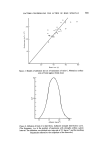
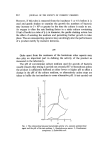
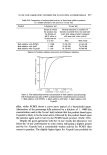
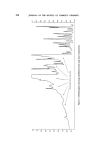
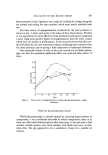
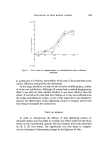
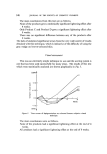
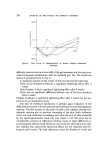
BEHAVIOUR OF PERFUMERY INGREDIENTS IN PRODUCTS 327 at the centre and lowest near the surface. Had the rate of evaporation from the surface been the rate determining step, then of course the concentrations at points along the axis would have-been identical. For some ingredients that were studied, e.g. benzophenone, no measur- able change in the concentration at the centre of the soap bar was observed after 24 weeks storage. This technique had many restrictions and could not be applied generally to the study of all perfumery ingredients. Firstly, there are only a limited number of materials used in perfumery which have uv absorbing properties. Secondly, the preparation of each sample for analysis is time consuming and, thirdly, the method does not identify possible breakdown products which may be either falsely identified as the original material or may be missed altogether. Any complex breakdown would of course be impossible to diagnose. A more generally applicable technique was therefore required and glc appeared to be the most promising. Previous workers have used this tech- nique, but they have all employed some cumbersome form of extraction procedure to isolate the perfume material prior to analysis. Although preliminary extraction techniques can be used for studies of a limited number of materials, it became desirable to develop a simpler, more straightforward system for studying a large number of perfumery materials under various storage conditions in different products. Such a straight- forward system has been used by Proprietary Perfumes Limited for about 4000 analyses with good results,'- The approach that was used was very simple. It involved placing small samples of the soap (or detergent) on the top of the glc column in the flash- heated zone, the idea being that the perfumery ingredients evaporate into the carrier gas, leaving the soap behind. Many who have tried this technique have found that the chromatogram is ruined by the presence of large peaks from the soap base, as shown in Fig. 1. This problem was overcome by utilizing a modified injection system. The sample is placed in a sample tube which is then inserted in the injection head the latter is then flushed with carrier gas. Once the correct column inlet pressure is reached the sample tube is injected into the flash-heated zone of the glc column. After a short period the sample tube is removed. In this way it was found possible to elute all of the perfumery ingredients from the sample without getting the undesired components from the base, some of which are probably produced by thermal breakdown. Complete elution of the ingredients was proved by the re-injection of the sample
Purchased for the exclusive use of nofirst nolast (unknown)
From: SCC Media Library & Resource Center (library.scconline.org)