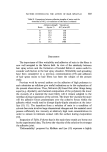
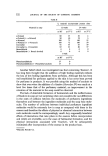
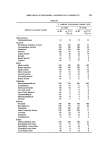
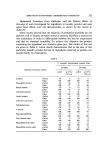
IN-USE AND LABORATORY METHODS FOR EVALUATING ANTIMICROBIALS 309 RESISTANCE AND SENSITIVITY OF BACTERIA Simple laboratory tests are usually performed according to the rules of well-established protocols and strict attention is usually paid to details like the temperature at which bacteria are grown, the temperature at which the test is carried out, the age of the culture etc., but attention to this kind of detail is not sufficient. Our knowledge of the relationship between the resistance of a culture of a particular organism grown in the laboratory and the same organism present on the skin is very scant. Table I illustrates the concentration of parachlorometaxylenol (PCMX) required to kill the same strain of Pseudo- monas aeruginosa when grown in two different culture media. A factor of 10 is involved in the concentration effectively killing the culture yet the only difference between the two culture media resides in the concentration of magnesium ions. The media growing (Table I) the more resistant culture Table I. Concentration of PCMX required to kill culture of Ps aeruginosa in medium containing either 4 ppm Mg •'+ or 40 ppm Mg 2+ Organism Culture medium contains 40 ppm Mg 2+ 4 ppm Mg •+ t's aeruginosa 2.4 mg g-X 0.15 mg g-X (NCTC 1999) t's aeruginosa 1.5 mg g-X 0.12 nag g-X (recent isolate) contains 36 ppm more Mg a+ ions than the media growing the sensitive culture. This is a very minor difference and unless one is aware of the problem it can be completely overlooked. Yet the penalites for doing so may be to reject a worthwhile antibacterial agent. This phenomenon has been repeated with every strain of Ps aeruginosa examined within the author's laboratory, including new isolates from patients suffering from Pseudomonas infections. Whilst these results are obtained in a synthetic medium, in which careful control can be maintained over each of the ingredients, an identical situa- tion can be achieved with the more complex nutrient media normally em- ployed in bacteriological laboratories, simply by removing certain ions by the use of ion exchange columns and then replacing them at the required levels. Moreover, differences in the resistance of Pseudomonas aeruginosa cultures grown in different complex culture media (e.g. Oxoid nutrient

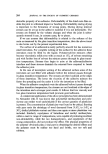
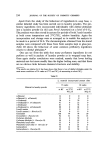
310 JOURNAL OF THE SOCIETY OF COSMETIC CHEMISTS broth and Oxoid nutrient broth No. 2) to PCMX and other halogenated phenols can be explained in part by the magnesium content of the media. The effect, however, is more complex and phosphate ions have been shown to influence still further the resistance of the culture. If Pseudomonas aeruginosa is transferred from a sensitive to a resistant type media, the culture becomes resistant within a few divisions and vice versa. The implications of these findings are important because they indi- cate that culture of this bacterium in the laboratory, even over a short period of time, can modify the resistance of the bacterium to such an extent that it cannot be related to the resistance of the organism in its natural state. The influence of the growth medium on resistance is not confined to Pseudomonas aeruginosa. The incorporation of either glucose or glycerol into the medium used for the growth of Staphylococcus aureus also causes an increase in the resistance of the organism to a number of antibacterial agents which are lypophilic in nature (2, 3). This increase in resistance can be related to an increase in the lipid content of the outer surfaces of S. aureus. Whether staphylococci and micrococci, which are present on the skin, possess substantial quantities of lipid in their outer coat has not yet been established and so the question must remain unanswered as to whether glucose should or should not be added to the media used for the growth of micrococci and staphylococci for testing antimicrobial products. Other, less well defined, factors also have a bearing on the resistance of staphylococci grown in the laboratory. Thus, filtering the growth media through filter paper during its preparation can have a profound effect on the subsequent culture dependent upon the type and grade of filter paper used (Table II). The difference in resistance probably arises from the absorption of certain minor components of the growth media on to the paper, but the difference highlights the influence that even minor components of a growth medium can exert on the resistance of a bacterium. Table II. Sensitivity of Staphylococcus aureus to PCMX when grown in FDA Broth filtered through different types of filter paper Concentration of PCMX required to Filter paper kill culture in 10 min but not in 5 min Green 803 0.45 mg g-• Whatroans No. 41 3.0 mg
Purchased for the exclusive use of nofirst nolast (unknown)
From: SCC Media Library & Resource Center (library.scconline.org)