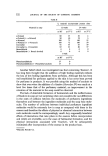
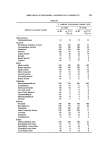
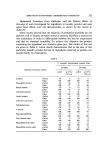
IN-USE AND LABORATORY METHODS FOR EVALUATING ANTIMICROB1ALS 31 [ The above observations are important for another reason also. The resistance or sensitivity shown by the bacterium is not universal to all antimicrobial agents, but is specific to certain types or groups of agent. Failure to recognize that such factors are imposing a possible unnatural resistance or sensitivity on a bacterial culture can lead to the selection of an agent which, whilst performing well in laboratory tests, can perform less satisfactorily in practice. Several factors have been highlighted here, but the question remains how many more, so far unrecognized, factors are influencing the resistance of the cultures used in the laboratory? AGE OF CULTURE Once a factor influencing resistance is established steps can be taken to control it. For example, the age of the culture often has a bearing on the resistance of an organism, and it is generally reported that older cultures are more resistant than younger ones. However, this is by no means true and the reverse may be equally true for certain bacteria. Thus, the individual worker must decide, very often quite arbitrarily, whether to use a young or old culture. Either way he cannot be certain whether the resistance is related to the resistance existing in practice. NUMBERS OF BACTERIA USED IN TEST SYSTEM It is well known that the number of organisms used in a test may con- siderably affect the results obtained, particularly if the antibacterial agent is one which is highly active by virtue of a large proportion of the molecules binding to the active site. In laboratory testing less emphasis is usually placed on using realistic numbers of bacteria, more emphasis being placed on using a standard number, somewhat higher than those known to occur naturally. It is believed that the excess numbers may offset to some extent the exclusion from laboratory tests of other inactivating factors known to occur in practice. Eighteen to twenty-four hour cultures grown in a nutrient broth are often used on the assumption that the numbers of bacteria from such a culture remain fairly constant. This assumption is, however, only correct if the culture is treated in an identical manner each time it is grown. For instance, a 24-h static culture of a typical test bacterium grown for the testing of an antiseptic will produce approximately 2 x 10⁸ organisms/g.

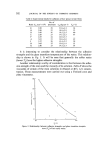
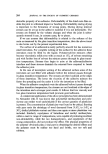
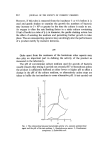
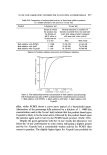
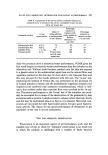
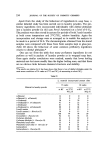
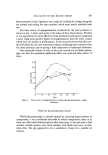
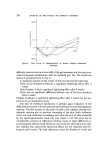
312 JOURNAL OF THE SOCIETY OF COSMETIC CHEMISTS However, if this tube is removed from the incubator 3 or 4 h before it is used and gently shaken to examine the growth the numbers of bacteria may increase to 5 x 10⁹ or greater by the time the culture is ready to use. As oxygen is often the rate limiting factor in a static culture containing 10 ml of broth in a tube of •-• in diameter, the gentle shaking action has the effect of aerating the medium and permitting further growth to take place. Thus an unsuspecting operator may unwittingly alter the performance of a product merely by excessive keenness. pH Quite apart from the resistance of the bacterium other aspects may also play an important part in defining the activity of the product as measured in the laboratory. The pH of conventional culture medium used for growth of bacteria usually ensures that testing is carried out around pH 7 or thereabouts unless the product is sufficiently buffered at either lower or higher pH to effect a change in the pH of the culture medium, or alternatively unless steps are taken to buffer the test medium to some alternative pH. A test carried out 33- 1000 I 6 7 8 pH Fig. 1. The relationship between bactericidal activity of a cationic antimicrobial agent and the pH of the test medium. 1, Staphylococcus aureus. 2, Pseudornonas aeruginosa. 3, Escherichia coli.
Purchased for the exclusive use of nofirst nolast (unknown)
From: SCC Media Library & Resource Center (library.scconline.org)