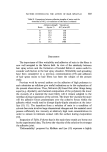
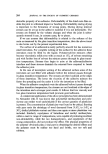
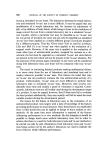
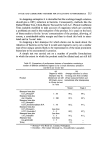
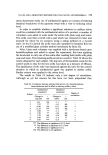
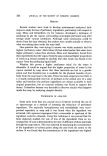
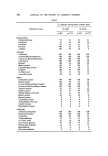
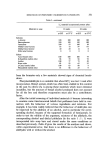
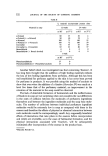
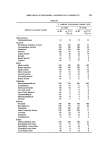
334 JOURNAL OF THE SOCIETY OF COSMETIC CHEMISTS Apart from the study of the behaviour of ingredients in soap base, a similar detailed study has been carried out in laundry powders. The per- fumery ingredients were incorporated individually with diethyl phthalate into a laundry powder (in this case Persil Automatic) at a level of 0.1•. The products were then stored in cartons for periods of both 3 and 6 months at both room temperature and 37øC/70• relative humidity. Again the incorporation and storage were so arranged as to enable the analysis to be made in a period of 24 h. The chromatograms obtained from the stored samples were compared with those from fresh samples kept in glass jars. Table III shows the behaviour of some common perfumery ingredients relative to diethyl phthalate.* One can see from the table that many perfumery ingredients do not perform as well in packets of laundry powder as in wrapped soap bars. Once again similar conclusions were reached, namely that lower boiling materials are lost more readily than the higher boiling ones, and that there are no obvious links between chemical structures and stability. *The results are relative for it has been shown that there is loss of diethyl phthalate under the most severe conditions of 24 weeks at 37øC and 70% rh amounting to about 20%. Table IV Material in laundry powder material incorporated present after 12 weeks 24 weeks at RT at 37øC/ at RT at 37øC/ 70 % rh 70 % rh n-Decanal 14 0 0 0 n-Decanal (-t- n-Decanol) 15 0 0 0 n-Undecenal 50 0 29 0 n-Undecenal (-t- n-Undecenol) 41 0 22 0 n-Dodecanal 83 0 74 0 n-Dodecanal (-t- n-Dodecanol) 80 0 68 0 Linalyl acetate 32 0 12 0 Linalyl acetate (-t- Hercolyn D) 30 0 13 0 Citronellol 100 74 74 30 Citronellol (•- Hercolyn D) 94 61 74 33 Cyclamen aldehyde 81 0 59 0 Cyclamen aldehyde (-t- Hercolyn D) 80 0 49 0 Phenylethyl amyl ether 35 0 23 0 Phenylethyl amyl ether (•- Hercolyn D 45 0 25 0 Jasmacyclene 78 14 59 11 Jasmacyclene (-t- Hercolyn D) 85 18 59 14

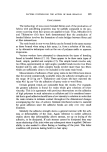
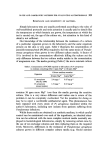
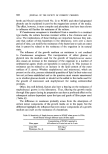
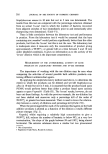
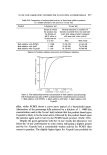
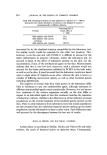
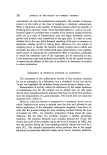
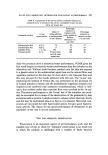
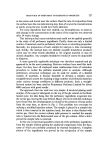
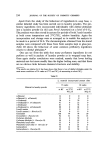
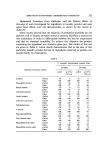
BEHAVIOUR OF PERFUMERY INGREDIENTS IN PRODUCTS 335 Hemiacetal formation from aldehydes and the fixative effects of Hercolyn D were investigated for ingredients in laundry powder and once again these effects were not demonstrable, as shown by the results in Table IV. These results showed that the majority of perfumery materials do not perform well in laundry powders stored in cartons, therefore a second test was undertaken in order to differentiate between the loss by evaporation and that by chemical instability. To achieve this objective the product containing the ingredient was stored in glass jars. The results of this test are given in Table V, which dearly demonstrates that in the case of this particular laundry powder the loss of ingredients observed in packets was caused mainly by evaporation. Table V Material in laundry powder •o material incorporated present after 12 weeks 24 weeks at RT at 37øC/ at RT at 37øC/ 70 % rh 70 % rh Linalool Carton 38 8 27 0 Glass 100 100 100 98 Phenylethyl alcohol Carton 66 66 52 17 Glass 100 97 93 80 Benzyl acetate Carton 18 0 13 0 Glass 100 83 75 50 Citronellyl acetate Carton 65 0 31 0 Glass 100 100 100 86 Linalyl acetate Carton 32 0 12 0 Glass 100 100 100 100 Citral (cis and trans) Carton 40 0 0 0 Glass 100 100 100 92 Dihydrojasmone Carton 92 20 72 0 Glass 100 79 83 37 a-Ionone Carton 86 26 78 4 Glass 100 100 100 93 Phenylacetaldehyde Carton 20 0 7 0 Glass 100 100 100 100 Amyl benzyl ether Carton 40 0 12 0 Glass 100 100 100 75 Phenylethyl amyl ether Carton 35 0 23 0 Glass 100 100 100 93 Phenylethyl n-butyl ether Carton 44 15 38 0 Glass 100 100 100 100
Purchased for the exclusive use of nofirst nolast (unknown)
From: SCC Media Library & Resource Center (library.scconline.org)