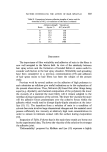
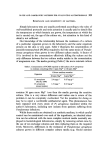
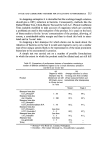
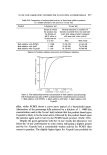
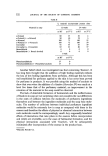
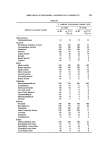
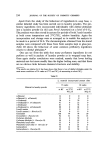
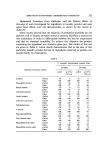
IN-USE AND LABORATORY METHODS FOR EVALUATING ANTIMICROBIALS 321 Table X. Comparison of the activity of four antiseptic solutions as measured (a) by a laboratory test, (b) by a simulated 'in-use' test and (c) by an 'in-use' test Antiseptic solution Percentage reduction in Ratio of bacteria artifi- In-use killing dilution cially applied to concentration to recommended forearm 'in-use' dilution (simulated 'in- use' test) Percentage reduction in bacteria on skin ('in-use' test) Chloroxylenol B.P. 0.12 •o 7.5 92 77 Chlorhexidine B.P. 0.05 •o 1.7 72 68 Iodophor Prep. 1% avia 100 100 60 Thiomersal B.P. 0.1 •o Product does 100 28 not kill when tested neat other two products show a somewhat better performance. PCMX gives the best result despite its relatively weaker performance than the iodophor in the laboratory test. Without doubt bacteria painted onto the skin are exposed to a greater extent to the antimicrobial agent than are the natural flora, and organisms painted on the skin may be more akin to the transient flora and this may account for the results achieved with this test. The 'in-use' test, employing the method of Verdon (6), was performed on the perineum (7) of women patients in labour and the predominant organisms isolated were Staoehylococcus epidermis and cutaneous corynebacterium, which is indi- cative that resident rather than transient flora were involved in the 'in-use' test. The poorer performance in the 'in-use' test of the iodophor can prob- ably be accounted for in terms of the deactivation of the germicide by skin secretions such as protein. Iodophors tend to release iodine relatively slowly and this may be neutralized almost as fast as it is released. Mercurial com- pounds are not noted for their bactericidal action, but give good bacterio- static activity. The reason for the good performance of thiomersal in the simulated 'in-use' test is not yet understood. TEST FOR ADEQUATE PRESERVATION Preservation is an important aspect of all formulation work and the simplest type of test to check for 'adequate' preservation is an insult test in which the product is challenged with a number of likely bacteria

322 JOURNAL OF THE SOCIETY OF COSMETIC CHEMISTS which are considered as possible contaminants. This challenge can either be made with single organisms or mixed cultures, and, moreover, may, if required, be repeated at intervals. This procedure can fail, however, primarily because the resistance of the organisms to a preservative may be lower when grown in the laboratory than the resistance which can occur in practice. Since resistance to antimicrobial agents is often variable in many organisms it is necessary to ensure during preservation tests that organisms of a suitable resistance are used. This can be achieved by growing the organism in a suitable medium to which has been added either the preservative or the product in low con- centration. The method of Basset, Stokes and Thomas (8) which uses the above principle has worked well in establishing whether working strength solutions of antimicrobial agents are likely to be contaminated. The results from practical experience correlating 100• with the predictions from the Basset et al. method (8). CONCLUSIONS In comparing the relative merits of 'in-use' and laboratory methods no attempt has been made to review the various methods available neither has any attempt been made to review the various methods by which bacteria may be recovered from the skin. Such topics are covered in a number of reviews (9-11). Instead the purpose of this paper has been to demonstrate that sufficient data is not yet available to enable laboratory tests to be designed which can represent sufficiently closely, in most cases, the situation appertaining in practice. 'In-use' testing is necessary in order that an insight in the various factors affecting performance may be studied, but 'in-use' testing by itself is incapable of doing this without some inter- play from the laboratory tests. At the present time, therefore, wherever possible both 'in-use' and laboratory testing should be carried out, but if resources restrict both types of evaluation it is far safer to apply 'in-use' tests rather than laboratory tests. The 'in-use' tests have, however, to be very carefully designed, taking into consideration the various factors which may influence the final con- clusions reached. (Received: 13th September 1973)
Purchased for the exclusive use of nofirst nolast (unknown)
From: SCC Media Library & Resource Center (library.scconline.org)