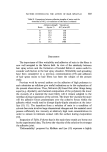
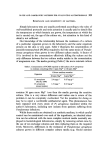
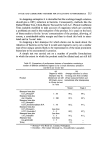
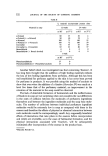
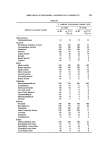
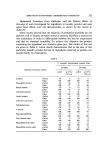
IN-USE AND LABORATORY METHODS FOR EVALUATING ANTIMICROBIALS 319 many deodorants make use of antibacterial agents as a means of reducing bacterial breakdown of the apocrine sweat with a view to reducing odour level. In order to establish whether a significant reduction in axillary odour could be correlated with the antibacterial action of a product, a number of volunteers were asked to wash under the axilla with plain soap and water. The axilla were then covered with a pad which was removed 6 h later and assessed for odour by six assessors using a rating method on a 5-point scale. At the 6 h period the axilla were also sampled for bacterial flora by use of a modified glass cylinder method introduced by Story (5). After 5 days each volunteer was supplied with a deodorant based upon hexachlorophane and asked to repeat the experiment, this time applying the deodorant to only one of the axilla after washing both axilla with plain soap and water. The remaining axilla served as a control. Table IJ(shows the results obtained for each subject. The log ratio of the bacterial count for the control axilla to that for the test axilla was taken as a measure of efficacy. The significance of this ratio was measured against the ratio for the control situation in which an antibacterial agent was applied to neither axilla. Similar criteria were applied to the odour level. The results in Table IJ( indicate only a low degree of correlation. Although as yet the reasons for this have not been pinpointed they Table IX. Correlation between antimicrobial activity of a hexachlorophane based deodorant and its effect in reducing axillary odour Antibacterial Deodorant assessment assessment Subject Degree of correlation Change in t Change in t log ratio test odour test 1 4.0 NS --1.1 * -- 2 7.57 ** --0.5 NS -- 3 --0.70 NS +0.1 NS + 4 11.53 *** •0.5 NS -- 5 6.99 ** --1.3 * + 6 5.70 ** --0'8 NS -- 7 3.79 NS --0.9 NS + 8 9.49 *** --1.4 ** + 9 8.97 *** --1.9 * + *** The difference is significant at 0.1 •o level. ** The difference is significant at 1% level. * The difference is significant at 5 •o. NS The difference is not significant.

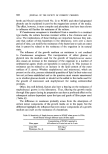
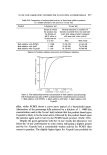
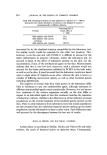
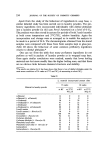
320 JOURNAL OF THE SOCIETY OF COSMETIC CHEMISTS undoubtedly lie with the antibacterial assessment. The number of bacteria present on the axilla at the time of sampling is relatively unimportant. What is important is the number of bacteria present which are capable of breaking down apocrine sweat. Since hexachlorophane is used as an anti- bacterial agent it is probable that a number of the bacteria isolated from the axilla are in a state of bacteriostasis and only begin metabolic activity, growth and division once transferred to the agar plate. In order to assess whether this is the case, fairly frequent sampling of the area is necessary to determine whether growth is taking place. However, the very nature of sampling serves to deplete the bacteria already present and to dilute and neutralize the action of the antibacterial agent. Quite clearly a very sophisti- cated system of measuring the antibacterial effect is necessary, preferably in which the metabolic state of the organisms can be measured on site. In the meantime until such methods are available, by far the easiest method of measuring the efficacy of this type of product is to determine its control in odour production. ASSESSMENT OF PRODUCTS INTENDED AS ANTISEPTICS The assessment of the antibacterial activity of four products intended for use as antiseptics, by a laboratory test, a simulated 'in-use' test and an 'in-use' test highlights the problems facing anyone trying to design a test. Measurement of activity within the laboratory by the simple technique of determining how far the product can be diluted and yet still retain activity (loop sampling method), indicates that three out of the four products meet the requirements of a good antiseptic. The fourth does not reach the necessary level (Table X). However, when the activity is measured by a simulated 'in-use' test in which Staphylococcus aureus is painted onto the skin and allowed to dry before application of the antiseptic, subsequent sampling 5 min later re- veals that the product failing the loop sampling method reduces the level of bacteria by 100•o. An iodophor preparation brings about the same reduction, but the other two products produce a smaller percentage reduction. The situation becomes more complex because the 'in-use' test reveals that none of the products reduce the level of bacteria by 100•o, but that the product failing the loop sampling method reduces the level by a mere 28•o. The iodophor preparation which performs best in the simple laboratory test performs relatively weakly in the 'in-use' situation, whilst the
Purchased for the exclusive use of nofirst nolast (unknown)
From: SCC Media Library & Resource Center (library.scconline.org)