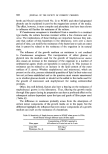
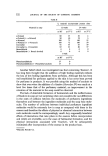
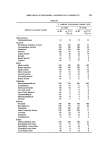
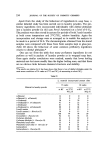
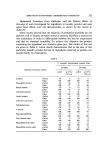
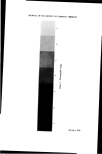
352 JOURNAL OF THE SOCIETY OF COSMETIC CHEMISTS Although the three groups were arbitrarily chosen, and the perception of greater or lesser lightening effects on groups may change depending on the group boundaries chosen, it is still nevertheless apparent that clinical tests carried out on light-skinned subjects would need larger panels and longer testing periods to show significant differences. DISCUSSION Of the various techniques used to measure lightening of the skin, only three gave results that were capable of being analysed. These techniques were (i) the grey scale (ii) EEL reflectance technique (iii) comparative visual assessment. A comparative summary of the results obtained with these three techniques is shown below. Grey wedge Visual Reflectance (EEL) None None None Only products All products Only product A C and D were effective effective effective None C better None than ABD Lightening effect after 4 weeks Lightening effect after 8 weeks Differences between products It is apparent that the only technique capable of clearly showing the depigmenting effects of all the skin lightening creams is that based on com- parative visual assessment. This is probably due to the fact that the eye can compensate for odd blemishes, scaling due to irritation and can also inte- grate the lightening effect over the total area of skin treated. The technique is extremely simple to use, and the scatter of results com- pared to the other techniques is smaller which gives a greater degree of statistical significance. In addition since it is a visual technique, it is giving a measurement of effectiveness of the products which is directly related to the way in which users judge the effectiveness of skin lightening creams. ACKNOWLEDGMENTS The author is indebted to many of his colleagues at Unilever Research Laboratory, Isleworth and Unilever Research Laboratory, Colworth House,

EVALUATION OF SKIN BLEACH CREAMS 353 for their assistance in carrying out the animal tests and to Messrs. Wilkinson and Allright for their invaluable assistance during the tests carried out in Africa. REFERENCES (1) Beehan, S.S., Pathak, M. A., Hori Y. and Fitzpatrick, T. B. Depigmentation of the skin with 4-ispropylcatechol, mercaptoamines and other compounds. J. Invest. Dermatol. 50 103 (1968). (2) Frank, E., Pathak, M. A., Szabo, G. and Fitzpatrick, T. B. Selective action of mercapto- ethylamines on melanocytes in mammalian skin. Arch. Dermatol. 97 465 (1968). (3) Gellin, G. A., Possick, P. A. and Perone, V. B. Depigmentation from 4-tertiary butyl catechol--an experimental study. J. Invest. Dermatol. 55 190 (1970). (4) Gibson, I. M. Measurement of skin colour in vivo. J. Soc. Cosmet. Chem. 22 725 (1971).
Purchased for the exclusive use of nofirst nolast (unknown)
From: SCC Media Library & Resource Center (library.scconline.org)