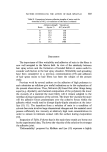
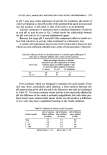
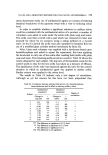
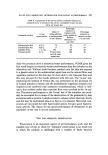
FACTORS CONTROLLING THE ACTION OF HAIR SPRAYS-II 303 Table II. Comparison between adhesive stengths of resins and the viscosities of 40 % w/w solutions of the resins in ethanol Adhesive strength Viscosity at Resin (kg cm -•) 40 % w/w (cP) E 21.8 360 D 18.5 450 B 15.0 450 C 17.1 63O F 16.8 925 G 14.5 1900 DISCUSSION The importance of fibre wettability and adhesion of resin to the fibres is now well accepted in the fabrics field. In view of the similarity between hair spray action and the formation of bonded fabrics it seems useful to consider such factors in the hair spray situation. Wettability and spreading have been considered in a previous communication (19) and adhesion of hair spray resins to hair fibres has been the subject of the present study. Previous work by several authors on the adhesion of high polymers to such substrates as cellulose give useful indications as to the explanation of the present observations. Thus, McLaren (9) found that other things being equal (e.g. dipolarity and chemical composition of the polymers) the lower the viscosity of a material the more likely will it remain adapted to the interface during evaporation of the solvent. The lower the viscosity the more will the adhesive forces predominate over the cohesive forces within the adhesive which would tend to disrupt dipole-dipole attraction at the inter- face (10, 11). The transition from a solution of resin to a condition of solvent-free resin involves large dimensional changes and the material must possess sufficiently low viscosity at relatively high resin concentrations in order to remain in intimate contact with the surface during evaporation (12). Inspection of Table H shows that in the main these trends are borne out by the experimental data. The lower the viscosity of the solution the stronger the adhesive joint. 'Deformability' proposed by McBain and Lee (13) expresses a highly

304 JOURNAL OF THE SOCIETY OF COSMETIC CHEMISTS desirable property of an adhesive. Deformability of the dried resin film en- ables the joint to withstand impact or bending. Deformability during drying is important to the formation of strong joints. During drying internal stresses can be set up in the adhesive material if it is not deformable. The stresses are formed by the volume changes and when the joint is subse- quently stressed it can, in extreme cases, fly to pieces. If we can assume that deformability is related to the softness of the resin as measured by the glass transition temperature, then the above trend is also borne out by the present experimental data. The surface of an adherend is rarely perfectly smooth but has numerous small interstices. For complete wetting of the surface by the adhesive these interstices must be filled by the liquid. Polymer-solvent mixtures often become viscoelastic solids even with as much as 15•o of solvent remaining and with further loss of solvent the mixture passes through its glass transi- tion temperature. Stresses then begin to arise at the adherend/adhesive interface and these stresses diminish the external force required to break the adhesive joint. In the case of incomplete wetting of the adherend surface some of the interstices are not filled with adhesive before the mixture passes through its glass transition temperature. The stresses are then localized at the edges of these interstices. The lower the viscosity of the adhesive mixture the faster the spreading and the easier it is for the interstices to be filled. When the adhesive completely wets the adherend before it passes through its glass transition temperature, the stresses are not localized at the edges of the interstices and a stronger joint results. It follows that low viscosity and low glass transition temperature both promote good adhesion. A commercial application of the above principles has been demonstrated by Alexander (14). It was shown that polymethyl methacrylate and poly- styrene can render wool unshrinkable if the correct quantity of plasticizer is present. The concentration of plasticizer was found to be critical. Starting with pure resin the shrinkage of wool decreased from 31.8•o to 5.4•o at 30•o diethyl phthalate content and then rose again as more plasticizer was included. Similarly copolymers of butadiene and methyl methacrylate, within a narrow range of compositions, were capable of producing excellent non-shrinkability, while the two homopolymers, and copolymers of the wrong composition, did not produce the effect. The physical properties of the polymer obviously play a vital part in obtaining the desired effects and the polymer must be neither too hard and brittle, nor too soft and rubbery.
Purchased for the exclusive use of nofirst nolast (unknown)
From: SCC Media Library & Resource Center (library.scconline.org)