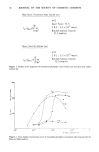
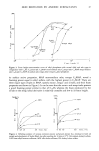
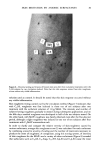
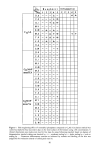
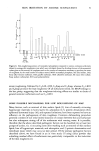
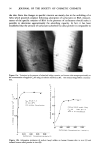
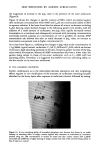
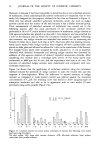
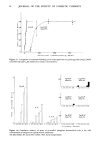
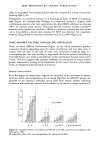
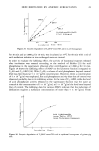
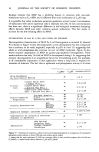
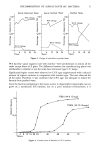
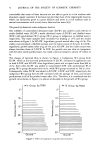
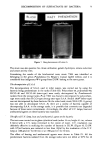
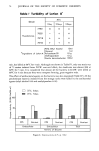
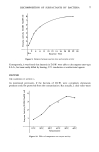
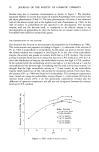
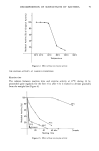
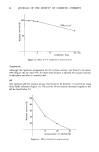
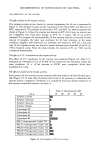
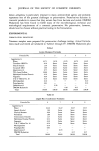
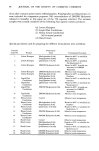
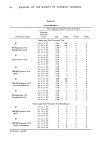
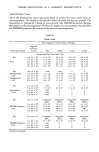
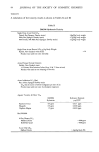
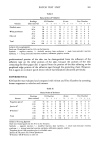
56 JOURNAL OF THE SOCIETY OF COSMETIC CHEMISTS However, in the past it has been impossible to determine the in vivo adsorbed amounts of surfactants, unless radioisotopically labeled surfactants are employed. Our in vivo study (14), designed for this purpose, ultilized the fact that as illustrated in Figure 12, when skin has already adsorbed surfactant molecules, acidic dye such as indigo carmine cannot stain the surface of the skin because it has a similar terminal group. Thus, measurement of adsorbed amounts of surfactants was carried out in the following manner: after the usual procedures of the circulation method were performed at 28 or 37øC and at definite concentration of surfactants, indigo carmine at 1.0% aqueous solution was placed in a tube with 1.5cm diameter, and was attached for ! min on the forearm area on which the circulation method was applied. Following this treatment, any indigo carmine not adsorbed was washed out by immersing the forearm 10 times into a water bath kept at 40øC. One hour after this washing process, horny layers stained with indigo carmine were stripped off with cyanoacrylate resin placed on slide glass and allowed to adhere for I min on the tested area of the forearm. The stripped horny layers were scrapped by knife, adjusted to 1.5 cm in diameter, dissolved with dimethyl formamide and ahering indigo carmine was desorbed by addition of 25% aqueous solution of dodecyl trimethyl ammonium chloride. After transfering this mixture into a centrifuge tube, pieces of the horny layers were sedimented at 3000 rpm for 10 min, and the supernatant was read at 615 nm. The amounts of adsorbed indigo carmine were determined and compared with non- surfactant treated area. Figure 13a shows that the application of surfactant solution using the circulation method reduces the potential of inidgo carmine to stain the treated skin and this response is dose-dependent. When the difference in stained amounts of indigo carmine as compared to water-treated control was plotted against the treatment concentration of C•2AS, the resulting curve was found to show Langmiur-type of adsorption isotherms and also to be in agreement with in vitro results (7) seen previously using callus powder (Figure 13b). 1.0 0.5 c 8 clo c12 c14 t• A s---• ::1• 2 hr after removal f--I 24 h r II cs qo q2 c,4 q6 t-L A S ----t C12 C14 C16 CI8 C 8 CI0 CI2 C14 C14 t"A O S "• t_ S O A P '• SAS Figure 15. Cutaneous reaction of various anionic surfactants on forearm skin following 24 hr closed patch test using 28 subjects. AS: alkyl sulfate, LAS: linear alkyl benzene slufonate, AOS: alfa-olefin sulfonate, Soap: sodium carboxylate, SAS: paraffin sulfonate.

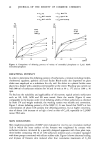
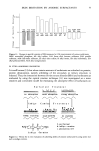
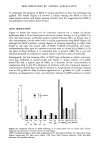
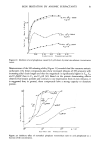
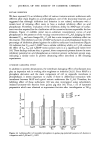
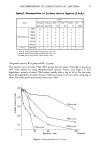
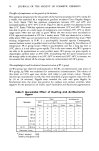
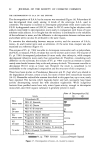
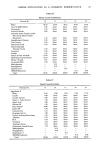
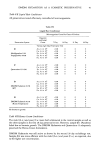
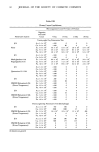
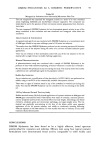
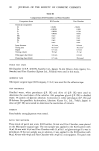
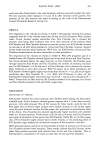
SKIN IRRITATION BY ANIONIC SURFACTANTS 57 To determine the potential of MAP to remain adsorbed on skin, this technique was applied. The results (Figure 14) showed a similar staining for MAP to that of water-treated control, and higher staining intensity than ES, suggesting that MAP is less adsorptive onto surface layers of skin. SKIN IRRITATION Figure 15 shows the results (15) of cutaneous reaction for a variety of anionic surfactants after a 24-hr closed patch test on the human forearm at 1.0 g/lOOml. It is clear that most anionic surfactants possess marked irritating effect on human skin at this concentration. On the other hand, in similar experiments using MAP (Figure 16), although the MAP's produce varying degrees of irritation depending on alkyl chain length or salt type, two typical types of MAP, C•2MAP monosodium and mono- triethanolamine salts, gave no cutaneous reaction even at 2.0 and 4.0 g/lOOml (1). On the basis of these findings, it is concluded that, in general, MAP has a very low irritation potential as compared to typical anionic surfactants used commercially. Subsequently, the low irritating effect of MAP-type surfactants at higher concentra- tions was confirmed in animal studies (16). Figure 17 shows irritancy of C•2MAP mono-TEA salt, a typical type of MAP, as a function of the concentrations in comparison with C•2AS. The elicitation of irritation with this compound required a concentration of more than 4 g/100 ml, whereas C•2AS produced an irritating response even at 0.05 g/100 mi. After occlusive application of 2 g/lOOml of C•2AS, a marked irritation accompanied by crusta was observed, whereas C•2MAP produced a similar ClO C12 C12 C14 C16 C12 C12 C12 C12 C12 C12 C12 C12 M A P AGS IE4 O AS SOAP E3S LASAOSSAS Na Na TEA Na Na Figure 16. Cutaneous reaction of MAP following 24 hr closed patch test on human skin. Clinical diagnosis was carried out 2 hr after removal of closed patch. MAP: monoalkyl phosphate, AGS: alkyl acylglutamate, EO: alkyl polyoxyethlene, AS: alkyl sulfate, Soap: sodium carboxylate, ES: alkyl ether sulfate, LAS: linear alkyl benzene sulfonate, AOS: alfa-olefin sulfonate, SAS paraffin sulfonate.
Purchased for the exclusive use of nofirst nolast (unknown)
From: SCC Media Library & Resource Center (library.scconline.org)