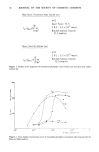
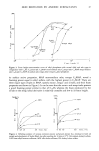
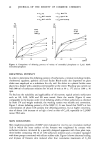
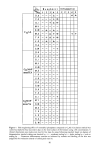
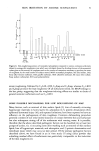
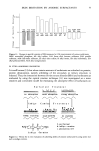
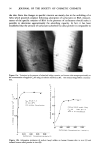
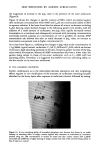
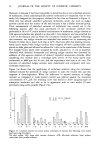
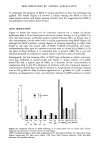
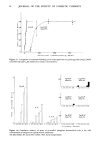
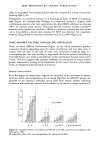
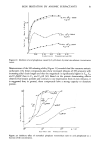
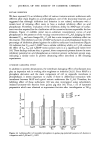
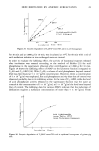
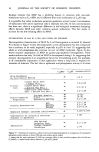
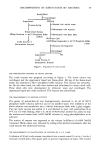
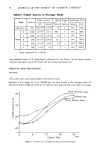
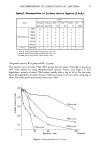
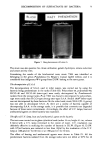
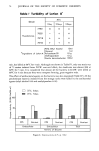
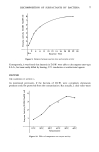
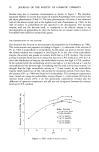
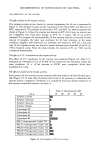
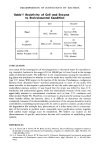
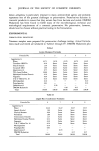
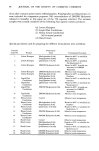
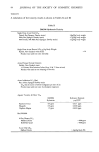
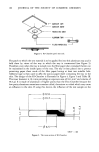
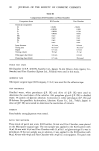
82 JOURNAL OF THE SOCIETY OF COSMETIC CHEMISTS THE DECOMPOSITION OF S.A.A. BY THE ENZYME The decomposition of S.A.A. by the enzyme was examined (Figure 16). Polysorbate-20 was decomposed most easily among 13 kinds of the ester-type S.A.A. used in cosmetics. The enzyme is inclined to deocmpose polysorbate series more easily than P.E.G. hydrogenated castor oil (H.C.O.) series. In H.C.O. series higher ethylene oxide adducts were liable to decomposition more easily in comparison with those of lower ethylene oxide adducts. It is thought that the tendency is attributable to the solubility of the surfactant in water, and the difference in decomposition between sorbitan series and sorbate series can also be attributed to the same reason. To examine the relationship between enzyme activity and the structure of S.A.A., mono-, di- and tri-ester were used as substrates. At the same time, steapsin was also examined as a reference (Figure 17). The enzyme of Ps. sp. 77801 was able to decompose mono-ester such as polysorbate- 20, P.E.G.-10 stearate, P.E.G.-10 oleate but not the all-ester and tri-ester. The enzyme of Ps. sp. 77801 decomposed polysorbate-20 more easily than tributyrin, while steapsin decomposed tributyrin more easily than polysorbate-20. Therefore, considering such difference on the substrate, the enzyme of Ps. sp. 77801 must be an esterase to attack mainly ester bonds between fatty acids and primary alcohols. This esterase was able to decompose H.C.O. series at lower rate. However the result is considered to be attributable to the complicated composition and the structure of this compound. There have been studies on Pseudomonas fluorescens and Ps. fragi which are related to the degradation of butter, cream or lard, but most of these were extracellular enzymes (10-12). Heatstable endocellular esterase described in this paper has, up to now, rarely been reported. The bacteria which degrades butter and lard, necessarily have lipase activity decomposing natural fats with abundant triglyceride. While indigenous bacteria from purified water have only minor lipase activity, enough to decompose mono-ester, since little organic substance is generally present in water. S.A.A. Polysorbate-20 PEG PEG-10 Stearate Mono-ester PEG-10 Oleate PEG PEG-10 Di-stearate Di-ester PEG-10 Di-oleate PG Propylene Glycol Stearate Mono-ester Propylene Glycol Oleate PG Propylene Glycol Di-stearate Di-ester Propylene Glycol Di-oleate PEG-10 Trimethylol Propane Tri-stearate Tri-ester PEG-5 Glyceryl Tri-stearate Tri-butyrin • Ps. sp. 77801 Esterase Rate of Decomposition (%) 10 20 I I • •Steapsin (Lipase) Figure 17. Decomposition of mono-, di-, tri-ester by enzyme

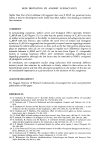
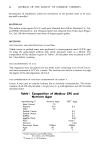
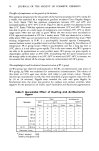
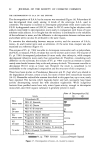
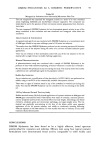
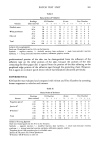
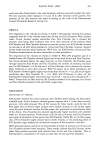
DECOMPOSITION OF SURFACTANTS BY BACTERIA 83 TableY Resistivity of Cell and Enzyme to Environmental Condition Cell Enzyme o Heat X Survival 20% 60øC, 5minutes 80øC, 10minutes uv x o Survival 66% Irradiation 600•zw/cm 2, 5minutes 1700•zw/cm 2, 24hrs Alcohol 10% O Methyl Paraben 0.1% X Survival 40% 10% Alcohol CONCLUSION As a result of the investigation of microorganisms in deionized water for manufactur- ing cosmetics, bacteria in the range of 10 to 100,000 per ml were found in the storage tanks of deionized water. The difference in the contamination among the manufactur- ing plants was attributed to whether or not the tanks were installed with the immersed type U.V. lamps. With respect to the species of the bacteria, Pseudomonas--indigenous bacteria from deionized water--survived predominantly in most of the tanks. The strain was able to decompose a polysorbate-20 and the other ester-type S.A.A. by its endocellular esterase activity. It was found that the strain was killed by heat, U.V. irradiation and antibacterial agents, while the endocellular esterase of the strain was appreciably resistant to evironmental conditions such as heat, U.V. irradiation and ethyl alcohol (Table VI). Therefore, it is necessary to deactivate the esterase in purified water besides killing the bacteria. Since it is difficult to deactivate the esterase completely, because of its thermostability, production of the enzyme should be strictly controlled by controlling bacterial growth. In order to protect cosmetic products from the degradation (for example hazy phenomenon of a toilet water) due to contamina- tion of the bacteria in purified water, reasonable water purification system together with careful water storage must be established. We believe our studies on the characterization of specific water-borne bacteria will contribute to establishing these systems. REFERENCES (1) L. A. Carson, M. S. Favero, W. W. Bond and N.J. Peterson, Factors affecting comparative resistance of naturally occurring and subcultured Pseudomonas aeruginosa to disinfectants, Appl. Microbial., 23, 5, 863-869 (May 1972). (2) L. A. Carson, M. S. Favero, W. W. Bond and N.J. Peterson, Morphological, biochemical, and growth characteristics of Pseudomonas cepacia from distilled water, Appl. Microbial, 25, 3, 476-483 (Mar. 1972).
Purchased for the exclusive use of nofirst nolast (unknown)
From: SCC Media Library & Resource Center (library.scconline.org)