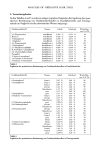
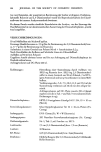
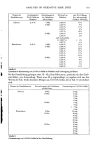
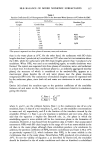
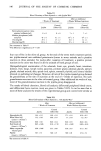
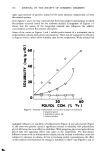
HLB BALANCE OF MIXED NONIONIC SURFACTANTS 117 Table I Partition Coefficients (Ki) of Homogeneous OPEs for the Isooctane-Water System at 25øC below the CMC EO Chain Ki (Co/C,,) Emulsion Type Length Crook's Data Our Data at 25øC 1 5,430 2 1,390 3 319 4 102 5 40.7 6 16.9 7 5.49 8 1.98 9 0.704 !o 0.260 150 w/o 60 Three Phases* 21 O/W 2.0 O/W *The system is separated into three phases of isooctane, water, and surfactant. than in the water phase at 25øC. On the other hand, the surfactants with EO chain lengths less than 5 produced w/o emulsions at 25øC when used at concentrations above the CMC, while the surfactants with EO chain lengths greater than 5 produced o/w emulsions. When OPE 5 was used as an emulsifying agent, no stable emulsions were formed. The system was separated into three phases of isooctane, water, and surfactant in a short time. It is known that a surfactant phase (i.e., an infinitely aggregated miceliar phase), the structure of which is considered to be sandwich-like, appears as a macroscopic phase besides the oil and water phases near the phase inversion temperature (PIT) (14). The coalescence of emulsion droplets cannot be repressed well by the surfactant phase, since both oil and water are continuous in such a structure (15). Davies (16) related the emulsion type to the partition coefficient of the emulsifier between oil and water on the basis of a study on coalescence kinetics in emulsions, giving the relation Q Rate 2 C2 Rate 1 - \Co! (2) where C• and C2 are the collision factors, Rate I is the coalescence rate of an o/w emulsion, Rate 2 is that of a w/o emulsion, C,• and Co are the emulsifier concentrations in water and oil, respectively, and 0 is the fraction of the interface covered by the emulsifier. If Rate 2 Rate 1, an o/w emulsion is stabilized, and vice versa. Also, he said that the equation 2 implies the Bancroft rule, i.e., the phase in which the emulsifying agent is more soluble will be the continuous phase in the formation of emulsions. However, it was found from the partition data in Table I that unassociated monomeric OPEs with EO chain lengths in the range of 6 to 8 are more soluble in the oil than in the water phase although these emulsifiers produce o/w emulsions. In addition, the partition coefficient of NPE8 between cyclohexane and water is 70 at 25øC as previously reported (12), which indicates that NPE8 is far more soluble in the cyclohexane than in the water phase. Nevertheless, NPE8 produced o/w emulsions at 25øC. To test the validity of equation 2, as described by Davies (16), the emulsifier should be dissolved in the oil under conditions such that no dissolved or solubilized

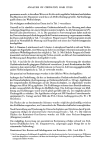
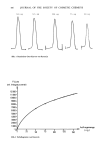
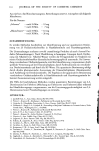
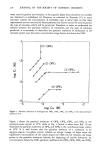
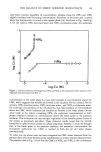
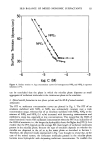
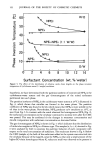
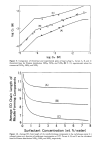
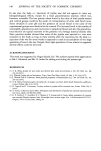
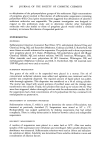
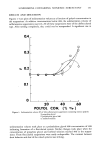
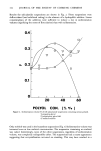
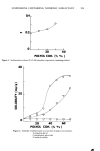
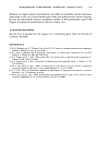
118 JOURNAL OF THE SOCIETY OF COSMETIC CHEMISTS water must be present and similarly, in the aqueous phase there should be no micelies nor dissolved or solubilized oil. However, as criticized by Sherman (17), in many emulsion systems the concentration of emulsifier used is rather high, so that these requirements are not met and the theory presented by Davies cannot be used to predict the type of emulsion which will be produced. Therefore, in order to understand the relation between the partition behavior of emulsifiers and the type of emulsion produced, it is necessary to determine the partition isotherms of surfactants in the oil-water system over the entire concentration range below and above the CMC. -1 -2 -3 (1) OPE• //(2) OPE• (3) OPE6 o • (4) OPEg -4 i I -5 -4 -3 -2 log Cw (M) Figure 1. Partition isotherms of homogeneous OPE4, OPEs, OPE6, and OPE8 in the isooctane-water system at 25øC. Figure ! shows the partition isotherms of OPE4, OPE5, OPE6, and OPE8 in the isooctane-water system at 25øC, while in Fig. 2 (which is taken from Ref. 12) are illustrated the partition isotherms of NPE 6 and NPE8 in the cyclohexane-water system at 25øC. It is well known that the partition isotherm of a surfactant in an aqueous-organic two-phase system exhibits an abrupt change of slope when the equilibrium concentration of the solute attains the CMC (18, 19). Namely, the break points in the partition isotherms indicate the beginning of micelle formation. At concentrations below the CMC, partition coefficients for OPE6, OPE8, NPE6, and NPE8
Purchased for the exclusive use of nofirst nolast (unknown)
From: SCC Media Library & Resource Center (library.scconline.org)