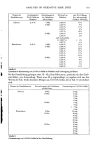
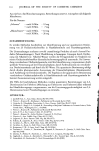
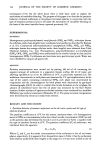
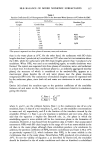
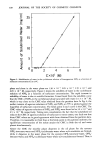
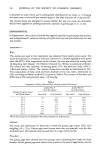
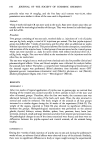
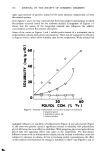
150 JOURNAL OF THE SOCIETY OF COSMETIC CHEMISTS to dehydration of the polyoxyethylene groups of the surfactants. High concentrations of propylene glycol resulted in flocculation of sulfamerazine suspensions containing polysorbate 40 (6). Cloud point measurements suggested that dehydration of adsorbed surfactant molecules was responsible. The present investigation was designed to expand on this preliminary study and to determine whether other hydrophilic molecules with uses similar to those of propylene glycol would exhibit a similar tendency to increase flocculation of suspended particles. EXPERIMENTAL MATERIALS Sulfamerazine (American Cyanamid, Pearl River, NY), salicylamide (Amend Drug and Chemical, Irving, NJ), and butamben (Matheson, Coleman and Bell, E. Rutherford, NJ) were chosen as model substances for suspension. The polyols used in these experiments were propylene glycol (J.T. Baker, Phillipsburg, NJ) polyethylene glycol 400 (Ruger Chemical, Hillside, NJ), and sorbitol solution, 70% (ICI Americas, Wilmington, DE). Other materials used were polysorbate 80 (ICI Americas, Wilmington DE) and methylparaben (Matheson Coleman and Bell, E. Rutherford, NJ). All materials were USP-NF grade and were used as received. SUSPENSION PREPARATION Five grams of the solid to be suspended were placed in a mortar. Five ml of concentrated surfactant solution were added and agitation was continued until the powder was completely dispersed. The required amount of liquid polyol was added, with thorough agitation. This dispersion was transferred to a 50 ml mixing cylinder. The mortar was rinsed with several portions of purified water and the rinsings were transferred to the cylinder. Finally, the cylinders were made up to volume (50 m o . They were then stoppered, shaken thoroughly and set aside for sedimentation studies. All of the suspensions had a final concentration of 0.2% polysorbate 80 they contained 0.1% methylparaben as preservative. MEASUREMENT OF SUSPENSION PROPERTIES Sedimentation volume, F, which is used to determine the extent of flocculation, was measured as previously described (7). Suspensions were stored at 24 ø _+ IøC. Redispersibility was judged qualitatively by shaking suspensions that had settled completely. There is a sharp demarcation in behavior between caked and redispersible suspensions. SOLUBILITY MEASUREMENTS A number of suspensions were placed in a water bath at 24øC. After two weeks, samples of the supernatant were withdrawn and centrifuged. After suitable dilution the absorbance was measured. Sulfamerazine solutions were read at 265nm and salicylam- ide solutions at 300nm. Solubility was determined from suitable calibration curves and consideration of dilution factors.

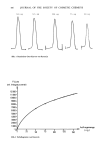
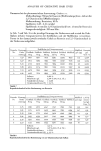
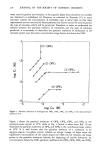
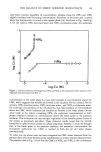
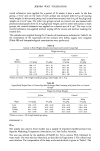
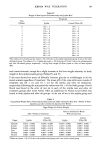
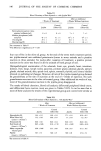
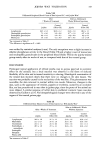
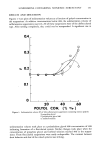
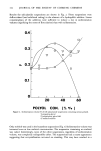
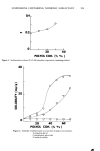
SUSPENSIONS CONTAINING NONIONIC SURFACTANT 151 RESULTS AND DISCUSSION Figures 1-3 are plots of sedimentation volume as a function of polyol concentration in the suspensions. At additive concentrations below 40%, the sedimentation volume of sulfamerazine suspensions was 0.16. All of these suspensions were of the defiocculated type. After settling completely, they could not be resuspended. A significant rise in 0.4 0.3 0.2• " 0.1 _ i I J J I [ 20 40 60 POLYOL COH. (% V/v) Figure 1. Sedimentation volume (F) of 1096 sulfamerazine suspensions containing various polyols. v propylene glycol O polyethylene glycol 400 [] sorbitol solution sedimentation volume took place at a polyethylene glycol 400 concentration of 40% indicating formation of a fiocculated system. Similar changes took place when the concentration of propylene glycol and sorbitol solution reached 50% in the suspen- sions. These fiocculated suspensions were easily redispersible. The contrast between their behavior and that of the caked systems was striking.
Purchased for the exclusive use of nofirst nolast (unknown)
From: SCC Media Library & Resource Center (library.scconline.org)