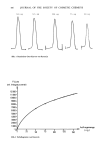
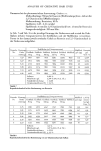
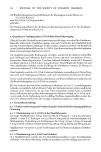
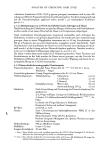
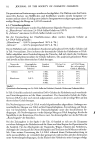
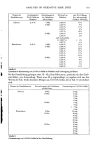
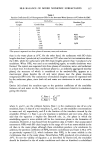
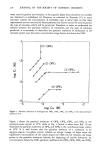
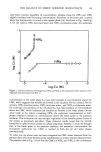
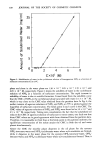
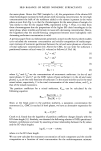
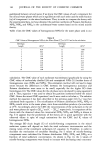
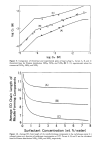
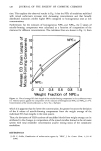
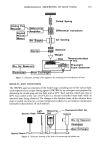
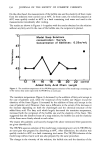
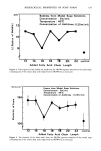
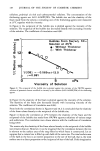
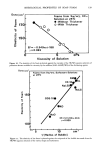
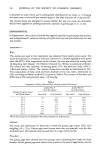
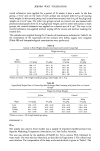
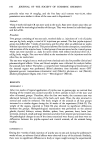
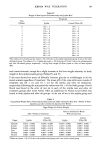
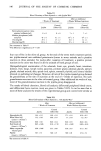
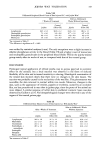
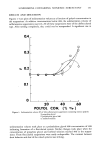
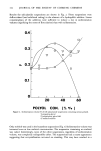
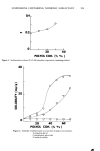
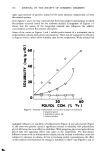
154 JOURNAL OF THE SOCIETY OF COSMETIC CHEMISTS tight, rigid network of particles instead of the loose structure characteristic of most flocculated systems. From figures 1 and 2 we may conclude that the lowest polyol concentration at which flocculation occurred varied for the additives studied. Comparison of Figures 1-3 shows that the nature of the suspended material also influences the additive concentration at which flocculation takes place. Some of the curves in Figures 1 and 2 exhibit peaks instead of a monotonic rise in sedimentation volume with polyol concentration. These may be explained by reference to Figures 4 and 5, which show solubility data for the suspensions. While sorbitol had 40 -' 20 0 0 o o o 30 60 POLYOL CON. (% V/v) Figure 5. Solubility of salicylamide as a function of polyol concentration. v propylene glycol O polyethylene glycol 400 [] sorbitol solution negligible influence on solubility of sulfamerazine (Figure 4) and salicylamide (Figure 5), the other two polyols caused a significant increase in solubility with polyethylene glycol 400 being the more effective solubilizer. With propylene glycol and polyethylene glycol 400, two opposing effects take place in the suspensions. The flocculation influence causes a rise in sedimentation volume, but the increase in solubility causes the sediment to decrease in volume. At low to moderate polyol concentrations, the effect on flocculation overshadowed the change in solubility so that F rose (Figures 1 and 2).

SUSPENSIONS CONTAINING NONIONIC SURFACTANT 155 However, at higher polyol concentrations, the effect of solubility became dominant, particularly in the case of polyethylene glycol 400, and sedimentation volume dropped. In fact the salicylamide became completely soluble in 60% polyethylene glycol 400 (Figure 2) causing the sedimentation volume to fall to zero. ACKNOWLEDGEMENT Ru-Yun Lue is grateful for the support of a scholarship grant from the Society of Cosmetic Chemists. REFERENCES (1) B. A. Mathews and C. T. Rhodes, Use of the D.L.V.O. theory to interpret pharmaceutical suspension stability,j, Pharm. Sci., 59, 521-525 (1970). (2) j, L, Zatz, L, Schnitzer and P. Sarpotdar, "Flocculation of sulfamerazine suspensions by a cationic polymer,"J. Pharm. Sci., 68, 1491-1494 (1979). (3) J, s. Tempio and J. L. Zatz, "Flocculation effect of xanthan gum in pharmaceutical suspensions,"J. Pharm, ScL, 69, 1209-1214 (1980). (4) J. s. Tempio and J. L. Zatz, "Interaction of xanthan gum with suspended solids,"J. Pharm. $ci., 70, 554-558 (1981). (5) W.-C. Liao and J, L. Zatz, "Effect of added salts on flocculation of local anesthetic suspensions containing nonionic surfactants,"J. Soc. Cosmetic Chemists, 31,123-131 (1980). (6) J. L. Zatz, "Effect of formulation additives on flocculation of dispersions stabilized by a nonionic surfactant," Int. J. Pharmaceut., 4, 83-86. (7) W.-C. Liao and J. L. Zatz, "Effect of surfactant polyoxyethylene chain length on flocculation of local anesthetic suspensions,"J. Soc. Cosmetic Chemists, 31,107-121 (1980).
Purchased for the exclusive use of nofirst nolast (unknown)
From: SCC Media Library & Resource Center (library.scconline.org)